




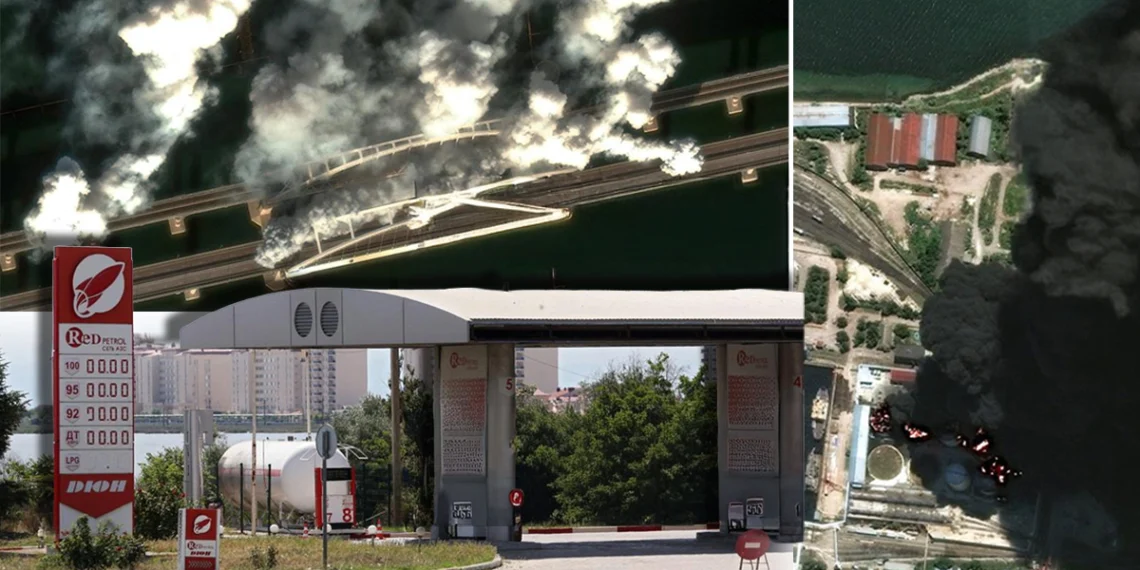
Crimea, annexed by Russia, remains the main military bridgehead for supplying Russian troops in southern Ukraine. However, Kiev is increasingly implementing a strategy whose aim is not so much the reconquest of the peninsula by military means, but rather making its maintenance a burden that is increasingly costly and difficult for Moscow to sustain.
Ukrainian forces are systematically targeting transportation infrastructure, air defense sites, fuel depots and logistics hubs. According to authorities in Kyiv, this strategy is gradually eroding one of the Russian military’s main advantages on the southern front.
Why Crimea remains a key element of the war
The widespread invasion of Russia into Ukraine, launched in February 2022, was largely possible due to its control over Crimea, annexed by Moscow since 2014. The peninsula served as the main supply route for Russian troops operating in the Herson and Zaporozhye regions. Today, Kiev is trying to change this reality.
The President of Ukraine, Volodymyr Zelensky, stated that Crimea is “at the center” of the Ukrainian strategy to end the war. According to him, the pressure exerted on the Russian infrastructure in the peninsula could significantly hinder the conduct of military operations.
Ukraine is stepping up pressure on Russian logistics
One of the main objectives of the Ukrainian strategy is the disruption of Russian logistic chains. The Minister of Digital Transformation of Ukraine, Mihailo Fedorov, has dubbed this campaign a “logistic lockdown”. According to him, the number of attacks carried out with medium-range drones has increased almost tenfold in recent months.
The main purpose of these operations is to disrupt the supply of Russian units. Ukrainian forces regularly attack:
- the railway lines;
- road bridges;
- fuel deposits;
- distribution energy objectives;
- transport nodes.
As a result, Russian troops are forced to use longer supply routes, harder to protect and easier to identify and attack from the air.
Fuel-related problems are becoming increasingly apparent
One of the most sensitive consequences of the Ukrainian attacks was the disruption of fuel supply. In June, the Russian authorities controlling Crimea declared a state of emergency following the damage to the energy and transport infrastructure. According to local authorities:
- restrictions on the sale of gasoline have been introduced;
- power supply interruptions have been recorded;
- public transport has begun to operate with restrictions;
- the distribution of fuel to the population has been temporarily limited.
On June 21, the sale of gasoline to the population was practically suspended, and the available reserves were directed exclusively towards emergency services and state institutions. At the same time, near the Kerch Bridge, there were queues of cars spanning several kilometers, formed by residents trying to leave the peninsula.
Why russian logistics is becoming increasingly vulnerable
According to military analysts, the destruction of the railway infrastructure has significantly increased the pressure on the Kerch Bridge. Russia is increasingly resorting to road transport to supply its troops, but this solution has several disadvantages:
- trucks move much slower than freight trains;
- secondary roads are less suitable for heavy machinery’s intense traffic;
- the columns are easier to detect by Ukrainian drones.
In addition, the repair of damaged bridges is hindered by the constant threat of new attacks. Military analysts emphasize that the Russian army’s engineering units are forced to work under the constant risk of repeated attacks, which significantly extends the time needed to rebuild the infrastructure.
Ukraine is systematically weakening Russia’s air defense system in Crimea
The isolation of Crimea is not limited to attacks on transport infrastructure. In parallel, Ukraine is conducting a broad campaign to weaken the Russian anti-aircraft defense system, in order to expand its capacity to further strike military targets on the peninsula.
According to analysts, this strategy has been applied for several years, but recently it has taken on a much more systematic character.
“For several years now, Ukrainian drones and missiles have been striking Crimea and the Russian Fleet in the Black Sea, yet Russia has not managed to fully protect the peninsula from these threats”, states George Barros, Director of Innovation and Open Source Data Analysis at the Institute for the Study of War (ISW).
Crimea is becoming an increasingly costly asset for Moscow
According to the director of the Center for International Studies at the National University of Odessa, Volodimir Dubovik, it is unlikely that the military significance of Crimea can be completely eliminated in the near future.
However, the constant pressure makes maintaining control over the peninsula gradually much more costly. If the Russian army is forced to allocate more resources for protecting logistics, rebuilding infrastructure, and ensuring supply, its capacity to act on other sectors of the front is diminished.
Experts emphasize that, for the Kremlin, Crimea holds a special political significance. Unlike certain sectors of the front line, the peninsula remains a symbol of one of Vladimir Putin’s most important foreign policy successes. Therefore, any deterioration of the situation in Crimea has not only a military dimension, but also a significant political one.
Could pressure on Crimea change the course of the war?
Most military experts believe that Ukraine’s current strategy will not lead to a swift return of the peninsula under Kiev’s control. However, it could significantly complicate the use of Crimea as Russia’s main military base in southern Ukraine.
The systematic destruction of transport infrastructure, attacks on anti-aircraft defense systems, and the reduction of supply capabilities increase the cost of maintaining control over the peninsula for Moscow and could become an additional pressure factor in potential future negotiations.
According to Volodimir Dubovik, the scale of Ukrainian attacks has reached such a high level that even the state press in Russia is forced to regularly report on them.
Ukraine is gradually shifting from a strategy based on direct confrontation to one of systematic erosion of Russia’s capabilities. Instead of betting on rapid breakthrough attempts, Kiev is focusing on precision drone attacks, destruction of logistics, and weakening of the anti-aircraft defense system.
Crimea remains the central element of this strategy. The more difficult it is for Russia to supply and defend the peninsula, the higher the cost of maintaining control over it becomes, both militarily and politically. Therefore, the struggle for Crimea will most likely remain one of the key directions of the war in the near future.
