




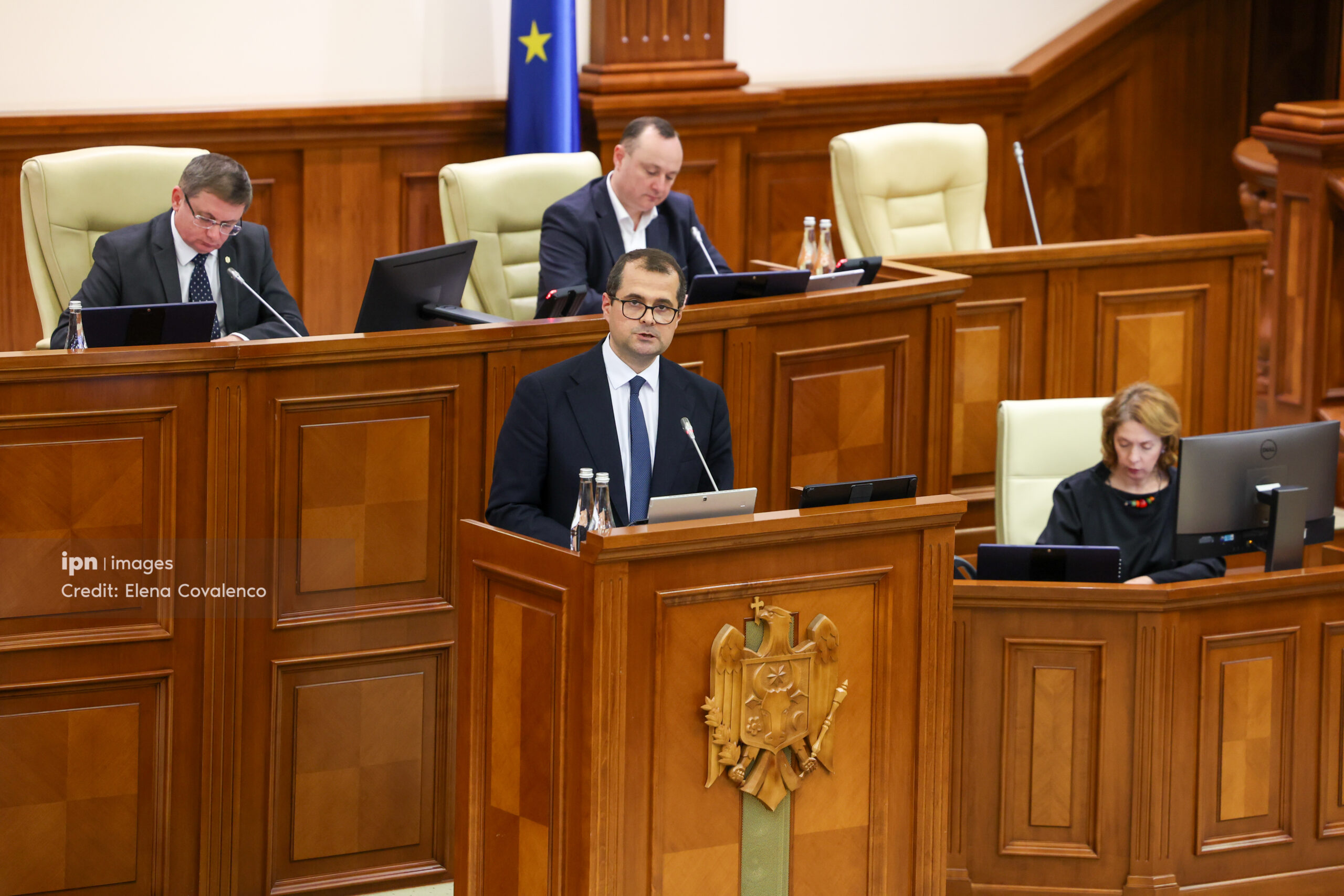
The current state of alert does not provide the Government with all the necessary tools to intervene quickly in case of energy and fuel supply issues or significant price increases. The statement was made by Prime Minister Vasile Tofan in Parliament, where he requested the establishment of a state of emergency in the energy and hydrological sectors for 60 days, reports IPN.
“We have also considered the option of continuing the state of alert, but we would not have all the necessary tools, if many of these risks we talked about were to materialize simultaneously,” Vasile Tofan declared from the Parliament’s podium.
According to the Prime Minister, the state of alert has already allowed daily reporting of stocks and import plans, protection of minimum fuel volumes at Giurgiulesti, limitation of exports, and creation of fast lanes for fuel trucks. However, the state of emergency would allow accelerated purchases of equipment in case of breakdowns in critical infrastructure, temporary simplification of some procedures and permissive acts, and in case of major price shocks, temporary fiscal measures regarding VAT or excise duties.
In the case of gas, over 90% of the winter requirement is contracted, but the purchase price is calculated based on the price at the TTF exchange. In the first half of September, this reached approximately 84 euros/MWh, about 50% above the benchmark used in calculating the current tariff, Tofan said.
Another risk is that of fuels. In August, diesel stocks fell to the consumption requirement for less than four days, and in 109 gas stations, there was no diesel for sale. After the authorities’ intervention, stocks reached about ten days, and the number of stations with problems decreased to eight. The Prime Minister said that the situation demonstrates that the risk is real, but also that the state’s intervention can stabilize the market.
Vasile Tofan also spoke about the drought, which, in his opinion, has created a water supply and energy security issue. On average, about 22 cubic meters of water per second flow into the reservoir at Novodnestrovsk, while a discharge flow of at least 60 cubic meters per second is needed. And at Costesti, on the Prut, electricity production has dropped by approximately 55%, the Prime Minister stated.
Another risk is related to the possibility of reducing Ukraine’s energy exports. Vasile Tofan said that, during peak hours, Moldova will have to import 400-450 MW this winter, while the import capacity from Romania is limited to 360 MW. The difference should come from Ukraine, but the destruction of generation capacities could affect this country’s ability to supply the necessary energy, said the prime minister.
