

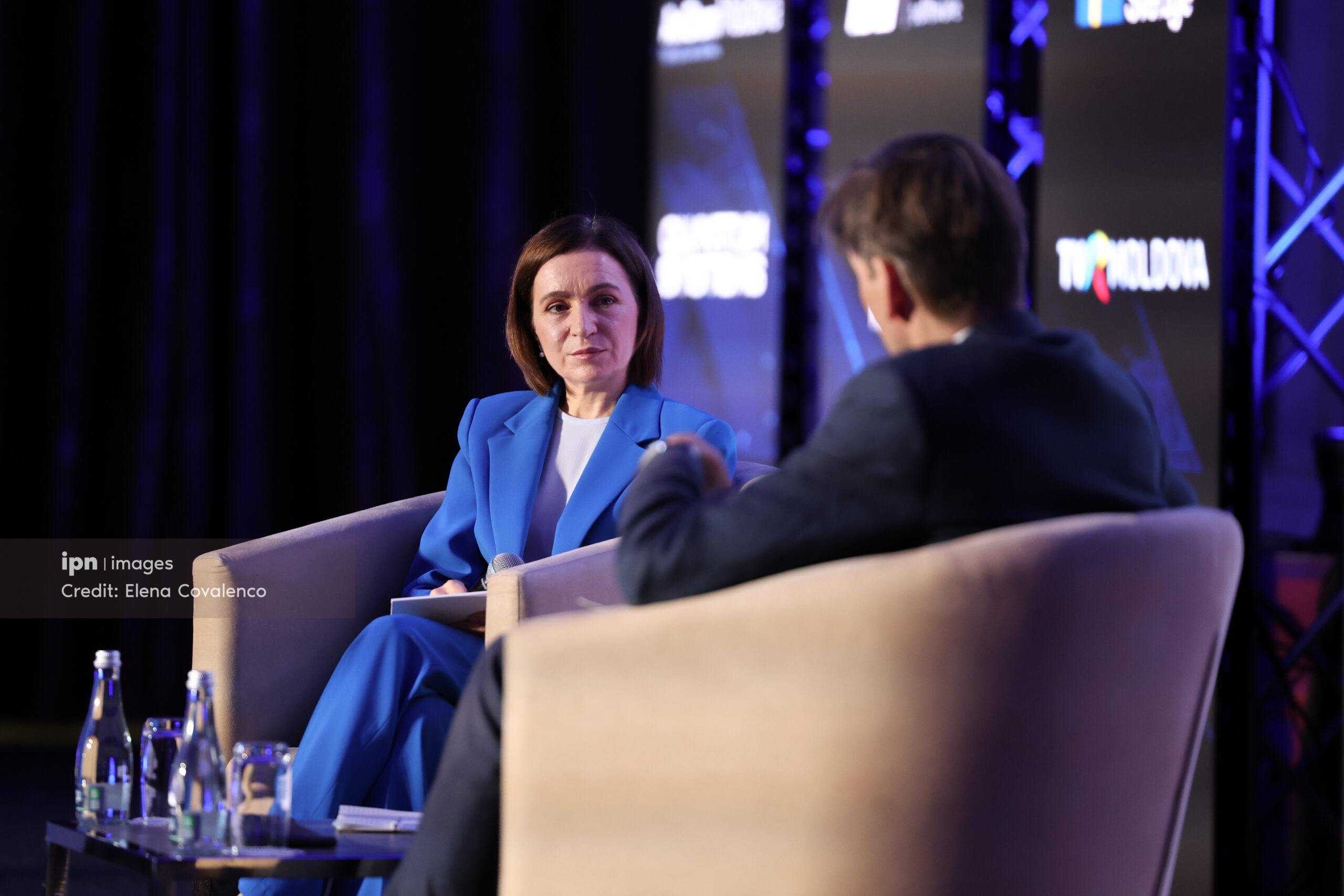
Maia Sandu: The cognitive war, the greatest risk for Moldova in the perspective of the upcoming elections

The cognitive war represents the greatest risk for the Republic of Moldova in the perspective of the upcoming elections, believes President Maia Sandu. At the Moldova Security Forum, the head of state declared that informational manipulation is becoming increasingly subtle, and the development of artificial intelligence facilitates the spread of false content, reports IPN.

Maia Sandu pointed out that cyber attacks, money used for buying politicians and other attempts at influence are dangerous, but cognitive warfare poses an even greater risk for Moldova and other democracies.

According to the president, Russia is hiring people in the Republic of Moldova to create networks through which false information is spread. She clarified that it takes time to demonstrate the connection between certain anonymous accounts and influence actions, however, behind these, there would be real people paid by Russia.

The head of state emphasized that the response to these threats must involve the entire society and the Government. At the same time, she said that dialogue with representatives of companies that own social networks is difficult, especially for a small country like the Republic of Moldova. Maia Sandu expressed her hope that the European Union will be able to impose stricter rules on social media platforms. According to her, the development of artificial intelligence complicates the situation, as it facilitates the manipulation of people and the distribution of false content.

At the forum, Maia Sandu also spoke about the objective of the Republic of Moldova to join the European Union. According to her, the authorities aim to finalize the negotiations and necessary activities by 2028, by signing the accession treaty, and the country to be prepared for accession by the end of this decade, in 2030.

The Moldova Security Forum takes place from October 8-9 and includes public sessions as well as meetings with restricted access. The event is organized by Konrad-Adenauer-Stiftung Moldova, IPRE, the Ministry of Foreign Affairs, the Ministry of Defense and the NATO Liaison Office in the Republic of Moldova.


The Republic of Moldova does not intend, for the moment, to close the Embassy in Moscow, declared President Maia Sandu, when asked if the recent drone incidents could lead to such a decision. The head of state specified that the diplomatic mission still has tasks related to Moldovan citizens located in the Russian Federation, reports IPN.

“The Embassy in Moscow has some tasks related to several of our citizens who are there. There are citizens who still need this support and, for now, the decision is to keep things as they are”, Maia Sandu declared to the press.

The President, however, mentioned that the decision could be revised depending on the situation’s evolution. “If other things happen, if circumstances change, then we will review the decision and communicate”, says Maia Sandu.

In August 2026, the Ministry of Foreign Affairs recalled for consultations the ambassador of the Republic of Moldova to Moscow, Lilian Darii, after a “missile-drone” fell and exploded in the town of Crocmaz, Stefan Voda district. Darii has not returned to the Russian Federation so far. Subsequently, the Speaker of the Parliament, Igor Grosu, confirmed that the ambassador will not return to Moscow for the time being.

0 FacebookTwitterPinterestEmail


Maia Sandu: The cognitive war, the greatest risk for Moldova in the perspective of the upcoming elections

The cognitive war represents the greatest risk for the Republic of Moldova in the perspective of the upcoming elections, believes President Maia Sandu. At the Moldova Security Forum, the head of state declared that informational manipulation is becoming increasingly subtle, and the development of artificial intelligence facilitates the spread of false content, reports IPN.

Maia Sandu pointed out that cyber attacks, money used for buying politicians and other attempts at influence are dangerous, but cognitive warfare poses an even greater risk for Moldova and other democracies.

According to the president, Russia is hiring people in the Republic of Moldova to create networks through which false information is spread. She clarified that it takes time to demonstrate the connection between certain anonymous accounts and influence actions, however, behind these, there would be real people paid by Russia.

The head of state emphasized that the response to these threats must involve the entire society and the Government. At the same time, she said that dialogue with representatives of companies that own social networks is difficult, especially for a small country like the Republic of Moldova. Maia Sandu expressed her hope that the European Union will be able to impose stricter rules on social media platforms. According to her, the development of artificial intelligence complicates the situation, as it facilitates the manipulation of people and the distribution of false content.

At the forum, Maia Sandu also spoke about the objective of the Republic of Moldova to join the European Union. According to her, the authorities aim to finalize the negotiations and necessary activities by 2028, by signing the accession treaty, and the country to be prepared for accession by the end of this decade, in 2030.

The Moldova Security Forum takes place from October 8-9 and includes public sessions as well as meetings with restricted access. The event is organized by Konrad-Adenauer-Stiftung Moldova, IPRE, the Ministry of Foreign Affairs, the Ministry of Defense and the NATO Liaison Office in the Republic of Moldova.


The official reserve assets reached 5.45 billion euros at the end of September, increasing by over 39 million euros compared to August. According to the National Bank of Moldova, since the beginning of the year, the reserves have increased by approximately 349 million euros, reports IPN.

According to BNM, the increase in September was mainly due to the appreciation of the currencies that make up the reserves against the euro, with an impact of 59.85 million euros, as well as the income from the management of foreign exchange reserves, which amounted to 13.61 million euros.

At the same time, the revenues in favor of the Ministry of Finance amounted to 5.76 million euros. Out of this amount, 4.68 million euros represented loans and grants for investment projects, while 1.08 million euros – budget support provided by the European Bank for Reconstruction and Development.

On the other hand, reserves have been reduced by payments for the external public debt service, amounting to nearly 19 million euros, and by the revaluation of securities in the investment portfolio, which generated a decrease of 14.43 million euros. The payments of the Ministry of Finance constituted another 4.3 million euros.

Other reductions were generated by the net outflows related to the mandatory foreign currency reserves of licensed banks, amounting to 1.35 million euros, as well as by the outflows from the accounts of the Office for the Management of External Assistance Programs – 700 thousand euros.

0 FacebookTwitterPinterestEmail


1 IANUARIE, 2025
1 IANUARIE, 2025