

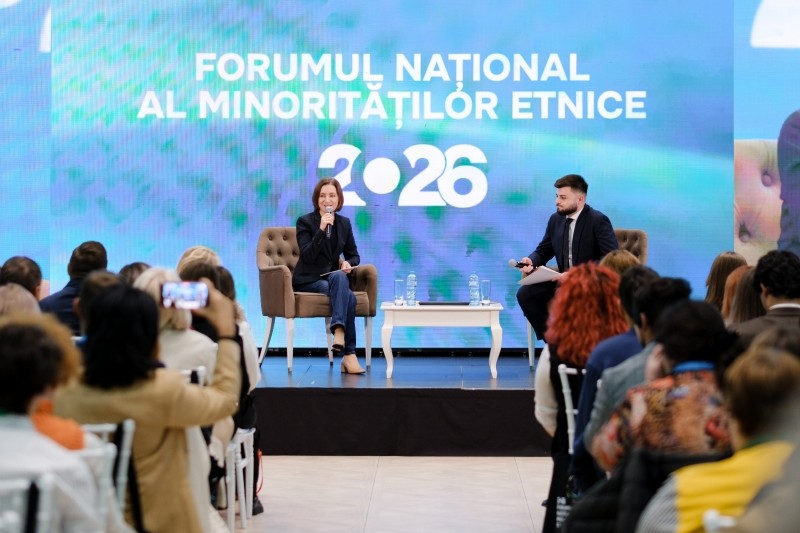
Maia Sandu, at the Ethnic Minorities Forum: Building trust and avoiding hate speech are important

Photo source: Presidency

President Maia Sandu asserts that the respect for the cultural identity of ethnic minorities and the sense of belonging to the Republic of Moldova are not contradictory. The statement was made at the National Forum of Ethnic Minorities 2026, where the head of state spoke about social cohesion, security risks, and European integration, reports IPN.

Maia Sandu emphasized that, in the context of the war in the region and attempts to divide society, it is important to strengthen trust among people and avoid hate speech. “There is no contradiction between respect for each person’s identity and the feeling of belonging to the country. We must respect each other, understand each other, listen to each other when we speak and not choose hate speech,” declared the president.

The head of state also spoke about security challenges, mentioning drone incidents in the localities of Etulia, Crocmaz and near the localities of Ceadar-Lunga and Valea Perjei. According to her, such risks target all citizens, regardless of the language spoken or the community they belong to.

Maia Sandu stated that joining the European Union would bring benefits to all citizens, including by enhancing security, economic opportunities, investments in infrastructure, and resources for protecting the cultural and linguistic identity of ethnic minorities.

At the same time, the president mentioned that the authorities must create conditions for each community to preserve its mother tongue, traditions, and culture. She highlighted the role of education and cultural events in bringing people closer together and strengthening social cohesion.

The National Forum of Ethnic Minorities 2026 gathered approximately 210 participants, including representatives of ethnocultural organizations, public authorities, civil society, and international partners. The event was organized by the Center for Civic Initiatives for National Minorities, in partnership with the Konrad Adenauer Foundation and the Soros Foundation Moldova.


President Maia Sandu asserts that the respect for the cultural identity of ethnic minorities and the sense of belonging to the Republic of Moldova are not contradictory. The statement was made at the National Forum of Ethnic Minorities 2026, where the head of state spoke about social cohesion, security risks, and European integration, reports IPN.

Maia Sandu emphasized that, in the context of the war in the region and attempts to divide society, it is important to strengthen trust among people and avoid hate speech. “There is no contradiction between respect for each person’s identity and the feeling of belonging to the country. We must respect each other, understand each other, listen to each other when we speak and not choose hate speech,” declared the president.

The head of state also spoke about security challenges, mentioning drone incidents in the localities of Etulia, Crocmaz and near the localities of Ceadar-Lunga and Valea Perjei. According to her, such risks target all citizens, regardless of the language spoken or the community they belong to.

Maia Sandu stated that joining the European Union would bring benefits to all citizens, including by enhancing security, economic opportunities, investments in infrastructure, and resources for protecting the cultural and linguistic identity of ethnic minorities.

At the same time, the president mentioned that the authorities must create conditions for each community to preserve its mother tongue, traditions, and culture. She highlighted the role of education and cultural events in bringing people closer together and strengthening social cohesion.

The National Forum of Ethnic Minorities 2026 gathered approximately 210 participants, including representatives of ethnocultural organizations, public authorities, civil society, and international partners. The event was organized by the Center for Civic Initiatives for National Minorities, in partnership with the Konrad Adenauer Foundation and the Soros Foundation Moldova.

0 FacebookTwitterPinterestEmail


Maia Sandu, at the Ethnic Minorities Forum: Building trust and avoiding hate speech are important

Photo source: Presidency

President Maia Sandu asserts that the respect for the cultural identity of ethnic minorities and the sense of belonging to the Republic of Moldova are not contradictory. The statement was made at the National Forum of Ethnic Minorities 2026, where the head of state spoke about social cohesion, security risks, and European integration, reports IPN.

Maia Sandu emphasized that, in the context of the war in the region and attempts to divide society, it is important to strengthen trust among people and avoid hate speech. “There is no contradiction between respect for each person’s identity and the feeling of belonging to the country. We must respect each other, understand each other, listen to each other when we speak and not choose hate speech,” declared the president.

The head of state also spoke about security challenges, mentioning drone incidents in the localities of Etulia, Crocmaz and near the localities of Ceadar-Lunga and Valea Perjei. According to her, such risks target all citizens, regardless of the language spoken or the community they belong to.

Maia Sandu stated that joining the European Union would bring benefits to all citizens, including by enhancing security, economic opportunities, investments in infrastructure, and resources for protecting the cultural and linguistic identity of ethnic minorities.

At the same time, the president mentioned that the authorities must create conditions for each community to preserve its mother tongue, traditions, and culture. She highlighted the role of education and cultural events in bringing people closer together and strengthening social cohesion.

The National Forum of Ethnic Minorities 2026 gathered approximately 210 participants, including representatives of ethnocultural organizations, public authorities, civil society, and international partners. The event was organized by the Center for Civic Initiatives for National Minorities, in partnership with the Konrad Adenauer Foundation and the Soros Foundation Moldova.


The damages caused by the pollution of the Nistru river with petroleum products in the spring of 2026 are estimated at 47 million lei, and approximately 100 thousand people were temporarily left without water from the centralized system. The data is found in the Post-Disaster Needs Assessment Report, presented by the National Crisis Management Center, in partnership with the European Union and the United Nations, reports IPN.

During the intervention, over 620 tons of drinking and technical water were distributed. Some non-urgent medical services were postponed, and in the city of Balti, schools temporarily switched to online learning.

The report specifies that the most vulnerable were the elderly, people with disabilities, households without means of transport, and families with low incomes. Although the incident did not cause destruction of infrastructure, buildings or equipment, the response operations and maintenance of public services generated costs, and the surrounding environment suffered.

The greatest damages were recorded in the disaster risk reduction sector, estimated at 23.71 million lei. This is followed by the environment, with 14.55 million lei, water and sanitation, with 6.61 million lei, and health, with 1.95 million lei. Locally, the Soroca district was the most affected. The assessment did not identify measurable macroeconomic effects.

The document establishes and requires recovery needs for the period 2026-2031, with a focus on preventing similar crises and preparing authorities for interventions. Among the priorities are the strengthening of environmental monitoring, the development of laboratory capacities, the management of contaminated waste, the replenishment of intervention stocks, and the procurement of specialized equipment. Measures are also provided for ensuring reserve water sources, the continuity of water and energy supply to medical institutions, as well as the training of intervention teams.

The report recommends seven priority action packages, including the completion of monitoring and decontamination where justified, increasing the resilience of water supply systems, real-time monitoring and data exchange between institutions, as well as strengthening cross-border cooperation with Ukraine. Other measures aim at civil protection, supporting vulnerable individuals, and restoring the ecosystems of the Dniester basin.

0 FacebookTwitterPinterestEmail


1 IANUARIE, 2025
1 IANUARIE, 2025