




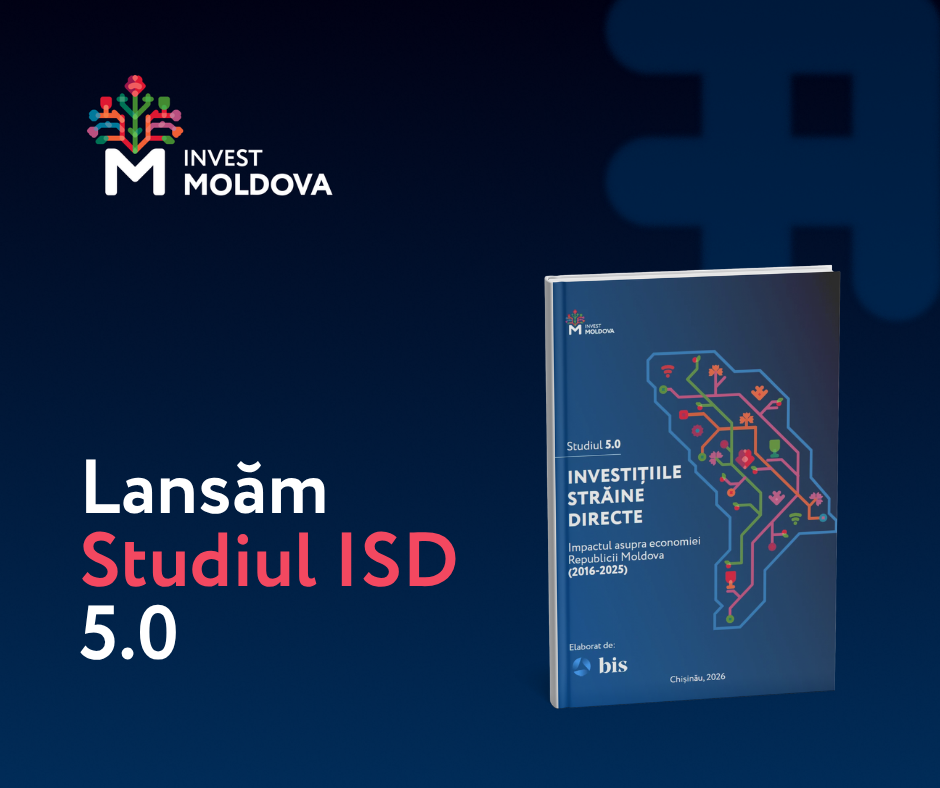
Invest Moldova Agency launched Study 5.0 on the impact of Foreign Direct Investments (FDI) on the economy of the Republic of Moldova (2016-2025), a comprehensive analysis presenting the latest data on the role of foreign capital in the country’s economic development and European integration trajectory.
The study examines global developments and investment dynamics in the Republic of Moldova within an atypical international context. Although global FDI flows increased by 14% in 2025, reaching USD 1.6 trillion, this recovery remains fragile, being largely driven by transit financial transactions. At the same time, global capital shows a clear preference for developed European markets over emerging economies, favoring technology-intensive projects, such as data centers, at the expense of traditional manufacturing industries.
At the national level, despite an external environment marked by unpredictability, the evolution of FDI indicates a clear consolidation of a stabilization and maturation phase. In 2025, the economy of the Republic of Moldova attracted a net FDI inflow of EUR 409 million, a level close to that recorded in 2024 (EUR 424 million)1 and above the level of 2023 (EUR 334 million), while the total cumulative stock surpassed the historic threshold of EUR 5.37 billion. This development confirms a transition from a phase of expansion to one of consolidation of existing investments, supported by investors’ reinvestment of profits in the market. This dynamic reflects the strong performance of foreign-owned companies and their focus on strengthening existing operations. However, the report notes that the attraction of new capital remained limited, underscoring the urgent need to intensify efforts to secure major new investment projects, including greenfield investments.
From a geographical perspective, the European capital overwhelmingly dominates the national economy. By the end of 2025, investments originating from European Union Member States reached a record EUR 3.14 billion, confirming the Republic of Moldova’s definitive anchoring in Western value chains. The distribution reveals a pronounced concentration: five countries (Cyprus, the Netherlands, Romania, Bulgaria and the United Kingdom) account for approximately 56% of total equity capital. In contrast, the presence of capital originating from the CIS region continued to decline, registering a slightly negative net position (EUR -14 million), against the backdrop of the economy’s gradual reorientation toward the European space.
The sectoral analysis highlights that 78% of foreign capital is concentrated in three core sectors: financial and insurance activities (33%), trade (27%) and manufacturing industry (17.7%). This structure signals significant untapped potential in innovative, high-value-added sectors such as IT&C, which currently attract only 5.2% of total foreign capital.
The macroeconomic impact of foreign capital remains an indispensable pillar for national prosperity. Demographic indicators demonstrate a constant accumulation of capital: the stock of FDI per capita increased steadily, reaching EUR 2,257 in 2025, more than double the level recorded in 2016 (EUR 999). At the same time, foreign investments currently account for 9.4% of the country’s Gross Fixed Capital Formation, complementing the unprecedented efforts of local entrepreneurs to modernize the productive infrastructure.
The conclusions of Study 5.0 underline that, although the domestic investment base is solid, accelerating economic convergence requires immediate measures. A public policy focused on increasing predictability, diversifying the origins of capital and directly stimulating new projects in productive and technological sectors remains the top priority for the coming years.
The study was developed by Business Intelligent Services (BIS), at the initiative of Invest Moldova Agency and represents a fundamental instrument for shaping future national directions in the field of investment attraction. For a detailed overview of developments, the full document is available in digital format here.
1The FDI indicators presented in EUR are calculated by converting data initially expressed in USD, using the official methodology of the National Bank of Moldova and the USD/EUR exchange rate corresponding to the reference period. In 2025, the appreciation of the EUR against the USD influenced the values expressed in euros, which may generate differences in the annual dynamics of indicators depending on the reporting currency. Thus, FDI flows expressed in EUR indicate a slight decrease compared to the previous year, while in USD they show a relatively stable evolution, from approximately USD 458 million in 2024 to around USD 460 million in 2025. These differences are mainly due to currency conversion effects and do not reflect significant changes in the underlying dynamics of investment flows.
