




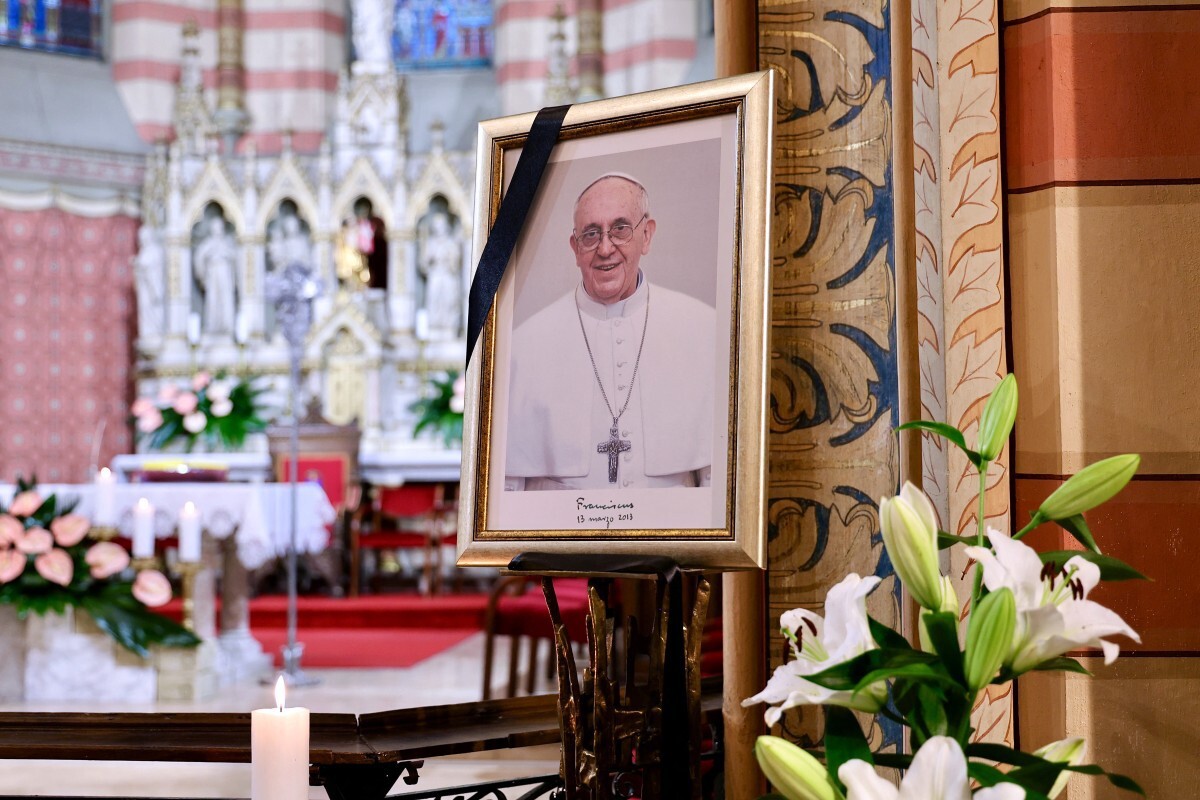
Pope Francis, the 266th pontiff, was driven to his final resting place and buried at the Basilica of Santa Maria Maggiore in Rome. The funeral ceremony was attended by around 250 thousand people from all over the world, including 150 official delegations, IPN reports.
Celebrities, politicians and thousands of followers turned out in St. Peter’s Square in the Vatican to pay tribute to Pope Francis. And more than 150,000 people accompanied the funeral procession through the streets of Rome to his final resting place, where he was buried, Vatican News reports.
“Now, dear Pope Francis, we ask you to pray for us, we ask you from heaven to bless the Church, to bless Rome, to bless the whole world,” said Cardinal Giovanni Battista Re, dean of the College of Cardinals, who led the Mass.
The funeral Mass began with an impressive procession. The pontiff’s coffin was carried on shoulders from in front of the Altar of Confession to the esplanade of St. Peter’s Basilica. The wooden coffin, unadorned, was significantly placed on the open book of the Gospels.
After the Divine Liturgy, the Litany of All Saints was sung, followed by the Byzantine chant for the deceased, sung in Greek by the patriarchs, major archbishops and metropolitans of the Eastern Churches united with Rome. Cardinal Giovanni Battista Cardinal Giovanni Battista Re then said the farewell prayer, after which the coffin was taken to St. Peter’s Basilica.
After a final greeting by the cardinals, the coffin was placed in a ‘popemobile’ and left in view to be taken through the streets of Rome to the Basilica of Santa Maria Maggiore in Rome. Hundreds of thousands of people applauded as the coffin passed, making the sign of the cross or wiping away tears. The last to greet him were the poor and needy, who stood on the steps of the basilica holding white roses.
A simple ceremony followed at the tomb the Pope had prepared during his lifetime. The metal cross, a reproduction of his pectoral cross and his Latin pontifical name, ‘Franciscus’, can be seen on the tomb gravestone.
Pope Francis died on Easter Monday, April 21, at the age of 88. Francis, born Jorge Mario Bergoglio, was elected on March 13, 2013 and was the 266th leader of the Roman Catholic Church and the first pontiff not to have originated from the European continent since Pope Gregory III nearly a thousand years ago, as well as the first Jesuit pope.
In the 12 years during which he led the Catholic Church he made 47 apostolic journeys, including to Romania, left to posterity 4 encyclicals: Lumen Fidei, Laudato si, Fratelli tutti and Dilexit nos, 7 apostolic exhortations, such as “Evangelii gaudium” in which he presents his program of Petrine ministry, 8 apostolic letters, 76 “motu proprio” documents and 39 apostolic constitutions, among the latter being “Praedicate evangelium” on the reform of the Roman Curia.
His period as head of the Church was characterized by a strong emphasis on mercy, social justice and the protection of creation, making him an iconic figure in recent decades, both within the Roman Catholic Church and on the international stage.
Pope Francis will also go down in history for his profoundly humane pastoral approach, constantly advocating a “poor church for the poor”. He has sought to be close to marginalized communities, to migrants, to prisoners, to the sick, often choosing to visit them in person, going beyond protocol.
