




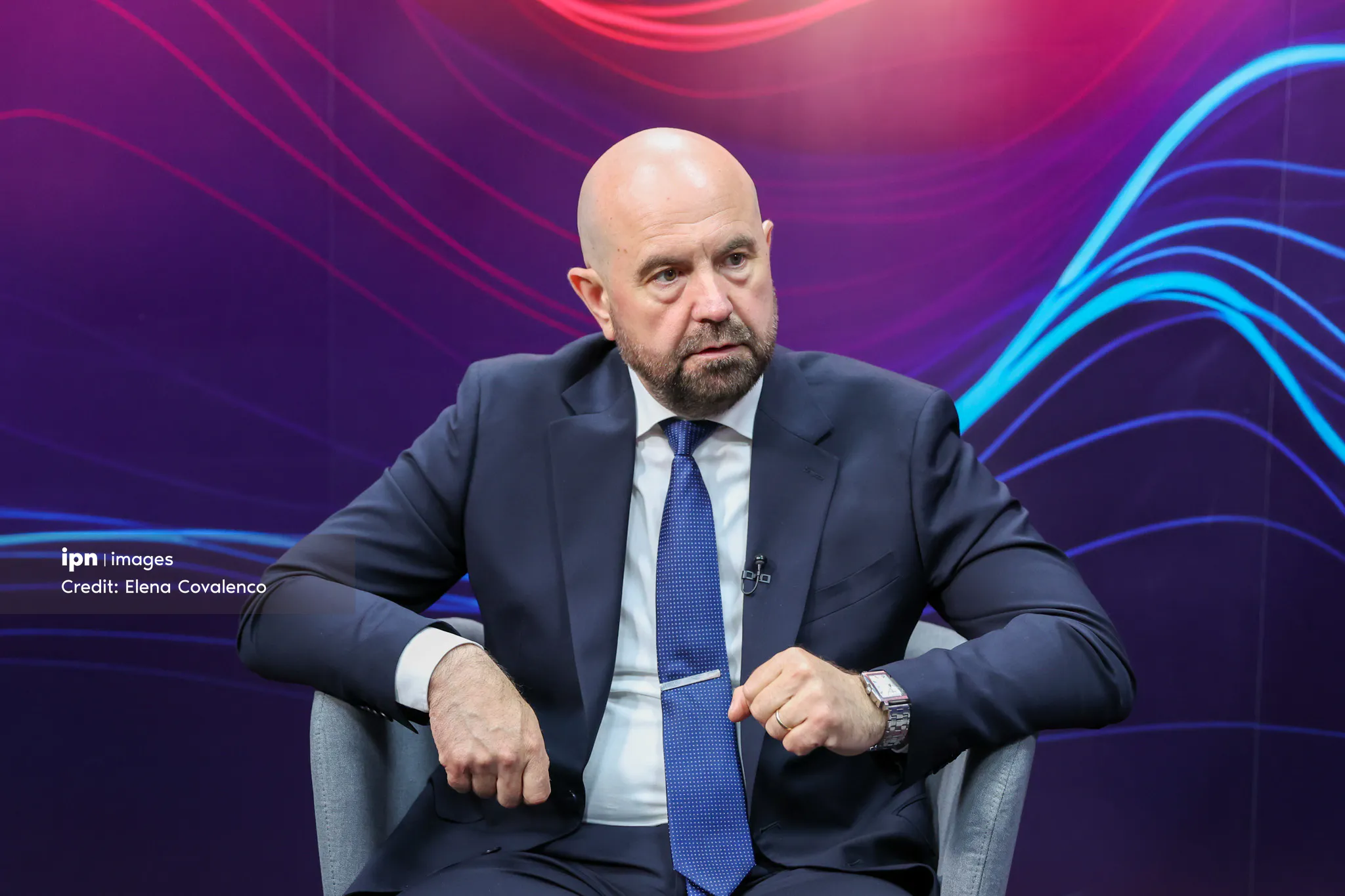
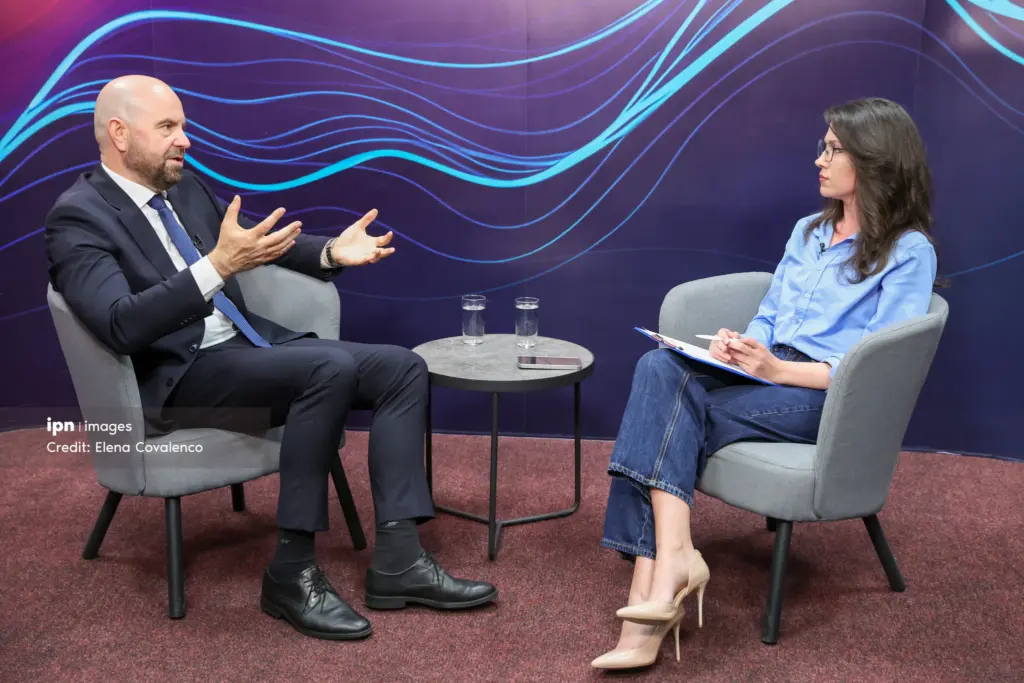
The Republic of Moldova is undergoing a period of rapid transformations, with major infrastructure projects in the implementation or preparation phase. Deputy Prime Minister Vladimir Bolea, Minister of Infrastructure and Regional Development, stated in an interview for IPN that among the priorities are the construction of the first kilometers of highway on the country’s territory, the development of an electrified European railway, the modernization of railway infrastructure, and the transformation of the Republic of Moldova into a regional logistics hub.
We will begin with a topic that, somehow, reflects the general state of the roads in the Republic of Moldova. We had a rather difficult winter, with cold and frost, and this winter has left visible traces. What is the current situation and where are interventions taking place now?
Interventions are taking place on all national roads. The Ministry of Infrastructure, through the AND, manages approximately 6,000 km of roads. As everyone knows, over the past four years, the Ministry of Infrastructure, through the AND and the implementation projects it has had, has rebuilt and completed the works started until 2022, putting into operation approximately 750 km of roads, out of the 6,000 km of national roads. All other roads, approximately 50-55% according to statistical data, are in poor and very poor condition. This means that, over the 36 years they have been in operation, with almost no investment in their maintenance, they have completely exceeded their warranty period.
In this context, we are working today on the development and implementation of projects to intervene, rebuild roads, and carry out major repairs. Otherwise, all national roads are intervened through the 10 JSCs, based on a well-established plan: scraping, patching, and performing regular maintenance work, so that by autumn, we have all the roads repaired. The truth is that we came out of winter with, according to the data from these 10 JSCs, approximately one million square meters of damaged roads, that is, full of potholes.
Furthermore, if we talk about the Chisinau-Hancesti-Cimislia road segment, it represents a very important road, a national artery.
By the way, has the intervention already started there?
We have put it up for auction and, up to the intersection at Hâncești, to the right, there will be work done to change the wear layer. In total, the investment amounts to about 140 million. I don’t know how much the auction ended at, but it was estimated to be around 150 million in financial resources for changing the wear layer on this entire segment. We’re talking about a four-lane road up to Hâncești.
The objective of the Ministry of Infrastructure for 2026 is to develop a strategy based on which we will have financial resources scheduled for the following years, so that the roads that need to enter a normal and ordinary maintenance process, after they have completed ten years of operation, can benefit from the change of the wear layer.
How do we ensure that after these repairs, these problems do not reappear and those holes do not occur, so that we still have a good quality of the roads?
Here, I believe we need to discuss two types of roads: those that have been substantially rebuilt and are included in the warranty period, where, under no circumstances, if the works have been performed qualitatively, potholes cannot appear, and the other roads, which are patched.
Obviously, we carry out the current filling works. Here we are talking about two stages. Essentially, the roads that have been built in recent years and put into operation are in the warranty period.
There should be no problems whatsoever. But, if they do occur, then AND automatically addresses the one who carried out the works, and this one must, from the warranty account, fix all the arisen issues. In the case of other types of roads, until they enter the major repair process, we will carry out maintenance works.
These are the two types of actions that the Ministry of Infrastructure will implement in the coming years through the National Road Agency, AND.
We have the roundabout from Peresecina, which has been reopened, I believe partially. I also saw the ministry’s post from January. At that time, the works were 70% completed. Have the works somehow finished? Some drivers complain that there are already potholes there, and the marking is still not stable, being improvised.
So there, the works were not completed, the wear layer was not applied, but only the binder layer. When I was there, I insisted on reopening traffic in both directions, because a blockage had formed, as people say, a “choke”, under the conditions where cars were coming from two lanes and were directed into a single one.
Next, the wear layer is to be applied, and work is being done on that roundabout in Peresecina.
Speaking of roads, when will we have the first section of the highway?
By the end of May, I hope to be invited to Bucharest, where the Ministry of Infrastructure of Romania will sign and designate the winning company. Just the other days, I was in Bucharest and met with the Secretary of State to resolve issues and objections, so that the contract with a winner could be signed. You know, I was sitting and thinking about how quickly and alertly things are unfolding in such a regime.
In November 2025, I was in Uzhgorod, discussing the possibility of extending the A8 highway, built by the Romanians up to Iași, which is set to end with the bridge scheduled to be put into operation in 2026. Ms. Magda Kopczyńska, the Director General of the European Commission’s Directorate for Mobility and Transport, spoke about how, through the SAFE program, financial resources allow beneficiary states – and Romania benefits from the SAFE program, being a member state of the European Union – to extend projects started in their own country onto the territory of other countries.
Then, on the spot, in November, we said that we are finishing the bridge, but we only have money for 400 meters of highway and we would have liked to extend it a bit. Thus, we made the decision to extend another 5 km to Berești, where the multimodal hub will be located, also managed by the Ministry of Infrastructure. There is railway, car infrastructure, and, of course, we are also talking about container transport. We have both the European line and the wide gauge.
Afterwards, in January, I went on an official delegation together with the Prime Minister of the Republic of Moldova and we discussed with the President of the Parliament, the President of the Senate, and even with the Prime Minister of Romania. We took advantage of the positive attitude and support of these three Romanian leaders to endorse the inclusion of this 5 km section, which will amount to a considerable sum. We are to find out, in the end, when the contract will be signed, how much this 5 km section will cost, because it is quite complicated, with loops and many engineering infrastructure components.
To understand, from November 2025 until now, in April 2026, approximately six months have passed, and we are already talking about the first 5 km of highway on the territory of the Republic of Moldova.
As decreed by Ilie Bolojan, the companies that win must build this highway and put it into operation by the end of 2028, because it is part of A8, that is, the Romanian section. Thus, in 2028-2029, the first 5 km of highway will be put into operation on the territory of the Republic of Moldova.
Moreover, if we’re talking about highways, when I came to the ministry there were some futuristic projects, very grandiose and with costs that were discouraging. There was also the highway project that was supposed to connect the cities of Iasi, Chisinau and Odessa, estimated in 2025 to be over 1 billion 200 million euros, at the pre-feasibility study stage.
When my colleagues asked me what we were going to do with this project, I said we would leave it at the pre-feasibility stage, because it was impossible to identify such financial resources. However, with the opportunity that arose in November 2025 to build the first 5 km and having the support and backing of the Romanian side, the construction of the highway to Chisinau automatically moved to the forefront.
We already have advanced discussions and support from the Delegation of the European Union, and the prefeasibility study for the entire highway, becoming a major priority for us, has moved into the feasibility study stage. The financial resources come from the Delegation of the European Union, which funds the transition from one type of study to another.
We are almost certain that by 2027 this feasibility study will be completed, which would allow us, if we identify together with the European Union and the partners of the Republic of Moldova the necessary financial resources and if all conditions align, to open the bidding and continue the construction. Thus, in 2029-2030, along with the first 5 km section, we could have also completed the section up to Chisinau, in the Cricova area.
We already have the route planning and we see how one opportunity attracts another opportunity. Today, thanks to the fact that we have true friends of the Republic of Moldova – and we can’t even talk about Romania only as friends, because we are the same people – and authentic partners in the European Union, we have someone to discuss with and we can turn projects into reality.
To what extent does the Republic of Moldova invest in these projects or are we just talking about European money?
At the current stage, all the money comes from the European Union. That is, if we’re talking about these 5.1 km, all the money is specifically from Romania.
What stage are we at with these bridges over the Prut, for example with the Bridge of Flowers, and do we have any other projects that are about to start?
The Bridge of Flowers is in the final stretch. Just yesterday, some metallic infrastructure elements arrived, which are to be installed in the coming days. For this, I congratulate the entire Republic of Moldova. These elements entered the territory of the Republic of Moldova and were transported to the bridge just yesterday.
The plan is that, when the assembly begins, I will go and see how these things unfold, because it is a highway-type bridge, with four lanes. It is the first bridge built over the Prut river in the last 60 years, but the positive aspect is that this is the first of the five bridges that are to be built.
In 2027, most likely, the construction of the Costesti-Stanca bridge will also begin, because today we use the dam for traffic, and this is an improper activity. Due to vibrations and transport, the dam deteriorates, and for us it is a priority to build a proper bridge, parallel to this one, to ensure traffic and interconnection of the Republic of Moldova with Romania. So, in 2027, the construction of the Costesti-Stanca bridge, which is already in an advanced stage as a project, will also begin.
We are set to further build the bridge at Falciu. Next to the pontoon bridge, on the right side, the location where it will be built has been identified. Also, at Leova-Bumbata, where the roads are already built, another bridge will be erected, and in the Nisporeni district, yet another one will be constructed.
In 2026, the Flower Bridge is expected to be put into operation, and following this, the construction of the first 480-meter segment of the highway will begin. After these 480 meters, another 5.1 km will be built on the Romanian side.
Minister Vladimir Bolea, in the context where in 2025 the works on the cross-border bridge between Cosăuți and Iampoli were suspended, and recently the Government approved the project agreement and bilateral protocol with Ukraine for the opening of the new road crossing point “Cosăuți-Yampil”, terrestrial. When do you estimate the actual resumption of the works and what is the realistic term for the completion of the bridge and the opening of the terrestrial crossing point?
The Ministry of Infrastructure, in this project, is responsible for the construction of the access road to that bridge. The Ukrainian side is responsible for the construction of the bridge on both banks.
This means that the entire project is in the process of implementation, and the main responsibility falls on the Ukrainian side. Here, the biggest problem is related to funding. The funding was initiated through the USAID programs from the USA. This funding has been completely halted.
In the current stage, as far as I understand, Ukraine has identified financial resources from the budget to complete the construction of the bridge. For them, this construction is very important. It is yet another path towards the European Union, through the territory of the Republic of Moldova, towards the ports of Constanța. In general, all powerful, civilized, and democratic states work and strive to interconnect their country with other states and other unions. This is the tendency of a healthy state: when you build bridges to other countries.
The Ministry of Infrastructure will take over the project. We had previously halted the works, as the project was not in an active implementation process, and now we will take over the design phase. We need to purchase lands to build the road section and, ultimately, based on the project, we will see what amount is needed to complete the construction of the access road to the Iampol bridge.
Has the Ukrainian side already announced when they might resume these works?
From their side, there is an intention to resume the project, but nothing is official yet. As for the Republic of Moldova, we, in May, will put all the documents back on the table, we will see at what stage we are and we will resume work, so as to finalize the design phase in 2026 and establish where that road will pass.
Afterwards, we will see how many plots of land need to be purchased, as it will be necessary to acquire land from individuals, if necessary, and later we will move on to the design and construction stage.
You announced that the wage debts from the Moldova Railway have been extinguished. However, the institution continues to have other financial arrears. What types of debts are currently in question and what is their total value to date?
There are no debts whatsoever in terms of salaries. But now, when you asked me about the Railway, you are most likely referring to the period when I was with you in April or May 2025. That’s exactly when we were discussing the debts at the Railway.
The Railway was systematically destroyed starting from the years 2010 – 2012. Debts amounting to hundreds of millions were accumulated in salaries, hundreds of millions in unpaid taxes. People could not go on medical leave because the contributions to the Insurance House were not paid. They could not retire because there were debts there too. Debts to Moldovagaz, debts to energy, debts to the companies that supplied diesel – debts, debts, and more debts.
And a former director would come, who, thank God, left, and would say: “You don’t understand what it means to not be able to pay the salaries.” And I would tell him: “But do you understand what it means to not pay the salaries? And why, as a general director, did you do so little to avoid this situation?”
Economic inefficiency, extremely poor management, and the thefts of politicians – these are the three factors that have brought to its knees the economic entity known as the Railways of the Republic of Moldova. There is an abundance of metaphor, poetry, and theft in the administration of the Railways.
Personal interests at all levels: general directors, ministers, deputies in Parliament. I don’t know how many were involved in the dispossession and theft process within the Railways of the Republic of Moldova.
From the moment everything came to a halt, it took about a year to change the situation. In one year we reduced the wage arrears to zero, after they had reached delays of nine months. These problems, I believe, existed since 2010.
Because we are talking about efficiency, cost optimization, economic factors, economic thinking, economic analysis, and development strategy. I was asking: how can we transport only 1 million or 1 million 200 thousand tons through the Railways of the Republic of Moldova, when only the cereals from group I and group II produced in the Republic of Moldova reach 5.5 million tons? And approximately 80-85% of these cereals are exported.
How can we only transport 1.2 million tons? How does the rest of the goods reach export? By road. And this means inefficiency and much higher costs.
You too have a transportation unit like the Railway, which, from an economic point of view, guarantees you high capacity, financial resource savings, and seriousness in approach. You don’t spend hours on end in customs. The endless queues at customs have also arisen because exporters were forced to switch almost exclusively to road transport, as the Railway was in a state of slow death.
And when you spoke with the then general manager, he recited poems and metaphors, without understanding what managing an economic agent means.
How have all these things changed now?
Things have changed, because if in February 2025 we had revenues of about 20 something million lei, now it has reached 50 million. In September 2025, because there were cereals and exports, we even reached 80 million lei in revenue in just a few months.
Why? Because the market has a very large potential and I emphasize: we have almost zero transit. That is, we are only talking about our internal market, and the sizing of the Moldovan Railway company should be done according to the real potential you have.
I also believe that the Railways of the Republic of Moldova have not yet discovered their full potential. Just yesterday, I had meetings at the ministry with economic agents operating in the field of logistics. Logistics means transfer from road to rail, from rail to sea – transport logistics.
Furthermore, imagine that within the country’s territory, you have a section of approximately 300 linear meters that, from the summer of 2022, is not functioning. You’ve lost the transport of diesel, gasoline, fertilizers, because the railway intersects Ukraine in four places. Companies have decided that there is danger: drones, missiles, war. We won’t go, because there’s a risk of a drone falling. And then, whether intentionally or unintentionally – although, unfortunately, in most cases it is intentional – these drones cause explosions, loss of goods, and even loss of human lives.
Out of responsibility, the importing companies have decided to switch from rail transport to road transport. And this means millions and tens of millions of lei that the Railway of the Republic of Moldova has lost.
Furthermore, we have reopened the third bridge, as we are preparing Moldova not to be just a passive observer of Ukraine’s reconstruction process, which will take place with the support of the European Union, but to be an integral part of these processes.
We have the bridge from Falciu-Cantemir, which we have reopened. We have the bridge from Ungheni and we have the bridge from Giurgiulesti. These are three bridges over the Prut River. This means a direct connection with Romania and, implicitly, with the Schengen area and the European Union.
In all these three points, the railway is both European and wide gauge. This means that, for example, if an economic agent from Greece wins a bid and participates in the reconstruction of Ukraine, they can load their goods into wagons in Greece, and it arrives without bogie changes and without problems to Cantemir, where we can unload it, transfer it to road transport or load it onto other wagons to be sent further into Ukraine.
By reopening the third bridge and through the investments we are making in the railways, in our port system, and in the construction of national roads, the Republic of Moldova is doing nothing but investing in its transformation into an authentic European logistics hub. And we have this potential.
Who shares a border with Ukraine? The Republic of Moldova and Poland. Romania also has a border segment. If we talk about Romania, it has only one railway crossing point to Ukraine. The Republic of Moldova has three.
We have extensive loading and unloading bases, with logistical takeover possibilities and even storage spaces. Therefore, the offers we make to companies in the European Union are very clear.
When will we have a European railway?
This is, once again, an extraordinary matter that is happening. In the summer of 2025, the situation was exactly identical to that of the highway. In June 2025, we received the result from a European structure that informed us that, together with the Ministry of Infrastructure in Bucharest, we had submitted an application and were selected as winners.
The total amount rises to approximately 33 million euros and a new, European and electrified railway will be built, with a length of approximately 32-33 kilometers, which will connect the city of Iași, Romania, with the city of Ungheni in the Republic of Moldova. The Romanian side builds up to the bridge, the so-called EFL. We, the Republic of Moldova side, rebuild the bridge and build the railway on the territory of the Republic of Moldova.
In addition, we also bring the Government’s contribution to this project. The Ministry of Infrastructure will contribute approximately around 8 million euros on behalf of the Government.
Now, at the end of May, the Ministry of Infrastructure is set to sign the contract with the company that will commence the construction of the first section of electrified railway. The need has also arisen to transition from the pre-feasibility study to the feasibility study for the construction of the subsequent segments.
Today we are discussing the fact that by 2027 we need to have completed the feasibility study for the construction of the electrified railway with European gauge, which will connect the city of Ungheni with the airport in the municipality of Chisinau.
This railway will be built from scratch, according to all the requirements of the European Union. In most cases, it will run parallel to the existing railway line that currently connects Ungheni to Chisinau, according to the presented study.
The first section will already enter the design phase in 2026, and in 2027-2028, it will most likely be built. In 2027 we will already be discussing the feasibility studies for the following sections.
What’s happening with Marculesti Airport?
Marculesti Airport is a constituent part of Chisinau Airport. In the Black Sea basin area, in this economic region, Moldova becomes a significant player in the aviation segment. As you know, we have exceeded the threshold of 6 million passengers at our airport.
Yes, a portion of them, approximately 30%, are Ukrainian citizens. We wish for them to be able to fly from home and for the war to end. But there is also a natural increase from the citizens of the Republic of Moldova, because until now we reached approximately 2.5 million passengers.
Marculesti Airport is now the second aerodrome. There are many requests from aviation companies for cargo flights. These represent money, income, and missed profits, because we cannot provide enough capacity for such flights.
The airport in Chisinau is already far too small to be able to serve large-scale commercial cargo flights.
Previously, you stated that Marculesti Airport could become operational for charter flights as early as 2025, following its transfer to the management of Chișinău International Airport.
Now, look, the project has passed as a bill. The reception process has been completed, the minutes have been signed, and the entire wealth of Măarculesti Airport has been received based on a set of minutes, because the process is managed by APP.
They are the holders of all assets that have been transferred. Chisinau Airport, already a mature institution, launched a tender for the development of a master plan about a week ago.
What does masterplan mean? It means a profound analysis of everything that has happened on the territory of the Republic of Moldova and in the region, in the aviation segment and, most importantly, an analysis of the prospects for the next 10-15 years.
We speak both about member states of the European Union and about states in the region that are not members. The trends, competition, and economic parameters are analyzed, and the economic component prevails in this masterplan.
Afterwards, we need to understand where and what we are investing in, what remains in Chisinau, what we emphasize in Chisinau and what we develop in Marculesti.
This does not mean that we will not invest in the runway. This does not mean that we will not build the landing system and that MoldATSA will not make the necessary investments in the meantime, because this airport must be functional and safe. Moreover, it is already a functional airport.
We will continue to invest in the aviation sector, because, in the coming years, we want the Republic of Moldova to become an important logistics hub in Southeast Europe.
Speaking of the direct connections we have with certain countries, I know that there were certain agreements, for instance with the USA and many other distant countries, regarding direct flights. Is it possible for this dream to finally become a reality for the Republic of Moldova, for example, in the USA?
I believe that we do not have enough passengers to fill a plane to fly directly to the USA.
Then why were those agreements signed, for example?
Firstly, this involves several components: recognition of documents, passports, flight security. There are many beneficial things for us. Not from all countries can you fly directly to the USA or to other distant destinations. There are hubs at the European level. Frankfurt is a major hub from where you can fly to the USA and America. Istanbul is another important hub from where you can fly to the USA, Australia, Japan, and everyone uses these connection centers.
So you need to have a completely different potential to be able to receive aircraft of such category and, most importantly, to be able to ensure the passenger flow. Because an aircraft that flies 8-11 hours costs differently than one operating on the Chisinau-Bucharest segment.
Mr. Deputy Prime Minister, I thank you very much for this discussion.
Thank you too!
Irina Boțu, IPN
