

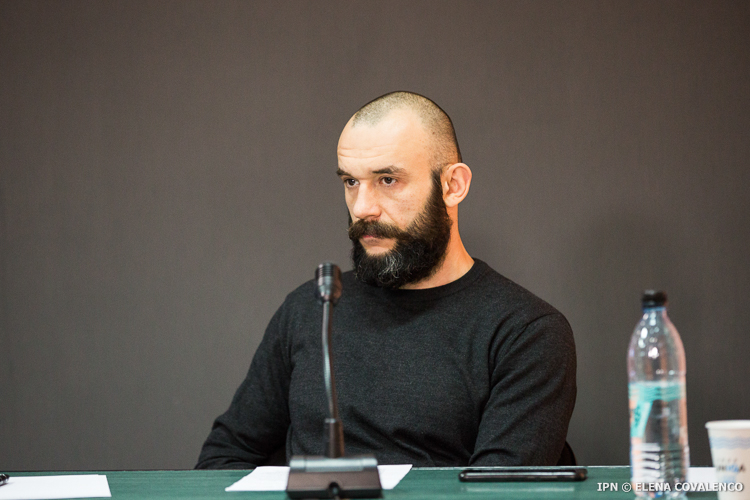
Mihai Țurcanu: “Stockholm syndrome” replaced feeling of national identity in many compatriots

If we believe Putin’s propaganda that Russia started the war for there to be no war, it means that the atrocities committed daily against children, women and older persons in Ukraine are not acts of genocide but acts of purification, denazification and these “good deeds” deserve to be glorified by medals, promotions and titles, doctor of history Mihai Țurcanu, of the Institute of History of the Moldova State University, said it a public debate hosted by IPN.

The mutilation of reality was permanently used as an instrument by the imperialist, Stalinist and Communist regimes, which during two centuries controlled the area between the Prut and the Nistru. “They say the evil witnessed in the Soviet Union during the 1930s occurred not as a result of “social and economic experiments”, such as the collectivization with victims of the Holodomor, but of sabotage. Stalin’s theory said the class enemies infiltrated into party, state bodies in order to put up resistance from inside, avoiding saying “the construct of communism”. In fact, the tyrant shirked from responsibility for failures and also kept his opponents far away,” said the historian.

He noted the Russian soldiers who hear Putin saying that he started the war in the name of peace realize that this offers them justification for any crime committed in Ukraine.

As to why a part of Moldovan society justifies the Russian invasion of Ukraine, Mihai Țurcanu said this is due to the long indoctrination of the disregard for our national identity, of the Romanian culture. “I think this perception persists. We were raised and educated practically in the spirit of the “Stockholm syndrome”, when the victim starts to sympathize with the aggressor or the kidnapper. There is a big difference between us and the Poles or the Baltic people. This was also seen in 1991, when the Soviet Union fell apart. They proclaimed their independence the first and we did it when we could no longer stay there as Ukraine also declared its independence,” stated the speaker.

The historian said the Moldovans’ level of culture, of national identity is very low compared with that of the Ukrainians, the Poles, the Estonians, who offered their entire artillery to Ukraine, the Lithuanians as these know the cost of the Soviet occupation of 1940. “I think our duty is to extend the ranks of those who know the history of the nation and to tend to a higher level national dignity and culture. With the feeling of respect for oneself, one will never accept the atrocities associated with the army that is celebrated on February 23,” concluded Mihai Țurcanu.

The public debate entitled “What did we celebrate and why did we celebrate on February 23?” was the fourth installment of IPN’s project “Impact of the Past on Confidence and Peace Building Processes” that is supported by the Hanns Seidel Foundation of Germany.


The City Hall of Chisinau is organizing the festival “Te salut, Chisinau!”, on the occasion of the 590th anniversary of the city’s first documentary attestation (July 17-19) /Pedestrian Street “Eugen Doga” /at 06:00 PM/.

The municipal chess and checkers championship for seniors is taking place in the sectors of the capital /July 18-19/.

The City Hall of Chisinau is organizing fairs and markets with local products and goods in the sectors of the capital /18-19 July/.

0 FacebookTwitterPinterestEmail


Mihai Țurcanu: “Stockholm syndrome” replaced feeling of national identity in many compatriots

If we believe Putin’s propaganda that Russia started the war for there to be no war, it means that the atrocities committed daily against children, women and older persons in Ukraine are not acts of genocide but acts of purification, denazification and these “good deeds” deserve to be glorified by medals, promotions and titles, doctor of history Mihai Țurcanu, of the Institute of History of the Moldova State University, said it a public debate hosted by IPN.

The mutilation of reality was permanently used as an instrument by the imperialist, Stalinist and Communist regimes, which during two centuries controlled the area between the Prut and the Nistru. “They say the evil witnessed in the Soviet Union during the 1930s occurred not as a result of “social and economic experiments”, such as the collectivization with victims of the Holodomor, but of sabotage. Stalin’s theory said the class enemies infiltrated into party, state bodies in order to put up resistance from inside, avoiding saying “the construct of communism”. In fact, the tyrant shirked from responsibility for failures and also kept his opponents far away,” said the historian.

He noted the Russian soldiers who hear Putin saying that he started the war in the name of peace realize that this offers them justification for any crime committed in Ukraine.

As to why a part of Moldovan society justifies the Russian invasion of Ukraine, Mihai Țurcanu said this is due to the long indoctrination of the disregard for our national identity, of the Romanian culture. “I think this perception persists. We were raised and educated practically in the spirit of the “Stockholm syndrome”, when the victim starts to sympathize with the aggressor or the kidnapper. There is a big difference between us and the Poles or the Baltic people. This was also seen in 1991, when the Soviet Union fell apart. They proclaimed their independence the first and we did it when we could no longer stay there as Ukraine also declared its independence,” stated the speaker.

The historian said the Moldovans’ level of culture, of national identity is very low compared with that of the Ukrainians, the Poles, the Estonians, who offered their entire artillery to Ukraine, the Lithuanians as these know the cost of the Soviet occupation of 1940. “I think our duty is to extend the ranks of those who know the history of the nation and to tend to a higher level national dignity and culture. With the feeling of respect for oneself, one will never accept the atrocities associated with the army that is celebrated on February 23,” concluded Mihai Țurcanu.

The public debate entitled “What did we celebrate and why did we celebrate on February 23?” was the fourth installment of IPN’s project “Impact of the Past on Confidence and Peace Building Processes” that is supported by the Hanns Seidel Foundation of Germany.


The former president of the Constitutional Court, Alexandru Tanase, stated that the changes regarding the competences of the Gagauz autonomy in organizing elections do not represent an infringement on its status. “Gagauzia does not have enemies in Moldova,” Tănase declared in the show “Teritoria Svobodi” with Lilia Burakovski, reports IPN.

Alexandru Tanase also stated that Comrat is being “brazenly manipulated”. “I am very sorry that, after 30 years, other political parties are not normally represented there, and pro-Moscow oriented politicians control the situation in the autonomy”, clarified the former president of the Constitutional Court.

In his opinion, this is a backlog of Chisinau, for which the country will pay a high price due to the ignorance of the situation in the region.

He mentioned that, most likely, legislative changes will be made, according to which Chisinau will designate the electoral bodies itself that will organize the elections in Gagauzia – on the date set by the Popular Assembly.

“Gagauzia has no enemy in the Republic of Moldova. There is no politician – not even the most marginal – who would say that autonomy should be abolished or that certain competencies should be reduced,” concluded the former president of the Constitutional Court.

0 FacebookTwitterPinterestEmail


1 IANUARIE, 2025
1 IANUARIE, 2025