

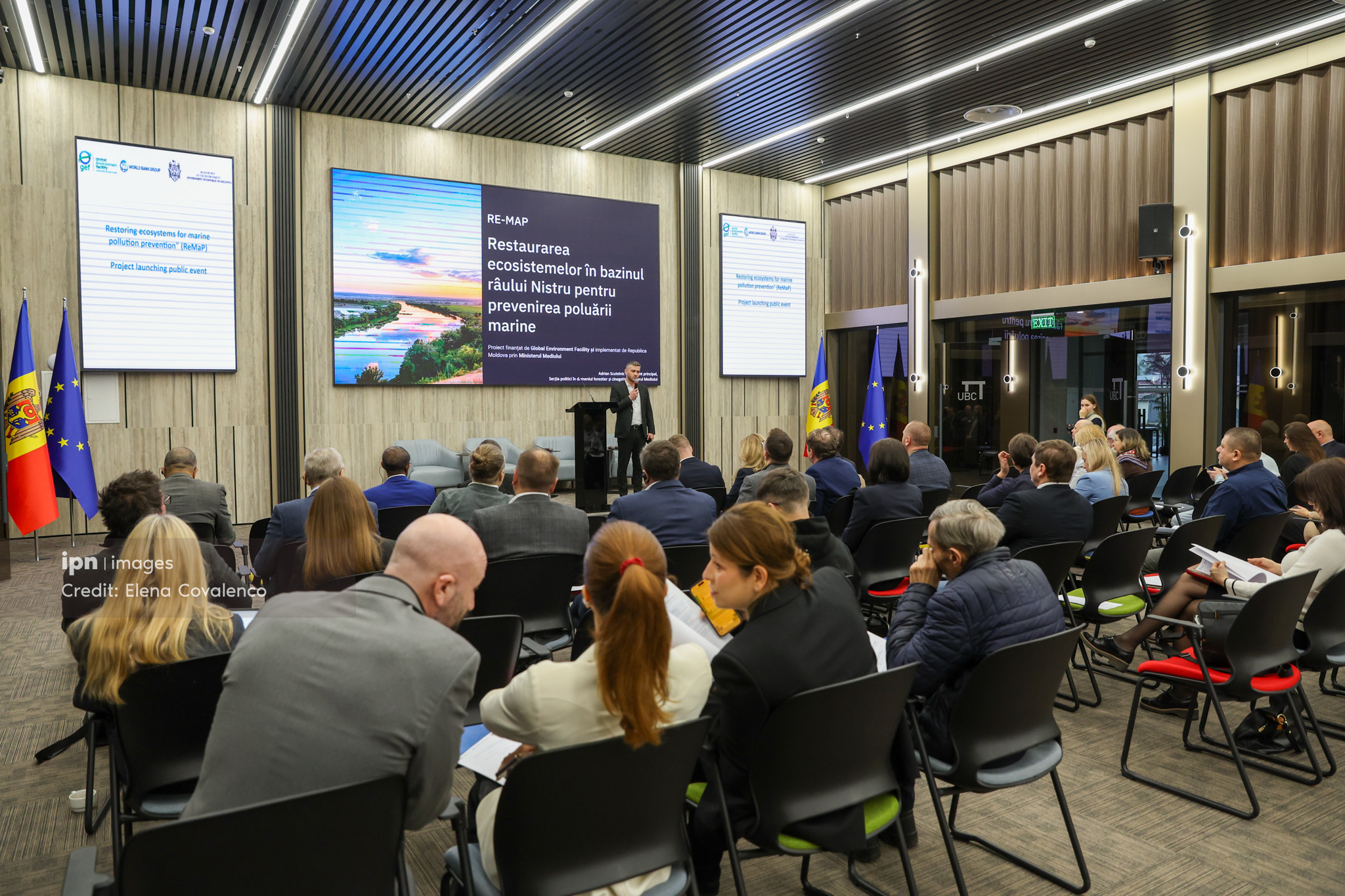
The wetlands of the Nistru will be restored in 15 districts through a new ecological project

Wetlands in 15 districts, along the Dniester basin, will be restored by planting 1,800 hectares of forests and restoring ecosystems for natural water filtration. In Chisinau, the “Restoration of ecosystems to prevent marine pollution – RE-MAP” project was launched, implemented by the World Bank, aimed at improving environmental quality, reports IPN.

The project aims to restore degraded ecosystems and protect water resources in the Dniester basin. In addition to planting 1,800 hectares of forests, silvopastoral management plans will be developed for approximately 10,000 hectares of land.

The initiative will be implemented over the next four years, in collaboration with international partners. Funding is provided through a grant of 7.9 million dollars offered by the Global Environment Fund.

According to the Ministry of Environment, the interventions will contribute to the protection of water resources, reduction of pollution, and improvement of people’s quality of life.


The Planeta Clounella Theater presents the children’s show “The Doughnut” /Clounella Theater, 55 Mihai Eminescu Street /at 11:00 AM/.

The City Hall of Chisinau is organizing the festival “Te salut, Chisinau!”, on the occasion of the 590th anniversary of the city’s first documentary attestation (July 17-19) /Pedestrian Street “Eugen Doga” /at 06:00 PM/.

The actors of the Russian State Drama Theater “A. P. Chekhov” perform the show “Method” /Theater “A. P. Chekhov” /at 07:00 PM/.

A movie is being projected outdoors as part of the “Chronograph Evenings” project /Alunelul Park /at 08:30 PM/.

A movie is scheduled to be screened at the Open Air Film Festival /Rose Valley Park /at 09:00 PM/.

The exhibition “Urban Archaeology and the Hidden Memory of Chisinau” continues /National Museum of History of Moldova /July 17-November 30/.

The contemporary art exhibition-competition continues: The municipal salon within the “Te salut, Chisinau!” Festival, the VI edition, dedicated to the 590th anniversary of the city /Constantin Brancusi Exhibition Center /July 8-26/.

The documentary exhibition “Echo from the past, for present and future” continues, dedicated to the memory of the victims of Stalinist deportations and one of the most tragic episodes in the history of Bessarabia /BNRM /July 3-August 3/.

The exhibition “The Thread of Identity! The traditional Romanian costume in book illustrations made by plastic artists from the Republic of Moldova” continues /BNRM /June 25-August 15/.

The graphic exhibition by Lica Sainciuc continues, opened as part of the Creative Industries Festival /Lutnita Gallery /June 5 – July 31/.

0 FacebookTwitterPinterestEmail


The wetlands of the Nistru will be restored in 15 districts through a new ecological project

Wetlands in 15 districts, along the Dniester basin, will be restored by planting 1,800 hectares of forests and restoring ecosystems for natural water filtration. In Chisinau, the “Restoration of ecosystems to prevent marine pollution – RE-MAP” project was launched, implemented by the World Bank, aimed at improving environmental quality, reports IPN.

The project aims to restore degraded ecosystems and protect water resources in the Dniester basin. In addition to planting 1,800 hectares of forests, silvopastoral management plans will be developed for approximately 10,000 hectares of land.

The initiative will be implemented over the next four years, in collaboration with international partners. Funding is provided through a grant of 7.9 million dollars offered by the Global Environment Fund.

According to the Ministry of Environment, the interventions will contribute to the protection of water resources, reduction of pollution, and improvement of people’s quality of life.


The Republic of Moldova and Ukraine are facing a severe hydrological drought in the Dniester river basin, caused by the lack of precipitation and high temperatures in recent months. In this context, the Ukrainian side proposed reducing the discharge flow from the Novodnestrovsk reservoir from 100 to 70 cubic meters per second. The authorities in Chisinau have requested the maintenance of the current regime, at least until the end of the month, to ensure the water supply for the population, reports IPN.

The situation was examined during an extraordinary meeting of the Commission on the sustainable use and protection of the Dniester river basin, convened to analyze the evolution of hydrological conditions.

According to the Ministry of Environment, Ukrainian authorities have reported that precipitation has significantly decreased in the Carpathian region, which has reduced the volume of water accumulated in the lake at Novodnestrovsk. At the same time, the heatwave has exacerbated water losses, and in some regions, levels below the historically monitored minimums have been recorded.

The Ministry of Environment specifies that the average monthly flow of the Dniester in June was below the multi-year average, which confirms the existence of a pronounced hydrological drought. Under these conditions, Ukraine has proposed reducing the flow. At the same time, Ukrainian authorities have announced that they have already introduced restrictions on water use and have implemented other conservation measures.

Representatives of the Republic of Moldova have requested to maintain the current flow rate of 100 cubic meters per second, a request accepted by the Ukrainian side until the end of the month. At the end of July, a new meeting of the Commission will take place to analyze updated data. Until then, the Ministry of Environment, together with the “Apele Moldovei” Agency, the Authority for Meteorology and Environmental Monitoring, and other competent institutions will continue to monitor the situation and develop intervention scenarios, the priority being to ensure the population’s water supply.

Authorities urge citizens and businesses to use water resources rationally, in the context of the risk of prolonging the hydrological drought. The Dniester is the main source of water for a large part of the Republic of Moldova. According to bilateral treaties, Ukraine is obliged to ensure a flow of at least 100 cubic meters per second from the Novodnestrovsk reservoir. Reducing this level can affect the ecosystem and could create problems for the pumping stations that provide drinking water to numerous localities in Moldova.

0 FacebookTwitterPinterestEmail


1 IANUARIE, 2025
1 IANUARIE, 2025