

The results of the socio-political Omnibus survey – November edition, 2025

Press Release

On March 25, 2026, at the IPN press agency, the presentation of the results of the sociological study entitled “Unification with Romania, national identity and political preferences of the citizens of RM” took place, organized by Iulian Gramațki, socio-economic researcher and doctor in economics at the University of Frankfurt on Main, in partnership with the sociological research company ATEȘ Research Group. For the first time in the history of sociological research in the Republic of Moldova, the subject of the unification of R.M. with Romania and that of national identity were investigated so thoroughly within a public opinion poll.

The respective study consisted of two samples: one – of 1078 respondents from the territory of the Republic of Moldova, as is usually practiced, and the other – of 235 respondents from the diaspora (citizens with the right to vote of the Republic of Moldova with usual residence in another country), which is another premiere for studies in the recent period that measure voting intention. The weight of the diaspora in the republican level elections is becoming increasingly significant, reaching the level of 15-20% of the total number of voters in the elections of the last two years.

This proportion is too large to be ignored, and the exclusion of the diaspora from socio-political surveys has led to a distortion too great compared to the actual election results. The inclusion in the study of a sample from the diaspora was done with the aim of correcting these deviations and filling the knowledge gap about the voting intention in the diaspora, providing a measurement that can be used for a more accurate simulation of electoral scenarios.

The results of the study revealed that, in the case of a referendum on the unification of the Republic of Moldova with Romania, 44% of the respondents residing in the Republic of Moldova would vote for unification, while 39.2% would vote against it (the other respondents either stated that they would not participate in such a referendum, could not decide, or refused to answer). In the diaspora, 60.8% of respondents would vote for unification and only 24.3% would vote against. Thus, supporters of unification constitute a relative majority in the territory of the RM and an absolute majority in the diaspora.
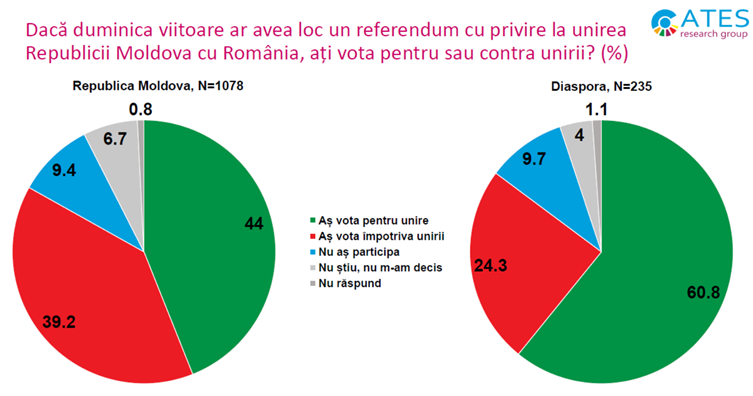
These results contradict the prevailing perception in the public sphere that the union is not desired by the population of the Republic of Moldova, a statement made even by several representatives of the top leadership, opinion makers, and mass media institutions. This perception has deeply rooted in public opinion, as evidenced by the fact that the biggest obstacle to the union, in the respondents’ view, was “the population of the Republic of Moldova does not want”, stated by 37.6% of the respondents from the RM and 35.7% in the diaspora. Such perceptions are, unfortunately, more rigid than reality itself, and this study comes specifically with the purpose of debunking them.

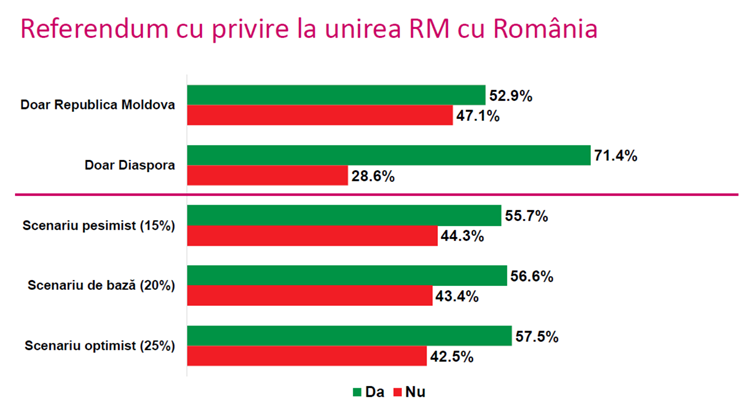
The proportions of support for union revealed in this survey mean that, in the event of a union referendum, the voting result (excluding indecisive votes) would be almost 53% for the “Yes” option solely on the territory of the Republic of Moldova, and together with the votes of the diaspora, it could reach 55-58%, depending on the number of voters who would turn out to vote in the overseas sections.
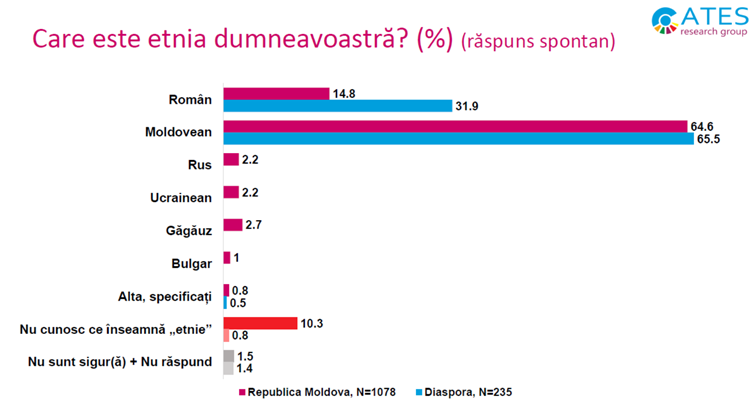
Additionally, the study measured the proportion of those who identify as ethnic Romanians – 14.8% in the territory of the RM (vs. 8% in the 2024 census) and 31.9% in the diaspora. The proportion of those who declared that they speak Romanian is 44.2% in the RM (a relative majority, also increasing compared to the census, where a relative majority chose “the Moldovan language”) and 71.9% in the diaspora (an absolute majority).
In terms of religious affiliation, 29.5% in the Republic of Moldova have chosen the Metropolis of Bessarabia (41.9% in the diaspora), while 49.2% in the Republic of Moldova – the Metropolis of Chisinau and All Moldova (33.8% in the diaspora). Another 12.3% (14.8% in the diaspora) declared themselves Orthodox without affiliation to a specific metropolis or patriarchate.

Respondents from the Republic of Moldova are almost equally divided between those who believe that Romanians and Moldovans are the same people and those who believe they are two different peoples (48.3% vs. 49.4%), while in the diaspora an absolute majority believes they are the same people (63.7%).

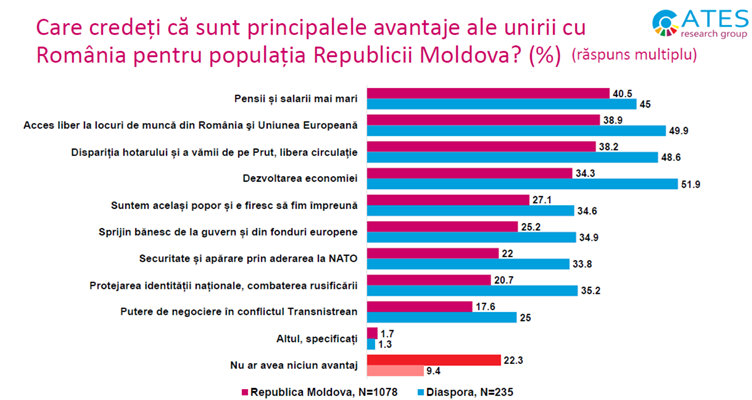
Moreover, ethnic or identity reasons occupy a secondary place in the motivation of the citizens of the Republic of Moldova to support the union – the most frequently mentioned benefits of the union for the population of the Republic of Moldova were of an economic nature: Higher pensions and salaries (40.5% RM / 45% diaspora), right to work in Romania and the EU (38.9% RM / 49.9% diaspora), free movement without a border on the Prut (38.2% RM / 48.6% diaspora). And the proportion of those who support the union is 3 times greater than those who declare themselves ethnic Romanians.
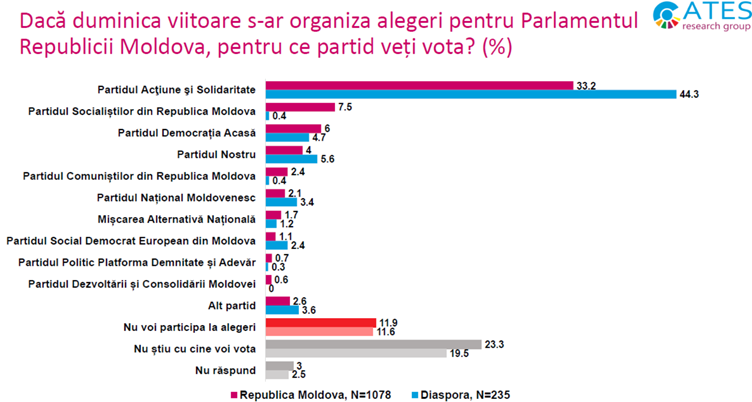
Regarding political preferences, the politician from the Republic of Moldova with the highest trust is Maia Sandu – 32.7% in RM and 48.4% in the diaspora), which is over 6 times more than the 2nd place – Vasile Costiuc (5.1% / 3.2%), followed by Igor Dodon (4.2% / 0.4%) and Renato Usatîi (3.1% / 3.3%). The party with the highest voting intention is PAS (33.2% RM / 44.3% diaspora), over 4 times more than PSRM (in 2nd place with 7.5% in RM, but only 0.4% in the diaspora).
In the case of a EU accession referendum, 62.1% of respondents in the RM territory would vote in favor and 24.1% against, while in the diaspora – 84.3% would vote in favor and 9.1% against. For NATO accession, 34.9% would vote in favor and 43% against in the RM, while in the diaspora – 56.4% would vote in favor and 28.7% against.

The segmented analysis of the sample from the territory of the RM shows that the proportion of those who would vote for unification is higher among ethnic Moldovan/Romanian respondents (48% vs. only 14.5% among ethnic minorities), supporters of EU membership (65.7% for unification), holders of Romanian citizenship (69.3% for unification) and PAS voters (79.8% for unification).

Continuing this thought, in response to the open question of which politician they associate with the reunification movement, respondents most frequently mentioned Maia Sandu, with an overwhelming margin – 34.6% (in RM, 37.4% in the diaspora) vs. less than 3% for any other politician (4% in the diaspora), and 50.5% did not mention anyone (42% in the diaspora). Thus, in the collective mindset, there is a strong association between PAS / Maia Sandu and unionism, which would make the overly cautious position adopted by the president and the ruling party on this subject unjustified.

In addition to these, the study tested the addressing of questions with suggestive forms (for example, the mention that pensions and salaries after unification will increase to the level of those in Romania) to measure the impact they have on the support of unification, Romanian national identity and NATO membership. The impact of these is an increase in the support of unification by 14 p.p. in RM and 11 p.p. in the diaspora, of the idea that Moldovans and Romanians are the same people by 18 p.p. in RM and 21 p.p. in the diaspora, of NATO membership by 9 p.p. in RM and 4 p.p. in the diaspora. These results illustrate how easily public opinion can be swayed by an information campaign with a simple message of 1-2 sentences issued by an authoritative institution that can reach the masses.

The study also contains dozens of other questions on subjects of political, social and economic interest, and the detailed results are available to the general public for informational, research and public policy formulation purposes, and can be accessed here.

In conclusion, the study counters the idea that there is no majority support for unification among the citizens of the Republic of Moldova. Moreover, this support can be further increased significantly through a national information campaign, even with the simplest messages. In addition to this, the survey provided an unprecedented image of the socio- and geopolitical preferences of Moldovan voters in the diaspora, who are considerably more unionist, more pro-European, but also better informed than their compatriots at home.

DISCLAIMER: The authors of the statements – not the IPN press agency – bear the sole responsibility for the accuracy and essence of the content of the statement, presented for publication and/or distribution.


The City Hall of Chisinau is organizing the festival “Te salut, Chisinau!”, on the occasion of the 590th anniversary of the city’s first documentary attestation (July 17-19) /Pedestrian Street “Eugen Doga” /at 06:00 PM/.

The municipal chess and checkers championship for seniors is taking place in the sectors of the capital /July 18-19/.

The City Hall of Chisinau is organizing fairs and markets with local products and goods in the sectors of the capital /18-19 July/.

0 FacebookTwitterPinterestEmail


The results of the socio-political Omnibus survey – November edition, 2025

Press Release

On March 25, 2026, at the IPN press agency, the presentation of the results of the sociological study entitled “Unification with Romania, national identity and political preferences of the citizens of RM” took place, organized by Iulian Gramațki, socio-economic researcher and doctor in economics at the University of Frankfurt on Main, in partnership with the sociological research company ATEȘ Research Group. For the first time in the history of sociological research in the Republic of Moldova, the subject of the unification of R.M. with Romania and that of national identity were investigated so thoroughly within a public opinion poll.

The respective study consisted of two samples: one – of 1078 respondents from the territory of the Republic of Moldova, as is usually practiced, and the other – of 235 respondents from the diaspora (citizens with the right to vote of the Republic of Moldova with usual residence in another country), which is another premiere for studies in the recent period that measure voting intention. The weight of the diaspora in the republican level elections is becoming increasingly significant, reaching the level of 15-20% of the total number of voters in the elections of the last two years.

This proportion is too large to be ignored, and the exclusion of the diaspora from socio-political surveys has led to a distortion too great compared to the actual election results. The inclusion in the study of a sample from the diaspora was done with the aim of correcting these deviations and filling the knowledge gap about the voting intention in the diaspora, providing a measurement that can be used for a more accurate simulation of electoral scenarios.

The results of the study revealed that, in the case of a referendum on the unification of the Republic of Moldova with Romania, 44% of the respondents residing in the Republic of Moldova would vote for unification, while 39.2% would vote against it (the other respondents either stated that they would not participate in such a referendum, could not decide, or refused to answer). In the diaspora, 60.8% of respondents would vote for unification and only 24.3% would vote against. Thus, supporters of unification constitute a relative majority in the territory of the RM and an absolute majority in the diaspora.

These results contradict the prevailing perception in the public sphere that the union is not desired by the population of the Republic of Moldova, a statement made even by several representatives of the top leadership, opinion makers, and mass media institutions. This perception has deeply rooted in public opinion, as evidenced by the fact that the biggest obstacle to the union, in the respondents’ view, was “the population of the Republic of Moldova does not want”, stated by 37.6% of the respondents from the RM and 35.7% in the diaspora. Such perceptions are, unfortunately, more rigid than reality itself, and this study comes specifically with the purpose of debunking them.

The proportions of support for union revealed in this survey mean that, in the event of a union referendum, the voting result (excluding indecisive votes) would be almost 53% for the “Yes” option solely on the territory of the Republic of Moldova, and together with the votes of the diaspora, it could reach 55-58%, depending on the number of voters who would turn out to vote in the overseas sections.

Additionally, the study measured the proportion of those who identify as ethnic Romanians – 14.8% in the territory of the RM (vs. 8% in the 2024 census) and 31.9% in the diaspora. The proportion of those who declared that they speak Romanian is 44.2% in the RM (a relative majority, also increasing compared to the census, where a relative majority chose “the Moldovan language”) and 71.9% in the diaspora (an absolute majority).

In terms of religious affiliation, 29.5% in the Republic of Moldova have chosen the Metropolis of Bessarabia (41.9% in the diaspora), while 49.2% in the Republic of Moldova – the Metropolis of Chisinau and All Moldova (33.8% in the diaspora). Another 12.3% (14.8% in the diaspora) declared themselves Orthodox without affiliation to a specific metropolis or patriarchate.

Respondents from the Republic of Moldova are almost equally divided between those who believe that Romanians and Moldovans are the same people and those who believe they are two different peoples (48.3% vs. 49.4%), while in the diaspora an absolute majority believes they are the same people (63.7%).

Moreover, ethnic or identity reasons occupy a secondary place in the motivation of the citizens of the Republic of Moldova to support the union – the most frequently mentioned benefits of the union for the population of the Republic of Moldova were of an economic nature: Higher pensions and salaries (40.5% RM / 45% diaspora), right to work in Romania and the EU (38.9% RM / 49.9% diaspora), free movement without a border on the Prut (38.2% RM / 48.6% diaspora). And the proportion of those who support the union is 3 times greater than those who declare themselves ethnic Romanians.

Regarding political preferences, the politician from the Republic of Moldova with the highest trust is Maia Sandu – 32.7% in RM and 48.4% in the diaspora), which is over 6 times more than the 2nd place – Vasile Costiuc (5.1% / 3.2%), followed by Igor Dodon (4.2% / 0.4%) and Renato Usatîi (3.1% / 3.3%). The party with the highest voting intention is PAS (33.2% RM / 44.3% diaspora), over 4 times more than PSRM (in 2nd place with 7.5% in RM, but only 0.4% in the diaspora).

In the case of a EU accession referendum, 62.1% of respondents in the RM territory would vote in favor and 24.1% against, while in the diaspora – 84.3% would vote in favor and 9.1% against. For NATO accession, 34.9% would vote in favor and 43% against in the RM, while in the diaspora – 56.4% would vote in favor and 28.7% against.

The segmented analysis of the sample from the territory of the RM shows that the proportion of those who would vote for unification is higher among ethnic Moldovan/Romanian respondents (48% vs. only 14.5% among ethnic minorities), supporters of EU membership (65.7% for unification), holders of Romanian citizenship (69.3% for unification) and PAS voters (79.8% for unification).

Continuing this thought, in response to the open question of which politician they associate with the reunification movement, respondents most frequently mentioned Maia Sandu, with an overwhelming margin – 34.6% (in RM, 37.4% in the diaspora) vs. less than 3% for any other politician (4% in the diaspora), and 50.5% did not mention anyone (42% in the diaspora). Thus, in the collective mindset, there is a strong association between PAS / Maia Sandu and unionism, which would make the overly cautious position adopted by the president and the ruling party on this subject unjustified.

In addition to these, the study tested the addressing of questions with suggestive forms (for example, the mention that pensions and salaries after unification will increase to the level of those in Romania) to measure the impact they have on the support of unification, Romanian national identity and NATO membership. The impact of these is an increase in the support of unification by 14 p.p. in RM and 11 p.p. in the diaspora, of the idea that Moldovans and Romanians are the same people by 18 p.p. in RM and 21 p.p. in the diaspora, of NATO membership by 9 p.p. in RM and 4 p.p. in the diaspora. These results illustrate how easily public opinion can be swayed by an information campaign with a simple message of 1-2 sentences issued by an authoritative institution that can reach the masses.

The study also contains dozens of other questions on subjects of political, social and economic interest, and the detailed results are available to the general public for informational, research and public policy formulation purposes, and can be accessed here.

In conclusion, the study counters the idea that there is no majority support for unification among the citizens of the Republic of Moldova. Moreover, this support can be further increased significantly through a national information campaign, even with the simplest messages. In addition to this, the survey provided an unprecedented image of the socio- and geopolitical preferences of Moldovan voters in the diaspora, who are considerably more unionist, more pro-European, but also better informed than their compatriots at home.

DISCLAIMER: The authors of the statements – not the IPN press agency – bear the sole responsibility for the accuracy and essence of the content of the statement, presented for publication and/or distribution.


The former president of the Constitutional Court, Alexandru Tanase, stated that the changes regarding the competences of the Gagauz autonomy in organizing elections do not represent an infringement on its status. “Gagauzia does not have enemies in Moldova,” Tănase declared in the show “Teritoria Svobodi” with Lilia Burakovski, reports IPN.

Alexandru Tanase also stated that Comrat is being “brazenly manipulated”. “I am very sorry that, after 30 years, other political parties are not normally represented there, and pro-Moscow oriented politicians control the situation in the autonomy”, clarified the former president of the Constitutional Court.

In his opinion, this is a backlog of Chisinau, for which the country will pay a high price due to the ignorance of the situation in the region.

He mentioned that, most likely, legislative changes will be made, according to which Chisinau will designate the electoral bodies itself that will organize the elections in Gagauzia – on the date set by the Popular Assembly.

“Gagauzia has no enemy in the Republic of Moldova. There is no politician – not even the most marginal – who would say that autonomy should be abolished or that certain competencies should be reduced,” concluded the former president of the Constitutional Court.

0 FacebookTwitterPinterestEmail


1 IANUARIE, 2025
1 IANUARIE, 2025