




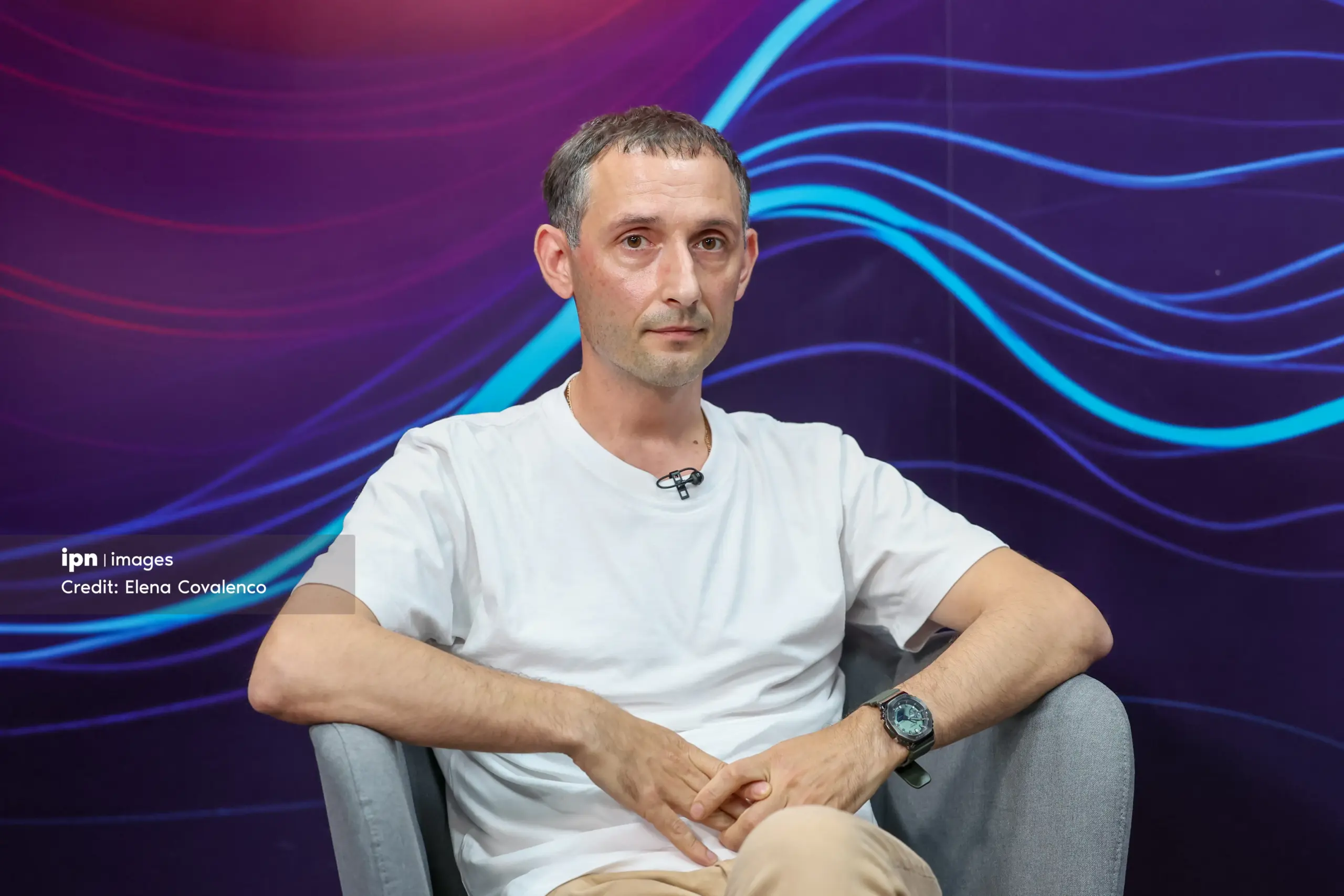
The Prut River is facing a decline in biodiversity, caused by climate change, pollution, and the degradation of natural habitats, even though its water remains cleaner than that of the Nistru. In an interview for IPN, the head of the Ichthyology and Aquaculture Laboratory of the Zoology Institute at the State University of Moldova, Dumitru Bulat, warned that without urgent conservation measures, biodiversity will continue to be affected.
Recently, there has been a lot of talk about the Dniester River and the situation there, but we have forgotten that on the other side of the Republic of Moldova, we have another river – the Prut River. Mr. Bulat, what is the state of the Prut River? Have there been visible changes in recent years?
Of course, I have been active in the field for over 20 years and I see these changes very clearly. They are evident and, certainly, they are not for the better, meaning we have a negative dynamic, related to biodiversity and, generally, the ecological state of this river. Among the factors that have specifically influenced the state of the Prut River ecosystem, we mention climate change, pollution, overexploitation, as well as ecosystem fragmentation and invasive species.
Invasive species that have invaded the ecosystem, generally, if we talk about the entire ecosystem of the Prut river basin. We must not forget that the Prut River is the second largest river flowing through the territory of the Republic of Moldova and, of course, it is very important for the ecosystem services it provides to people.

Speaking of climate change, we are now in a heatwave period, how much can this influence rivers in general and the Prut river in particular?
You may have noticed that climate changes are not only expressed through rising temperatures. We are talking, in particular, about extreme phenomena: prolonged droughts, high temperatures that can be followed by catastrophic rains and floods. We are now in a period of extreme temperatures. Of course, in these situations there is stress for hydrobionts, because, with the increase in temperatures, the concentration of oxygen in the water decreases. Anaerobic decomposition processes also occur, with the release of toxic gases, and all these phenomena ultimately lead to the death of living creatures.
More than that, high temperatures lead to increased evaporation and the drying out of ecosystems. We are talking about ecosystems such as lakes, ponds, and marshes, and this phenomenon is, of course, increasingly evident lately, especially when we see almost completely dried up stagnant water lakes everywhere. However, we were lucky this spring, as there were quite abundant precipitations, and thanks to this, the situation was somewhat more favorable.
You mentioned invasive species earlier. In older research that I have consulted, it is shown that new species of fish appear in the Prut River. Is this phenomenon still current? Is it a sign that the ecosystem is adapting or, on the contrary, an alarm signal regarding an ecological imbalance?
To tell you the truth, the Prut River, in general, is characterized by an ichthyofauna, if we talk about fish – I am a fish specialist – not as rich as that of the Dniester River. However, the ichthyofauna is special, as we have endemic species, that is, species found only in the Danube River basin. We know that the Prut River is a tributary of the Danube River. Many species have a rarity status, and lately we observe the decline of the populations of many endemic species, which are included in the Red Book, against the backdrop of the biological progress of invasive, allochthonous species.
If I were to give you examples of invasive alien species that have reached us, it would be the Japanese freshwater shrimp. Recently, it has become very widespread. Just two weeks ago, I was in the field and set up our fishing gear, which got filled with shrimp. They are quite aggressive species, consuming fish eggs and other hydrobionts, meaning we’re talking about zooplankton, which serves as the trophic base for fish.
Also, the Chinese mitten crab, which is part of the Chinese complex, has now invaded the Prut River and we can say it is an invasive species. And many, many other species, for example, Corbicula, an invasive mollusk. In the context of climate change, when we see a rise in temperatures, species of southern origin are slowly, slowly advancing north and already occupying new territories.
How can we intervene to improve the situation?
If we talk about human intervention, we have reached such a situation where we must realize that nature can no longer do without us. It has reached such a critical situation that it needs human help. And here it is important to approach this issue from the perspective of the “One Health” concept.
We will be healthy if the ecosystem is healthy, and nature will be healthy if we intervene and restore these ecosystems. First and foremost, it’s about attitude – the attitude towards nature. We need to be careful with nature.
Secondly, we are talking about legislation, about tightening sanctions for illegal activities. Thirdly, we are discussing the protection of territories and the declaration of state-protected natural areas. All these activities are important. The Prut is a bordering ecosystem and there needs to be more efficient collaboration between the Romanian side and the Republic of Moldova, even when we are talking about fish species.
I don’t quite agree with the situation where we ban commercial fishing in the Prut River, while on the other side, this commercial fishing is allowed. If we ban it, then we ban it on both sides. If we allow it, then we allow it under the condition of strict monitoring. This is very important.

Who should manage this situation? Is there currently a collaboration with the authorities across the Prut? What is the level of these relations?
Collaboration is happening, but not as it should be. We have collaboration agreements and, considering that their legal power is much greater compared to that of the laws, we should, of course, together with the Romanian side, establish annual fishing ban periods, not for each party to separately set this period.
We need to carry out joint control raids. Why not? The inspectorates should have joint teams that monitor the Prut river along its entire length. And, of course, in this case, we’re talking about attitude. Because, if each of us is more careful, of course, the Prut river will be cleaner. Because the Prut river has numerous tributaries, I want you to know very well.
And, unfortunately, in our case, water supply systems, aqueducts, yes, are being built, but not the sewage systems. Thus, many households throw their waste where? Into the ravine.
From the rapids, these flow into tributaries, the tributaries flow into the Prut River, and the Prut River becomes increasingly polluted. This pollution has been observed recently. However, when talking about water quality, it is much superior to that of the Dniester River. And you really shouldn’t be alarmed by the fact that it’s murkier.
These suspensions, on the contrary, serve as nuclei for the adsorption of pollutants and, in one way or another, even contribute to maintaining the quality of water.
Which are the most polluted and affected areas?
The Prut, I tell you, is not in such an unfavorable ecological state as the Dniester River. Firstly, it is not fragmented to the same extent as the Dniester River, with only the Costești dam existing. We do not have major sources of pollution, only certain unauthorized waste deposits that can be found in the major bed of the Prut. I have observed numerous such cases.
I do not know, of course, what is happening in the tributaries, because, in fact, in ecology, small rivers should serve as the kidneys of the large rivers into which they flow. But we have reached the situation where, on the contrary, they pollute the large rivers, and this fact is very, very regrettable.
Major sources of pollution in the Prut River, as we mentioned, we do not have. There are certain issues, and in the confluence area it has been found that certain environmental gradients have exceeded the normative values. But, in general, we are talking about a good class of water quality.
If we talk about fish, indeed, the fish from the natural ecosystems of the Prut River is the most recommended for consumption, because it is a clean fish, and from the point of view of heavy metal concentrations, persistent organic pollutants and, at the same time, from the point of view of bacterial, viral and parasitic diseases, it is a fairly healthy ecosystem, with very clean and tasty fish.

How much does the Costești-Stânca reservoir influence the life of the river? What effects does it have on fish migration and on the flow regime?
Costești-Stânca is a reservoir and, by volume, it is the largest reservoir on the territory of the Republic of Moldova. Of course, it has certain functions, which are very important for humans, but at the same time, it also has negative consequences on the fauna of the Prut River, because it is, in fact, a dam, and upstream of the dam a water accumulation forms. Naturally, those spring floods, which should exist, we no longer have them.
Afterwards, you know very well that for fish to reproduce, most species need to reach the flood zones. If the water is held upstream, these flood zones often cease to function, so what do the fish do then? Fish no longer lay their eggs or, if the eggs are laid, due to the dam the water level can drop suddenly, and they end up on dry land and, of course, are subject to dehydration.
We had, in the Prut River, over 33 thousand hectares of wetlands that fulfilled very important roles, numerous ecological functions. Now, many of these wetlands are dried up and these functions are lost.
Poaching – is it a problem or not?
I tell you honestly, poaching is a big problem, but it’s not as big as many say, in the sense that it alone does not determine the total degradation of fishery resources. There are several factors. However, it is a big problem, because, in the case of poaching, what is the aim? To extract the large-sized fish, that is, the best breeders. Large mesh nets are used and many species, even the same sturgeons, the sturgeons with black roe, reproduce late, at seven, eight or even up to 18 years old.
And they don’t even have the chance to reproduce once and they’re already being fished, do you understand? In this case, the potential for self-reproduction decreases. From this point of view, poaching has very negative effects on the populations of strategy species, that is, on large-sized species.
In the given case, poaching must be more severely sanctioned. Because there was a case, I tell you honestly, I received a letter stating that two people were detained with two bags of fish, large carp breeders. There, if we talk about biomass, the biomass is very large, but the number of specimens is very small. And when we calculate the damage, we calculate it for each specimen. And then a damage results that does not seem so great, but the damage to nature is enormous, because a carp, for example, of 6-7 kilograms, can have over a million eggs. Can you imagine how many offspring can come from a million eggs and can, furthermore, perpetuate and continue the life cycle.
So should the law somehow be revised in this regard?
Yes, I believe it should be revised, because our Penal Code, in article 234, only stipulates the use of mass destruction means. Here we are talking about electric fishing, for example, about explosives and toxic substances, and it does not specifically provide for other fishing tools that are not considered means of mass destruction.
Because the concept of mass annihilation implies precisely this indiscriminate effect. It destroys zooplankton, phytoplankton, and zoobenthos alike. And when nets are used, it is not considered to be fishing by means of mass annihilation.
Although a lot of fish can be extracted and the damage can be very significant. In this case, we need to introduce certain changes, so that we can hold accountable and discourage such actions, I am referring to criminal liability, including imprisonment.

You mentioned wetlands earlier. We have Lake Beleu, in the south of the Republic of Moldova. What is its current state?
Beleu Lake is a natural lake. Of course, its condition is very degraded at present, as there are years when it completely dries up. And then we can no longer talk about certain ecological functions, even though this lake is very important for fish reproduction.
These degradations did not occur now, but much earlier. That Manolescu gully was dug because Lake Beleu, in fact, is fed by water from the Danube. When the water level in the Danube rises, the water penetrates against the current and does not bring suspensions. Since the Manolescu gully was built, the water comes from the Prut with suspensions and the silting becomes more and more intense.
Lake Beleu is, in fact, mired. The layer of mud can reach 2-3 or even 4 meters, while the layer of water can sometimes be only 20-30 centimeters. Under these conditions, in the summer, even when there is water, it is very warm.
The water becomes unbearable for most hydrobionts. If we talk about ichthyofauna, we only have 3-4 dominant species. However, I mention once again that, during the spring, when we are very lucky that the water reaches Lake Beleu, many rare species come and reproduce here. For example, the rizeafca. In 2012, for the first time, I saw the mass migration of the rizeafca in Lake Beleu. It is a species closely related to the Danube herring. The Romanian side asked me how this is possible, because their species is already in some decline.
Here, however, it has found favorable places for reproduction, as it can reproduce not only in the water current, like the Danube herring, but can also lay its eggs even on vegetation. Therefore, it is a species that has found very favorable conditions for reproduction here.
Moreover, in Lake Beleu, during the high water period of spring, numerous other species penetrate, including large-sized species and species included in the Red Book. Also, you have seen that Lake Beleu has a very rich avifauna, that is, a large diversity of birds, and it should be better protected, because, after all, illegal fishing and other illegal activities are observed.
But do you know what the situation is? We should not blame, I know, the lake administration, because our people, especially those living near the Prut river, consider this river to be theirs. And, if their father, grandfather or great-grandfather fished with a net, they believe they have the same right to fish in the same way. There needs to be better communication between the control authorities and the locals, of course.
What other solutions would be necessary to improve things?
Ecological reconstruction projects of riparian ecosystems are necessary. Activities to popularize ecological education are needed. People need to know because, indeed, when they see us collecting household waste from the roadside, from around aquatic ecosystems, all of these, in the end, end up in the water.
And we, unconsciously, do not realize that, afterwards, we use this water for irrigation, for drinking water, for example, the water from the Nistru, which reaches the treatment station, and then we use it for consumption. That’s why people’s attitude towards nature is also very important.

That area is also a tourist attraction. How do we ensure that, on the one hand, we promote tourism and have people who come and discover those places, and, on the other hand, we protect the nature there?
Tourism, especially ecotourism, is very important, I believe, because through ecotourism, we popularize the beauty that the Republic of Moldova has to offer. And the Republic of Moldova is truly a beautiful country. Specifically, when you realize what beauty you have, of course, you need to understand what to do with this beauty.
And there is a maxim that says we have borrowed nature from our ancestors to pass it on to our descendants in the same state. And these things, of course, are very important.
Mr. Bulat, I thank you very much for this discussion!
Thank you too!
Irina Botu, IPN
This journalistic material was prepared by the IPN Press Agency, within the Small Grants Program for Media “Community Journalism for a Healthy Environment and Green Justice”, carried out within the project “Green Justice for a Protected Environment and Sustainable Communities in the Republic of Moldova”, implemented by AO EcoContact, with the support of Sweden. The content of this journalistic material is the sole responsibility of the authors and does not necessarily reflect the views of EcoContact or the donor.
