

If parliamentary elections were held next Sunday, the Action and Solidarity Party, the Patriotic Bloc, and the Our Party Political Party would enter the legislature, according to a poll presented by the WatchDog.md community and the CBS Research Sociological Research Center. Of the total number of respondents, almost 30% said they would vote for PAS, just over 13% for the Patriotic Bloc, and 7.5% for PPPN. The other parties would not pass the electoral threshold. At the same time, about 27% of those interviewed said they did not know who they would vote for, almost 7% did not answer, and 5.5% said they would not vote for any candidate.
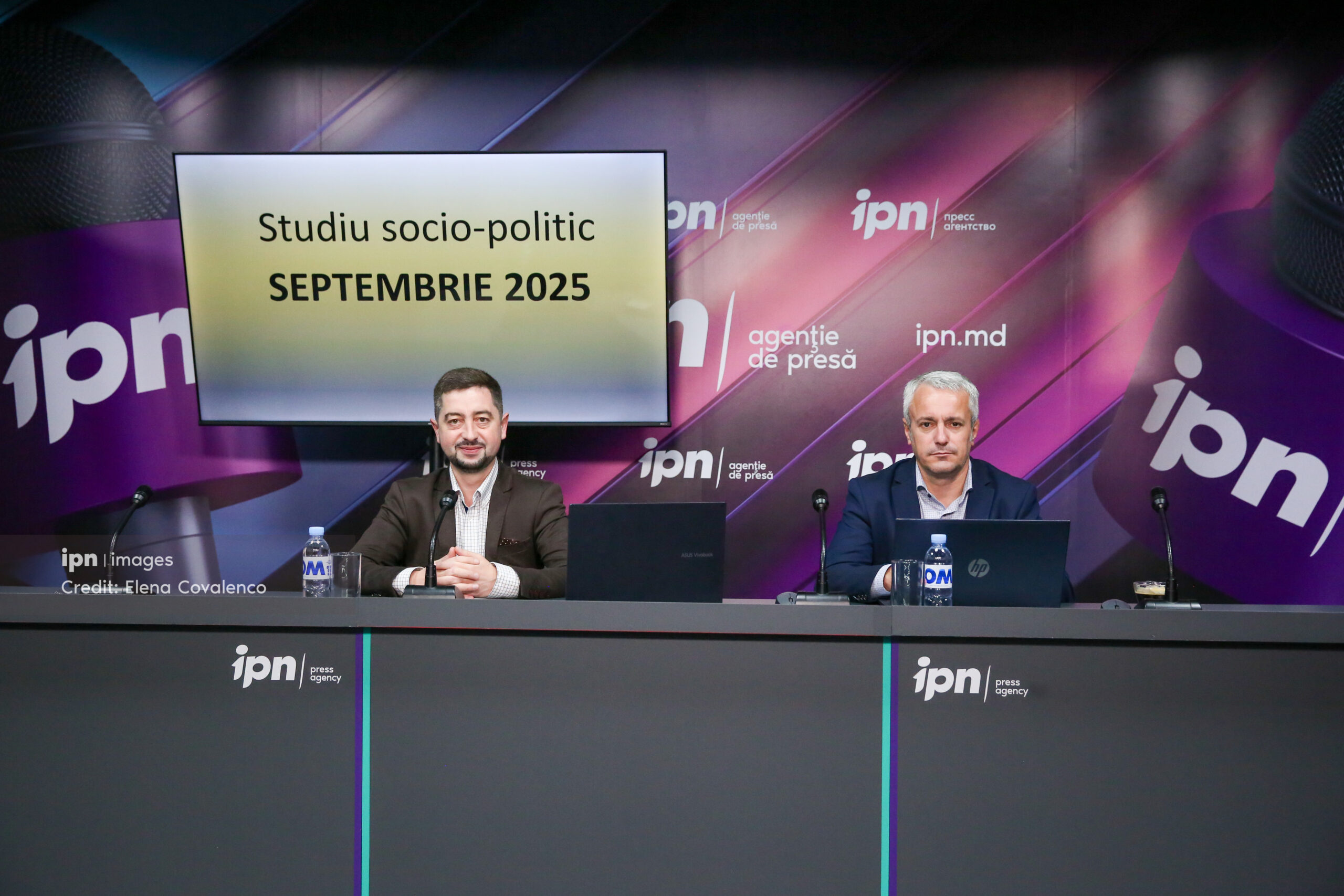
Presenting the survey results at a press conference at IPN, the president of the WatchDog.MD community, Valeriu Pasa, specified that the data had been adjusted based on a mathematical model that takes into account the distribution of undecided votes.
The modeling of the vote, based on respondents who have a high probability of participating in the elections and who have declared their electoral option, offers a slightly different picture. “In first place would be PAS with about 38.8%. In second place would be the Patriotic Bloc, with almost 27%, and in third place, Our Party, which would accumulate just over 14%”, explains Valeriu Pasa.
According to him, support for PAS has remained relatively stable, around 30%, over the past year. On the other hand, the Patriotic Bloc – officially called the Patriotic Electoral Bloc of Socialists, Communists, Hearts, and the Future of Moldova – has gained ground after several formations have united under the same electoral umbrella. Our Party, led by Renato Usatii, has registered the most significant increase in recent months.
Sociologist Vasile Cantarji, from CBS Research, emphasized that the presented model offers higher scores for opposition parties compared to the raw poll numbers. “We warn that the model favors formations such as the Patriotic Bloc and Our Party, assigning them significantly higher scores than those directly resulting from the poll data,” he explained.
The study highlights a relatively high level of voter turnout, with nearly 70% of citizens stating they are sure they will go to the polls. However, over a quarter of respondents remain undecided, and, according to the authors of the survey, this uncertainty could influence the final outcome of the elections.
The survey was conducted between September 6-13 on a sample of 1,127 people, through face-to-face interviews. The margin of error is ± 2.9%.
The sociological research was conducted by CBS Research, commissioned by the WatchDog.MD Community, within the project “Support for Combating FIMI in the context of elections in the Republic of Moldova”. The project is funded by the Ministry of Foreign Affairs of Estonia.
Disclaimer: This material is produced as part of a project implemented by the IPN Press Agency – “Integration through Cooperation and Information” and is funded by the Department for Relations with the Republic of Moldova. The content of this publication does not represent the official position of the Department for Relations with the Republic of Moldova.