




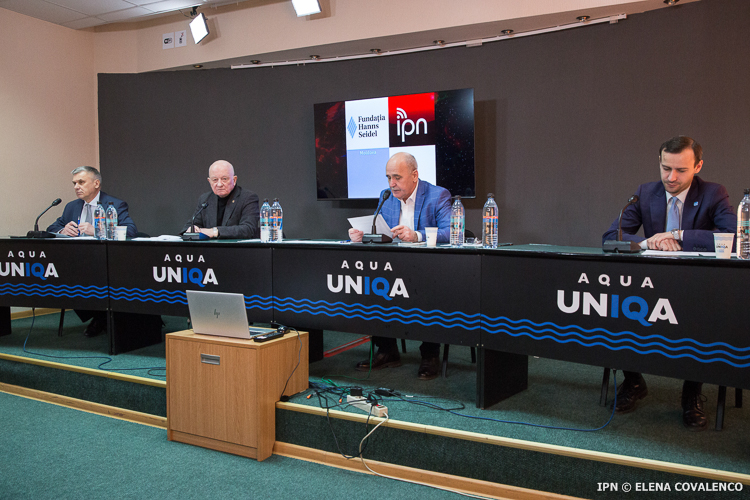
It will be soon a year of the start of the Russian Federation’s war of aggression against neighboring Ukraine. It has been a year of harsh war, with hundreds of thousands of killed and injured people, including civilians and children, millions of refugees, internally displayed people and people deported to foreign places, tens and hundreds of localities that were fully or partially destroyed, critical infrastructure damaged on a large part of the territory of Ukraine, which left other millions of people without elementary living conditions in the winter: without electrical energy, heat, drinking water and food. This happened during a year alone, several tens or hundreds of kilometers away from the Republic of Moldova and this surely dramatically and dangerously influenced the life of people in the Republic of Moldova as well. Experts invited to IPN’s public debate “The Republic of Moldova in a year of the outbreak of Russia’s war of aggression against Ukraine: challenges, opportunities, solutions” discussed how the people in Moldova coped in the period and what role the political class in general and the government and political opposition in particular played, what changes occurred in the mentality and behavior of Moldova society, if such occurred.
Igor Boțan, the permanent expert of IPN’s project, said the Resolution of the UN General Assembly of March 2, 2022 described the war in Ukraine as unprovoked aggression by the Russian Federation against Ukraine. “If we speak about the status of the Republic of Moldova in these circumstances, I would name this exceptional status as the country is primarily governed by a commission for exceptional situation and we for about a year have lived under the state of emergency,” said the expert.
In accordance with the law, the state of emergency is a set of political, economic, social and public order maintenance measures taken in some of the localities or all over the country. “There is a suitable legal framework for this state of emergency. It was developed in time and was adjusted during the COVID-19 pandemic based on the Venice Commission’s recommendations of April 15, 2020. From this viewpoint, we can say that the Republic of Moldova’s legislation on the state of emergency was adjusted to the highest standards. If the nonstop extension of this state of emergency is justified or not is yet another issue,” stated Igor Boțan.
According to him, missiles launched by Russia against Ukraine fell for three times on Moldova’s territory and this can be an explanation for the prolongation of the state of emergency. The law provides that the CES also agrees the special regime for using Moldova’s airspace. “This is one of the main justifications for the extension of this state of emergency,” said the expert.
Oazu Nantoi, MP of the Party of Action and Solidarity, said the day of February 24, 2022 was preceded by a series of events, moves and statements. For example, the Moscow paper Kommersant in April 2008 published an article saying that “if Ukraine will one day try to join the North Atlantic Alliance, it will remain without important territories”. “We all know that in Russia there is now no opposition press, no alternative press and no free press and nothing appears accidentally on the websites of official news agencies. On April 3 last year, there was published an article entitled “How should Russia act towards Ukraine”. This clearly says that the Russian Federation should apply a genocide policy against Ukrainian ethics who consider themselves Ukrainians and should raze to the ground the Ukrainian state,” he said.
According to the MP, the frontal aggression against Ukraine was preceded by shocking diplomatic moves. On December 15, 2021, the Ministry of Foreign Affairs of Russia that, in his opinion, long ago turned into a propaganda ministry, issued two ultimatums by which the United States and NATO were asked to return to the status quo of 1997. It was ascertained at European level too that Russia’s aggression against Ukraine started in February 2014.
“What we saw last February was massive aggression. The aggression moved to another phase. This aggression is aimed at liquidating the Ukrainian state at least. Yes, we can speak here about the failures of the regime of Putin, about the change of tactic, strategy, but today I saw the news item of the Institute for the Study of War, which says that Russia took over the strategic initiative in Luhansk region and launched an offensive. Ukraine fights back. To be sincere and realistic, Russia keeps the advantage in terms of cannon fodder,” said the MP
According to Oazu Nantoi, the Moldovan authorities since 2020-2021 have followed the situation in Ukraine with concern. “We then saw that the existence of Ukraine as a sovereign state is unacceptable for the regime and a massive provocation was expected,” he stated.
The chairman of the Party “Dignity and Truth Platform” Dinu Plîngău said the Republic of Moldova is in a very difficult situation. Many of the developments are related to the war in Ukraine. Besides the devastating economic impact on Moldovan society, a lot of human capital has been lost since the war broke out.
“As regards the refugee crisis, I think our authorities haven’t made sufficient effort. A lot of the accomplishments, including the foreign level ones of which those from the government boasted, are due to the extraordinary, exceptional mobilization of the citizens of the Republic of Moldova. You remember the thousands of citizens who stayed in customs posts with products, placards by which they offered accommodation. An extraordinary effort was also made by mayors and business entities to whom particular concessions were promised, but some of the promises weren’t fulfilled regrettably. Bu I realize it was a very difficult satiation for the authorities too. The human resources were dramatically insufficient,” stated Dinu Plîngău.
According to him, the integration of these persons into Moldovan society was one of the next challenges. As the Ukrainians know Russian, which is used in Moldova, and there are resemblances in mentality, the Ukrainians could find work here. Besides the human capital, there is also the economic one. Money came to the country together with many of these people. “Appropriate mechanisms should be identified to use the human capital and the financial resources that came to the Republic of Moldova. For example, concessions can be offered to legalize this capital and to invest in particular businesses. A lot of people who earlier ran businesses worth millions in Ukraine, hundreds of employee or experts with extraordinary skills came here, but their capacities are not appropriately used here. We can gain and they also can gain,” noted Dinu Plângă.
The public debate entitled “The Republic of Moldova in a year of the outbreak of Russia’s war of aggression against Ukraine: challenges, opportunities, solutions” was the 272nd installment of IPN’s project “Developing Political Culture through Public Debates” that is supported by the Hanns Seidel Foundation.
- Bad side and good side of Russian embargoes. IPN debate
- Virgiliu Bîrlădeanu: Russia uses historical memory as an instrument of informational warfare
- 1918 Union: why was it necessary, why was it possible? IPN debate
- Europe’s security at a historic crossroads. What is Moldova’s place? IPN debates
- Signs of reasoning in Moldovan politics? Analysis by Valeriu Vasilică
- “Dangers of new “spheres of influence” for Moldova, Ukraine and the EU”. IPN debate
- Collusion No.2: Tiraspol cannot accept EU-Moldova conditions. Analysis-prediction by Valeriu Vasilică
- Which side of curtain will Moldova be on after new division of the world? Analysis by Valeriu Vasilică
- Participation of Transnistrians in elections: between benefit and danger. Analysis by Valeriu Vasilica
- “Fish tail” of crisis in eastern region of Moldova. IPN debate
- The Moscow-Tiraspol collusion will continue ‘until the end’. Analysis by Valeriu Vasilică
- What do Russian fabrications bank on? What does Chisinau respond with? IPN debate
- Three fundamental myths sustaining the URSS: IPN debates
- Contemporary danger of mythologization of 1812. IPN debate
- Gas for Transnistrian region as a national security issue. IPN debate
- Russian factor in Transnistrian conflict: past, present and future. IPN debate
- Fate of Ukrainian children deported to Russia following the Hague Tribunal’s decision. IPN debate
- Double tragedy of refugees of 1940 and 1944. IPN debate
- Russia’s interference in choice of Moldova: goals, manifestations, effects
- What is “Shor phenomenon” based on? IPN debate
- Wellbeing of population is a priority for presidential candidates. IPN electoral debate
- Presidential candidates promise to ensure peace and security in Moldova. IPN electoral debate
- Natalia Morari: I will continue European path of Moldova, but I will not deal with “Euro-imitation”
- 100 years under sign of MASSR. IPN debate
- Composition of IPN electoral debates involving candidates decided
- War, Religion and Church. IPN debate
- Golgotha of the Romanian Language. IPN debate
- Moldova from Ribbentrop-Molotov to Independence. IPN debate
- From division to radicalization? IPN debate
- Effects of Iasi-Chisinau Operation 80 years later. IPN Debate
- Curse of frozen conflicts and their solutions. IPN debate
- How can small countries defend themselves? IPN debate
- War crimes: reasons and consequences. IPN Debate
- What safeguards are needed against election fraud? IPN debate
- Day of June 28, 1940 between celebration and catastrophe. IPN Debate
- Decapitation and uprooting of nation through deportations. IPN Debate
- Treason in legislation and in life. IPN debate
- What interests does “struggle for peace” hide in wartime? IPN debate
- Festive practices and identity engineering in (post)totalitarian regimes. IPN debate
- Why do Moldovans leave? Under what conditions can they return? IPN debates
- Why is a defense agreement with EU necessary? IPN debate
- EU enlargement after collapse of USSR: causes and effects. Moldova’s lesson. IPN debate
- Political mythologies in history and in actuality. IPN debate
- Natalia Stercul: Our civilizational choice is Europe
- How Russia and Romania defend their citizens abroad. IPN debate
- Consequences of Union and of “Reunion-Vossoedinenie”. Comparative analysis, Part II. IPN debate
- Consequences of Union and of “Reunion-Vossoedinenie”. Comparative analysis, part I. IPN debate
- Postal voting: pros and cons. IPN debate
- Long path home of the Romanian language. IPN debate
- Why is Treaty on Conventional Armed Forces suspended? IPN debate
- Human resources crisis and salary system within CPA and LPA. Research. IPN debate
- What traces “two years of decisive steps on European path” have left. IPN debate
- 32 years of an unfinished war. IPN debate
- The war that blew up the World. IPN debates
- History, an international antidote to political repression. IPN debate
- Role of history in forming person and modernizing society. IPN debate
- Moldova’s neutrality between advantages, risks and dangers. IPN debate
- GULAG phenomenon: genesis, manifestation, lessons. IPN debate
- Failure of Budapest Memorandum. IPN debate
- War and Peace in 2024. IPN debate
- Consensus and rivalry in pro-EU referendum. IPN debate
- Frozen conflicts: genesis, dangers, settlement. IPN debate
- What do farmers want? What can Government do? IPN debate
- Possible scenarios for European Council’s decision about Moldova. IPN debate
- Stalinist repression in MASSR and memory of victims of totalitarian communist regime. IPN debate
- Great Union of 1918: lessons for past, present and future. IPN debate
- Collapse of Constituent Assembly and of chance to democratize Soviet Russia. Effects on country and world. IPN debate
- European genealogy tree of Moldova. IPN debate
- Nonlocal stakes of local elections. IPN debate
- Humankind between Terrorism, Compassion and Interests. IPN debate
- Lessons of Cold War. IPN debate
- Harshness of law and “teeth” of democracy in elections. IPN debate
- Country’s security: dangers, solutions, novelties. IPN debate
- War in Israel: What is it and what should we expect? IPN debate
- Warsaw Pact: History without propaganda. IPN debate
- Temporary protection for displaced persons from Ukraine. IPN debate
- NATO: History without propaganda. IPN debate
- Truth and lie about beginning of World War II. IPN debate
- Moldova between Ukraine and Russia. IPN debate
- Chances of Romanian language and of Moldova society. IPN debate
- Price and effects of Independence. Comparative study (1877 vs. 1991. IPN debate
- USSR: Born and Destroyed by Putsches. IPN debate
- Amalgamation of localities as necessity, process and goal. IPN debate
- Diplomatic parity and its price. IPN debate
- Parties between rights, responsibilities and unconstitutionality. IPN debate
- NATO Summit: Impact on Ukraine and Moldova. IPN debate
- Stalinization and de-Stalinization of Moldovan society. IPN debate
- Difficulties in providing temporary protection to Ukrainian refugees. How can they be overcome? IPN debate
- Stalinization and de-Stalinization in European context. IPN debate
- What can Moldova gain from Connecting Europe Facility if…? IPN debate
- Kakhovka Dam: Why are laws and customs of war powerless? IPN debate
- “Stalinist deportations: echo of the past, for present and future”. IPN debate
- “EPC Summit to everyone’s understanding”. IPN interview with political pundit Igor Boțan
- Igor Boțan about messages of EPC Summit: Wellbeing cannot exist without security and security cannot exist without unity
- Victory Day: between reconciliation, antagonization and destabilization? IPN debate
- Moldova at a crossroads: EU and its alternative. IPN debate
- Organized famine of 1946-1947: victims, murderers, memory. IPN debate
- What do Fascism, Nazism and Stalinism have in common? IPN debate
- Poverty in Moldova: social, political and geopolitical dangers, IPN debate
- “Moldovan-Russian relations amidst war”. IPN debate
- Pogrom of 1903: executioners, victims and lessons. IPN debate
- Hybrid warfare: manifestations, dangers, solutions. IPN debate
- New Russian foreign policy concept and its impact on Moldova. IPN debate
- Fate of peripheries of empires. Quo vadis, Moldova? IPN debate
- Union of 1918: what was it, why was it and for what? IPN debate
- Arrest warrant for Putin: effects for Russia, Ukraine, Moldova and Europe. IPN debate
- Alignment with EU sanctions against Russia: reasons and risks. IPN debate
- Bessarabians’ civilizational drama of 1940-1941. IPN debate
- Partial withdrawal from CIS agreements: Reasons and effects. IPN debate
- What did we celebrate and why did we celebrate on February 23? IPN debate
- The War and the Planet. IPN debate
- New Government’s capacity to select priorities and to cope with them. IPN debate
- Replacement of Government: reasons and expectations. IPN debate
- Implementation mechanisms and possible effects of new anti-separatism legislation. IPN debate
- Common roots of USSR’s war against Afghanistan and of Russia’s war against Ukraine. IPN debate
- Common roots of World War II and of Russia’s aggression against Ukraine. IPN debate
- Why and how did USSR disappear? Why does it cause nostalgia yet? IPN debate
- Why did USSR appear and how did it work? Why does it cause nostalgia yet? IPN debate
- Budgetary-fiscal policy and budget for 2023: form and content in approach. IPN debate
- Evolution of Russia’s aggression against Ukraine and its influence on nostalgia for USSR. IPN debate
- Moldova for first time at NATO Summit: motives and effects. IPN debate
- Subsidies in times of crisis. Could these be higher? Who could offer more, from what sources and at what cost? IPN debate
- Unconstitutionality of parties under rule of law: legality, benefits, risks. IPN debate
- Chisinau-Tiraspol relationship amid worsening crises: new opportunities and dangers. IPN debate
- How did U.S. authorities reach decision to impose sanctions? What are possible reactions and consequences? IPN debate
- Final stage of World War II: reality and myths about USSR’s and Anti-Hitler Alliance’s contribution. IPN debate
- USSR’s participation in World War II: about real victories and defeats, about what propaganda does not say, about what myths and nostalgia reveal. IPN debate
- Who started World War II and why? Propaganda myths as source of nostalgia for USSR. IPN debate
- Antigovernment protests: motives, demands, players, actions and effects. IPN debate
- Valentin Constantinov: Dictators care only about personal power. IPN interview
- About Moldovan state’s and society’s attitude to persons who flee from mobilization in Russia, with and without Moldovan nationality. IPN debate
- Nostalgia for military grandeur of USSR as explanation for approval of current invasions. IPN debate
- Basic human rights and freedoms in USSR: Myths and realities. IPN debate
- Why are the nostalgic wrong when they attribute role of demolisher of USSR to Mikhail Gorbachev? IPN debate
- How does Romanian function as an instrument for harmonizing social relations in Moldova? IPN debate
- Independent Moldova and its Transnistrian birthmark, IPN debate
- Moldovan Government in exile during 1991 Soviet Coup. IPN Debate
- Was famine of MSSR of 1946-1947 organized or not? Could and wanted Soviet authorities to prevent devastating effects of this? IPN debate
- Candidate status and irreversibility of European integration rely on society’s wish: What does this depend on in current conditions? IPN debate
- 100 years of USSR and 31 years without USSR: Nostalgia for Chimeras. IPN debate
- Bomb threats between dementia, infraction, terrorist act and (geo)politics. IPN debate
- EU candidate status in times of cumulative, internal and external crises. IPN debate
- Merger of universities: arguments for and against. IPN debates
- Why was Moldova granted candidate status? When and in what conditions can it become fully-fledged member of EU? IPN debate
- State of justice sector reform on granting of EU candidate status: Conception, practical actions, effects, general perception. IPN debate
- Public transport fares: between necessity, equity and interests, including political ones. IPN debate
- European Council Summit: “To be” or …”to be” for Ukraine, Georgia and Moldova? What can decision be based on? IPN debate
- Facets of food crisis in Moldova and the word. IPN debate
- Socially responsible management of foreign assistance: mechanisms, guarantees, efficiency. IPN debate
- Roles and responsibilities of culture in times of war. IPN debate
- Prices and inflation from political, economic and social angles. IPN debate
- Why did all empires disappear, why didn’t any of them revive? IPN debate
- What are reasons and character of Russo-Ukrainian war? What do they tell Moldova about? IPN debate
- How did Moldova reach G7 Summit and what it should do to take foreign opportunities? IPN debate
- Moldovan-Ukrainian and Moldovan-Russian relations in time and before war. IPN debate
- What does it mean, why is it necessary and who is bothered by additional military support provided by EU? IPN debate
- Ukrainian refugees: 75 days of peaceful coexistence in Moldova during war in their homeland. IPN debate
- Significance of Low Sunday and May 9: Affinities, dissimilarities and specific features in times of war. IPN debate
- Real situation and Moldovan society’s reaction to provocations around Transnistrian region. IPN debate
- Associated Trio in new conditions: together and on their own. IPN debate
- Independent press in Moldova: after extensive sanitary crisis and during war. IPN debate
- Stop war! Stop… war movies! IPN debate
- EU Questionnaire: What it offers and what is asks instead, how are chances assessed inside and outside? IPN debate
- Dilemma of Moldovan fruit exports: to the East and/or to the West? IPN debate
- About state of spirit of nation during states of emergency and war. IPN debate
- Yoshihiro Katayama: Japanese assistance programs have expanded in almost all areas of Moldovan socioeconomic life. IPN Interview
- Republic of Moldova will buy gas through EU: What does this mean? IPN debate
- Western sanctions against Russia: reasons, effects, Moldova’s position. IPN debate
- Opportunities and risks of PACE’s position on Transnistrian region. IPN debate
- Benefits and risks of resumption of fruit exports to Russia. Analysis by Valeriu Vasilică
- Who approves of war and why? IPN debate
- Status of neutrality: Legislative and political reflections with flame of war nearby. IPN debate
- Refugees: Ukrainian exam for Moldovan society’s resilience. IPN debate
- Stop war!… and movies about war. Accounts by Valeriu Vasilică
- Position and actions of Moldova in new security conditions. IPN debate
- Benedetto Della Vedova: We start from excellent relations so as to create new spaces for rapprochement
- Ukraine’s requests to the West vs Moscow’s scenarios. IPN debate
- After Russia, a part of Moldova also attacks U.S. or Homeland is sold only cheaply! Analysis by Valeriu Vasilică
- Litmus test of case of turncoat MPs. Analysis by Valeriu Vasilică
- Association ‘from the Moon’ of Judges of Moldova. Analysis by Valeriu Vasilică
- Corruption fighting in Moldova: between objectives, processes and effects. IPN debate
- Ukraine as end goal or as starting point? Place reserved for Moldova. IPN debate
- Behavior and interests in energy crisis: government, opposition and society. IPN debate
- New Omicron variant: inheritance of 2021 for 2022. What should we do with it? IPN debate
- Venice Commission’s Opinion: signal of alarm about state of rule of law or call to improve democratic processes? IPN debate
- Germany has new government: Impact on situation in EaP and in Moldova. IPN Debate
- Elections in Bălti: between justice and politics, between lawfulness and surprises. IPN debate
- Thirty years without USSR: Why did it disappear, why is it still alive? IPN debate
- Chromatic scale of Moldovan-Russian and Moldovan-Romanian relations. IPN debate
- Migrant crisis in Belarus: reasons, dangers, solutions. IPN debate
- Shock of rates and government’s remedies for diminishing its impact on population. IPN debate
- Energy security of EU and Moldova: reciprocal lessons. IPN debates
- 100 days of rule in government’s, opposition‘s and society’s view. IPN debate
- Return of Teleradio-Moldova under Parliament’s oversight. IPN debate
- What is government’s optimism about energy crisis based on? IPN debate
- Last Sunday’s protest: motives, eventual developments, benefits and risks. IPN debate
- About what new EU-Moldova dialogue is, how it develops and what chances it has. IPN debate
- Pandemic as a divergent factor for Moldovan society. IPN debate
- Dangers to democracy in contemporary world: impact on the Republic of Moldova. IPN debate
- Government’s actions in relation to regulatory and inspection institutions. IPN debate
- Federal parliamentary election in Germany: possible effects for Germans, Europeans and Moldovans, IPN debate
- Independence-30: Subjective view on the state of the nation, IPN debate
- The burden of contradictory understanding of the problem of victims of totalitarian regimes, IPN debate
- The European Union’s mission is to generate stability. IPN debate
- Government was invested: What do we want? What can it do? IPN debate
- Snap elections 2021: What happened, what can happen at foreign level? IPN debate
- Snap elections 2021: What happened, what can happen at internal level? IPN debate
- A different Moldova, stop-genocide and life in Greater Romania. Promises of candidates in last electoral debate of IPN
- Economic development and democratic recovery. Promises of candidates in seventh electoral debate of IPN
- Voice of children in Parliament and “union” with Russia. Promises of candidates in sixth electoral debate of IPN
- For statehood and against all liars. Promises of candidates in fifth electoral debate of IPN
- Fight against corruption and emphasis on social sphere. Promises of candidates in fourth electoral debate of IPN
- Union with Romania, revitalization of Moldova and good times for country. Views of candidates at IPN’s third electoral debate
- Fight against underground economy and support for producers. Candidates’ promises in IPN’s second electoral debate
- Better life for all citizens and emphasis on ecology. Promises of candidates in IPN’s first electoral debates
- Role of the mass media in fighting disinformation. IPRE debate
- “Associated Trio” of Eastern Partnership. IPN debate
- Particularities of election campaign 2021: traditions and new tendencies. IPN debate
- Debunking of false electoral messages and counteracting of speech inciting division. IPN debate
- Attitude to the EU: objective reasons and political and geopolitical manipulations. IPN debate
- State of emergency in the country and at Constitutional Court: motives, players, solutions. IPN debate
- Constitutional Court’s judgment: what happened and what will happen in Moldova? IPN debate
- Alternative voting methods: benefits and risks, pros and cons. IPN debate
- “War” or “diplomacy” of vaccines in the world? Impact on Moldova”. IPN debate
- Virus or Second Person is a killer? Analysis by Valeriu Vasilică
- Components of political confrontation and impact of this on society. IPN debate
- Valeria Biagiotti: I invite you to become agents of change. Everyone should start from oneself
- State of emergency: for and against, health, economic and political aspects
- EU’s calculations in Ukraine, Georgia and Moldova –between political crisis, reforms and influence of Russia. IPN debate
- Polls and snap elections, electorate and change. IPN debate
- Transitional government, snap elections or impeachment: for and against, benefits and risks. IPN debate
- Overcoming of political crisis depends on PSRM and PAS. Why is communication between them blocked? IPN debate
- Tense relations between EU and Russia and impact on Moldova. IPN debate
- First attempt to vote in Government: What was it? IPN debates
- COVID-19 pandemic at a crossroads: Lessons learned and to be learned before vaccination. IPN debates
- Natalia Gavrilița: It is crucial to build the country based on a stable, uncorrupt and well-intentioned majority. IPN interview
- Reasons, components and consequences of restart of linguistic conflict. IPN debate
- Experts “translate” actions and statements of politicians concerning dissolution of Parliament. IPN debate
- What parliamentary parties think about snap elections, if they anticipate them? IPN debate
- Snap parliamentary elections: necessities, possibilities, interests. IPN debate
- What do farmers want? What does government want or does not want? IPN debate
- Situation in Parliament and the country – Where are we going? IPN debate
- Fluctuation of exchange rate, what it depends on and what we should know about it. IPN debate
- Reforming of Moldovan-Russian relations after presidential elections: problems, solutions, priorities. IPN debate
- Parliamentary elections in Romania: what Moldovans with Romanian nationality know about them and what they vote? IPN debate
- Why information resilience is needed and how it can be ensured. IPN debate
- “And in the Morning They Woke Up”. Aspects of state of society after presidential elections. IPN debate
- Strong and weak points of two finalists. IPN debate
- Election campaign in first and second rounds: affinities, differences, effects. IPN debate
- Split society and parallel worlds in elections in Moldova: causes and effects. IPN debate
- To Whom and to What voters of candidates who didn’t reach runoff migrate? IPN debate
- First round of presidential elections 2020: lessons learned and lessons to be learned. IPN debate
- About old and new faults of electoral process 2020 and of the press. IPN debate
- Ruth Huber: The new Swiss International Cooperation strategy confirms that Moldova remains a priority country. IPN interview
- Particularities of voting in Moldova’s regions. IPN debate
- We and President: who elects who, who represents who? IPN electoral debate
- Elections in times of pandemic: necessity, risks, scenarios, solutions. IPN debate
- Is isolation measure imposed on persons older than 63 discriminatory or not?
- Presidential elections in diaspora and geopolitics. IPN debate
- Who and what guarantee free and fair elections? IPN debate
- Stakes of presidential elections in view of political class and society. IPN debate
- Gas pipeline between politics, economy and chance to live better, IPN debate
- Presidency, President and presidential elections: processes, tendencies and effects. IPN debates
- Efficiency of Moldova’s COVID-19 crisis management discussed at ADEPT debate
- Situation in Belarus: mutual influences with world. IPN debate
- Two years of expulsion of Turkish teachers: lessons learned and lessons to be learned. IPN debate
- “Who is not afraid of COVID-19 and why?”. IPN debate
- Resistance to shock in Eastern Partnership – EU approach vs. NATO variant. IPN debate
- About quality of relationship with EU through angle of six, old and new conditions. IPN debate
- “COVID-19: Memories of the Future or what History teaches us?”. IPN debate
- How much and how Parliament worked for the people during spring-summer session? IPN debate
- Amendments to Election Code: advantages and risks to democracy. IPN debate
- Investigation of bank fraud: actions, perceptions, reasonable timeframes. IPN debate
- “Government”- Opposition, scoreline 1:1. Overtime or penalty shootout? IPN analysis
- Germany’s Presidency of Council of EU: impact on Europe, impact on Moldova. IPN debate
- Movement and place of Moldovans in Europe during and after pandemic: opportunities and risks. IPN debate
- “Political” criminal cases: protagonists, methods, goals, consequences. IPN debate
- Why doesn’t COVID-19 recede? Who should do and what should be done? IPN debate
- Voting of EU conditions: parliamentary majority’s twist? IPN debate
- Moldovan society amid pandemic: learned lessons, lessons to be learned. IPN debate
- Why was bank theft brought back into focus? IPN debate
- Mihai Murguleț: Reformation of justice sector depends on political will. IPN interview
- Government’s performance during six months since appointment and during two months of state of emergency: pros and cons. IPN debate
- Snap parliamentary elections and/or replacement of Government: probability, risks, benefits. IPN debate
- Political colors of international assistance in times of pandemic. IPN debate
- “Why wasn’t Constitutional Court heard in problem of presidential elections? IPN debate
- Constitutional Court swaying in political wind: norm or deviation? IPN debate
- Supporting business community: between economy and politics. IPN debate
- Desiree Jongsma: We are looking at the wider implications of COVID-19 for children and women. IPN interview
- Pandemic and Politics, barriers and chances of consensus. IPN debate
- Assumption of responsibility by Government: controversies, effects, solutions. IPN debate
- Mihail Cotorobai: “Coronavirus cannot annul human rights”. IPN interview
- Peter Michalko: “Together” is key word in new EU policies”. IPN interview
- Premier Chicu’s nerves on the edge?
- PSRM-PDM government coalition: necessities, possibilities, motives, impact. IPN debate
- Rescuing fissure of PDM. IPN analysis
- Chirtoacă, Cobzac and Postolachi about their stake vs. stake of voters in Hâncești. IPN debate
- Candidates of PDM, PAS and Shor Party about their stake and stake of voters in Hâncești. IPN debate
- Political or apolitical, party or common candidate for upcoming elections, why? IPN debate
- Military and geopolitical tensions in Middle East: impact on Moldova. IPN debate
- Ion Chicu: Our society is disappointed in institutions and future of this state
- Pavel Filip: Moldova follows yet an ascending path
- Maia Sandu: A better life means freedom and regime that respects human rights
- Andrei Năstase: PPPDA insisted on unity of pro-European forces
- Daniel Ioniță: Wherever there are Romanians living, there is also a small Romania … IPN interview
- Balanced foreign policy: capacities, advantages, risks. IPN debate
- Ion Manole: Political dialogue is very important and we will continue to encourage it, but we will insist that this dialogue definitely include real guarantees for the observance of human rights in Transnistria
- Valeria Biagiotti: There are certain things that make the Moldovan-Italian relations more special… IPN interview
- Technocratic and minority government as a solution: advantages and risks. IPN debates
- Initiative or Motion? Their reasons and effects. IPN analysis
- PSRM-ACUM: Sentenced to collaboration and destruction… IPN analysis
- Candidates Valeri Klimenco, Valeriu Munteanu, Vladimir Cebotari, Vitalie Marinuța, Andrei Năstase and Vladimir Țurcanu at IPN debates
- Candidates Dumitru Țîra, Ivan Diacov, Alexandru Fetescu, Victor Chironda, at IPN debates
- Candidates Serghei Toma, Vitalie Voznoi, Octavian Țîcu and Lilia Ranogaeț, at IPN debates
- Angela Ganninger: And it’s not true that things have been better before … IPN interview
- Characteristic features of the elections of October 20, 2019. IPN debates
- Relations between governance components: practice, expectations, challenges. IPN debates
- Nicu Popescu: We have a „deal” with the development partners, that’s shifted in time. IPN Interview
- Nicu Popescu: My ambition is that the Republic of Moldova will turn from recipient of assistance into donor
- Congratulations to the “holding”. Questions for Maia Sandu. IPN analysis”
- Summing up the results of the new Parliament first session: the good and the bad. IPN debates
- What did the MPs say and what did they mean to say during the last session? IPN analysis
- Why did Plahotniuc leave? Will he come back? IPN analysis
- Who is Ilan Shor afraid of? IPN analysis
- “Resetting of relations with EU: motives, chances, guarantees”. IPN debate
- Freeing Moldova from ‘Oligarchy’ and ‘State Capture’: Limits of Legality, IPN Debates
- Peaceful transfer of power: reasons, conditions and consequences – foreign factor. IPN debate
- Peaceful transfer of power: reasons, conditions and consequences – the domestic factor. IPN Debate
- Bartlomiej Zdaniuk: What connects us is the wish to be free. IPN interview
- Bartłomiej Zdaniuk: European integration doesn’t mean things will happen by themselves
- European Parliament elections, implications for Moldova. IPN Debate
- Passion, forgiveness and reconciliation in Moldovan politics. IPN Debate
- Government coalition: deficient communication, smokescreens and opaqueness. IPN analysis
- Snap elections would be avoided even if this is one of solutions suggested by voters. IPN analysis
- Elections 2019: Post-electoral scenarios in experts’ view. IPN debate
- Controversial discussions on justice and corruption between candidates running in U.S.–Canada constituency. IPN debate
- “Please elect me MP on behalf of Western Diaspora because…”. IPN debate
- Political class in Moldova remembers diaspora only in electoral period. IPN debate
- PVE an PL about stake of parliamentary elections. IPN debate
- Justice, energy and corruption are among priorities of “People’s Will”, “Democracy at Home” and “Speranța-Nadejda”
- Shor Party, Antimafie, PPPN and PNL argue why their candidates deserve to be voted, IPN debate
- ACUM, PCRM and PSRM argue why their candidates should be voted. PDM is absent from IPN debate
- Political culture of Moldovan society: current state and tendencies. IPN debate
- Year 2018: accomplishments, failures and challenges in Moldova’s European integration. IPN debate
- Kalman Mizsei: Line of demarcation between power and opposition goes through approach to quality of democracy
- Place of Parliament of 20th legislature in history of Moldovan parliamentarianism. IPN debate
- Stake of free and fair elections. Who ensures them, who respects them? IPN debate
- Impact of EP’s Resolution on Moldovan political class and society. IPN debate
- Zdeněk Krejčí : People from small countries cannot afford the luxury of quarreling between them over basic issues. IPN interview
- Better stage of Moldovan-Russian relations: myth, reality or déjà vu? IPN analysis
- Vadim Bachinski: “We are a nation hunted by so many controversies, chimeras and errors…”. IPN interview
- European integration in Constitution and in life, IPN debate
- Suspension of President: legality, institutional blockage, political confrontation. IPN debate
- Repositioning of PDM, correct, forced and insincere. IPN analysis
- European integration and consensus in Constitution, IPN analysis
- Daniel Ioniță: Backing of Moldova is an objective shared by whole Romanian society. IPN interview
- Independence: steps forward and steps backward, in view of parties that held and hold administrative posts in the state, IPN debate
- Moldova the Unapproachable, Editorial
- Reform not supported, revolution delayed. IPN analysis
- Solutions to crisis situation generated by invalidation of Chisinau mayoral elections, IPN debate
- Forester came and dispersed everyone or Why didn’t it go well? IPN analysis
- Opposition bites the lure. Who put it? Who will be caught? IPN reports
- Consequences of UN vote on withdrawal of foreign army from Moldova’s territory, IPN debate
- Valeria Biagiotti: Moldovans are integrated well and are appreciated by Italian population. IPN interview
- Andrian Candu, symptomatic recidivism? IPN analysis
- Bartlomiej Zdaniuk: My dream is to build a strong connection between people here and those in Poland. IPN interview
- “I ask you to elect me mayor because…” IPN debate, round II
- “I ask you to elect me mayor because…” IPN debate
- Professional army: motives, benefit, risks, IPN debate
- “Producer” was absent from Union demonstration, but its “product” was present there. Subjective notes
- Government recurs, while opposition is late. IPN analysis
- “Mucking out of stables” and of hopes in Chisinau. IPN analysis
- Administrative and political interference in capital city, IPN debate
- Peter Michalko: New elements in EU-Moldova relationship appeared in 2017. IPN interview
- Anti-propaganda law: necessity, advantages and risks, IPN debate
- Parliamentary elections of 2018, dragon with three heads condemned to swallow each other. IPN analysis
- Chances of fulfilling 28 conditions for obtaining €100m from EU, IPN debate
- Starting position of parties on official pro-European platform before an electoral year, IPN debate
- There is no interest in clarifying starting positions of parties on pro-Eurasian platform before an electoral year, IPN debate
- Starting positions of unionist parties before an electoral year, IPN debate
- Position of parties and candidates on pro-European platform before electoral year, IPN debate
- A Century of Russian Revolution: consequences and expectations, IPN debate
- What do drivers, politicians and button for weapons of mass destruction have in common? IPN Analysis
- Anti-Chirtoaca referendum: to take part or to boycott it, where and why should we put a tick?, IPN debate
- Quality of political class: importance, current state and ways of improvement, IPN debate
- Why did Plahotiuc go to Erdogan? IPN analysis
- Eastern model and Western model for Moldova: differences, advantages, disadvantages. Chances of “Third Way”, IPN debate
- Request to withdraw Russian troops: legality, advantages, risks and dangers, IPN debate
- Relations with development partners following adoption of mixed electoral system, IPN debates
- Mixed system: Angle or Demon that descended on Moldova? IPN analysis
- Consensus is necessary, but cannot be easily achieved, IPN debate
- Plans B of electoral system change. IPN analysis
- Merab Antadze: European development path is the most correct one for Moldova and Georgia, IPN interview
- “Geopolitical genes” of Moldovans: between myth and reality, IPN debate
- Shortage of communication and of consensus on “mixed-uninominal” voting system. IPN analysis
- May 9 as a holiday that unites and divides, IPN debate
- What do Moldovans want and what power can offer them? IPN analysis, episode 2
- What do Moldovans want and what can power offer them? IPN analysis
- Acts of vandalism: equation with unknowns on both sides. IPN analysis.Repeat of April 15, 2009
- Initiator is key problem of initiative on uninominal system. IPN analysis
- Predictable and inevitable deterioration in Moldovan-Russian relations? IPN analysis
- Political sense and human sense of reconciliation. IPN analysis
- Frozen Nistru conflict and chances of unfreezing it, IPN debate
- Priorities of parliamentary agenda are divided, IPN public debate
- Observance of Constitution ensures lack of blockages in relations between powers, IPN debate
- IPN debate: How was political year 2016
- Election campaign was dirty and with medieval techniques, IPN debate
- Grigore Novac: Igor Dodon will be the guarantor of Constitution
- Valeriu Giletski: Moldova needs peace
- Silvia Radu: Country has chance to elect President for one and all
- Dumitru Chubashenko: Moldova should restore relations with Russia, but keep those with EU
- Maia Sandu says what she will do first if she is elected Head of State
- Andrei Nastase: If Marian Lupu reaches runoff vote, it will mean elections had been rigged
- Voters in Moldova are frustrated, distrustful and disillusioned, IPN debate
- Specific features of presidential elections formulated by independent candidates, IPN debate
- Specific features of presidential elections: vision of extraparliamentary parties, IPN debate
- Specific traits of presidential elections formulated by representatives of parliamentary parties
- Unionists, statehood supporters and ‘nostalgic people’: confrontation of ideas. IPN debate
- Some of IMF money could be used to cover budget deficit, IPN debates
- Parties of center-right want a common candidate for presidential elections, but with variations, debate
- IPN debate about Europeanism of Moldovan government and society
- Marius Lazurca: Romania’s assistance depends on the order in key areas of Moldova
- Bill on information security should be amended before it is passed, IPN debate
- Why was a necessary public debate impossible? IPN analysis
- Alexandru Tănase: There are essential differences between judgments of the Constitutional Court of Moldova and political attitudes
- Motive of illegal cutting of trees in Moldova is economic in character, IPN debate
- Opinions of Chisinau councilors about searches performed by anticorruption officers at City Hall
- Government hesitates to accept invitation to dialogue to discuss demands formulated by Civic Forum, IPN debate
- “WE DO!” IPN Interview with Bureau for Diaspora Relations’ head Valeriu Turea
- Plenipotentiary or minority government, early elections, union with Romania are possible solutions to crisis, IPN debate
- Early elections are a solution to crisis in Moldova, debate
- Current anticorruption system needs to be veritably and complexly re-formed, debate
- Crises in Moldova affect European integration, IPN debate
- IPN debate: How appropriate behavior of Moldovan political class is in current situation?
- IPN debate: Views about negotiations on formation of government coalition
- Chances of forming AEI 4, IPN debate
- Conclusions following Vlad Filat’s arrest at IPN debate
- Government and protesters can and should communicate, IPN debate
- Independence 2015: The Year of Decline, the first and the last
- Independence 2015: The Year of Decline, the first and the last
- Secretaries general of … the Republic of Moldova or Programmed dualism
- Last pro-European alliance of Moldova
- IPN debate: Why do politicians need time to form ruling coalition?
- Pro-European coalition between national interests and party interests
- Marian Lupu: PDM became an associate of Party of European Socialists. We will use new status in country’s interests
- National symbols of local elections
- Protest movements are an absolutely normal phenomenon for all democracies, IPN debate
- Why do European leaders come to Moldova?
- Kroll report: fatal delay
- Debate: Ribbon of Saint George is a politicized symbol, but it cannot be banned
- Information security: between political awkwardness and special interest
- Two in one, with European impact
- Edgars Rinkevics: Association is not last stage in relations between EU and Moldova, IPN interview
- Transnistrian file: Third déjà vu in better circumstances than earlier
- News agencies of Moldova: between continuous adjustment and disappearance
- Current government lost voters’ confidence, IPN debate
- Check for pro-European government: reasons, dangers, solutions
- Iurie Leanca – symbol and Prime Minister?
- Talks in private show politicians’ lack of respect, civil society members
- Signs that this election can be either crucial or catastrophic – III
- Signs that this election can be either crucial or catastrophic – II
- Signs that this election can be either crucial or catastrophic – I
- Valentin Krilov: Dodon is a tremendous threat to peace and stability in Moldova. Election 2014
- Civic society and state institutions are late in developing legal framework, IPN debate
- Interview IPN x 2: Latvia wants to help Moldova open the European gates
- European Union is Moldova’s natural option, IPN debate
- Disagreements inside and between parties are normal, but only within limits, IPN debate
- CEC aims to establish more polling places abroad
- Why electoral behavior of coalition counts for Moldova’s European destiny?
- Linas Linkeavicius: “We all know that freedom has its price…”
- Marian Lupu: Citizens want changes in politics and we give them power to decide
- Moldova didn’t constitute itself, but didn’t fail either. What chances does it have? IPN analysis
- Press, Internet and Moldovan politics in off-shore? IPN Analysis
- Russian World versus the Rest of the World. Moldova’s place? IPN analysis
- Moldova is no longer ‘home alone’, IPN analysis
- EU, ECU and a lottery ticket, IPN analysis
- Vlad Filat: In 2020 Moldova will be in European Union
- 5+2 format of negotiations should be revised, opinions
- Romania can be a model for Moldova in European integration process, IPN debate
- Valentina Buliga: We will push PCRM towards the left, where an extremist party belongs
- Notion of fascism in Moldova is used inappropriately, IPN debate
- What Filat took to Washington and what he brought back? IPN analysis
- Moldova is the country that creates The Bats!
- Use of masks and balaclavas in protests must be urgently banned by law, IPN analysis
- Rogozin or Buffoonery as a style in geopolitics, IPN analysis
- War-related damage caused by regional crisis to Moldova
- There are four million arguments why free movement in Europe is of historical importance, IPN interview with Vadim Pistrinciuc, deputy chairman of PLDM
- Price of Moldova’s European integration is over US$60m or maybe less
- Moldovans are ready to fully benefit from visa-free regime with EU, debate
- Crimea crisis and abolition of visa requirements as a stimulatory factor for national idea of Moldovans
- Parliamentary parties set priorities before elections
- Several extraparliamentary parties can enter Parliament if they achieve their priorities, debates
- Cohesion and contradictions inside ruling alliance
- Dialog between Chisinau and Comrat is overdue, but is still possible, debate
- Goals and political investments of electoral year 2014
- Moldova after Vilnius: There is yet a lot of work to be done, while government must be vigilant
- Moldova starts to slow down oscillations
- Latvian Ambassador: EU is open to cooperation with Russia, but not at EaP’s expense
- Ex-President Arnold Ruutel: Current accomplishments of Estonia became possible only within EU
- During a year, parties will try to show that they are competitive, debates
- Why Pro-Moldova demonstration stirs things up?
- Vilnius Summit is a new stage for Moldova, public debates
- The Vilnius Stake: power in Moldova and free movement in Europe IPN CAMPAIGN
- Russia’s actions are a test for Moldova, which should react calmly, debates
- Romanian language that unites and separates
- Moldovan-Chinese cooperation relations entered new stage, Andrian Candu
- Baccalaureate exams, politics and trolleybus tickets
- Excessive aversion of Moldovan politicians led to political crisis, statement
- Moldova is doomed to have coalition government, debates
- Public area appropriated and co-existence laws violated. One case in a million, but one as a million
- Moldova is closer than ever to achieving goal set for Vilnius, Lithuanian Foreign Minister Linas Linkevicius
- Position on Transnistrian conflict: without right to mistake
- Now Moldova can obtain anything from EU, if it wants and is able to
- Government will be voted in because parties are not ready for early elections, debate
- Society must know truth about formation of new Government, debates
- Victor Chirila: Moldova is close to becoming politically and institutionally failed state
- New candidate for premiership will be old one – Vlad Filat
- Corneliu Gurin: Prosecution service can and should be reformed in people’s and society’s interests
- Society is politicized, while musical parodies deliver political messages in a different form
- Alexandru Oleinic: Moldova hasn’t yet had an anticommunist head of Government
- Denouement of political crisis is near? or Fish tail as national symbol
- Civil society is young and politicians do not listen to it, debate
- Mafiotic misunderstandings and political irresponsibility are the causes of political crisis, debates
- IPN News Agency has two new homes
- Current political crisis is artificial, ordinary and with purifying effect, debates
- Several war signs at peace talks on formation of AEI 3
- The news agency Info-Prim Neo is no more. Say hello to IPN
- I’d hope that citizens punish destructive politicians in next elections, Council of Europe Commissioner for Human Rights
- Filat will be Premier ‘until the end of the world’
- Neutron bomb in yard of (former?) AEI
- Dombrobskis: Moldova’s good pace in Eurointegration should be justly appreciated
- “There is nothing if there’s no EU” or is AIE learning how to make its bed?
- Press must be responsible for it output, public debates
- Part of press shows lack of professionalism and respect for public interest, Alexandru Tanase
- Moldova lacks culture of communication and of information consumption, debates
- Debates: Is there a stalemate in the Chisinau City Council?
- This is the final struggle… or The Internationale in Moldovan style – 2
- This is the final struggle… or The Internationale in Moldovan style
- Info-Prim: 14 years of search for oneself, with a break in the middle
- Rutieras’ Strike: Irrational or Obscurely Rational?
- Igor Corman: We need to understand Germany’s interest, in order to accomplish Moldova’s interests
- Latvian Government has chosen Moldova as top priority, Latvian Charge d’Affaires to Moldova
- In five years a country’s life can improve dramatically
- Government should be more open towards civilians, debates
- Political change occurred on values of a population that accepts change with reservations, debates
- Government will achieve nothing without compromise, debates
- Greatest achievement and greatest danger for Moldova
- Exclusive: Lithuania offers Moldova EU membership perspective, Irena Degutienė, Speaker of Lithuanian Seimas
- Moldova must show capacity to implement Laws on visa liberalization regime, Sergiu Ostaf
- European Integration of Moldovans as seen from… China
- Opposition should be institutionalized in Moldova, debates
- Political culture in Moldova is ‘catastrophic’
- A coalition government cannot rapidly promote reforms, minister
- AEI scores defeat-smelling victory
- “March 8 is my professional day”, Daniela Terzi-Barbarosie
- Wanting to be hilarious, politicians launch offensive messages
- Anti-Romanian hysteria caused by frustration or hypocrisy?
- Selling Moldovan wine in France: How hard can it be?
- Transnistrian conflict was planned in Moscow, opinions
- Microphone is one of few enemies of radio journalist Gheorge Danu
- Authorities’ reaction to Constitutional Court judgments points to maturity of rule of law, Alexandru Tanase
- Why political class keeps us in a trap?
- “I think mentality of Chinese and Moldovan peoples is generally the same”, Chinese chargé d’affaires
- Government provokes clashes between employees and employers
{Info-Prim Neo analysis} - Peacekeeping forces: hanging tank
- In a country like Moldova there is a risk that a person may grow too much above the people
- We took risks because mentality changes take place slower, Irina Tishakova
- No major political project is possible without clear ethnical conscience and powerful civic identity, Marius Lazurca
- PCRM misses chance to cause early legislative elections
- Plus-minus 2.5 reasons for electing Zinaida Greceanyi as head of state
- With Kalashnikov guns under the coat or AEI: “a life-and-death struggle” with assistants – 2
- The most important thing it’s not what is in the Constitution, but the practical work done by politicians, Dirk Schuebel
- “Political autumn in Moldova will definitely be ‘hot’, if not ‘arid’, Ion Tabarta
- 2011 was the Year on the Razor’s Edge, Valeriu Vasilica
- “Transforming force of Europe represents most powerful source for Moldova’s modernization”, Kalman Mizsei
- Hanging gun went off, but killed no one yet…
- Moldova without internal enemies – II
- Moldova without internal enemies
- PCRM prepares Great Social Revolution of … Autumn
- Filat listens and speaks as well, for first time
- It is necessary to start preparing society for potential far-reaching compromises in Transnistrian settlement
- Igor Dodon: “New, progressive life will start in Chisinau, full of accomplishments”
- Why did they have to ‘bite’ EU Ambassador to Moldova Dirk Schuebel?
- Election results in Chisinau: wolf entered pen
- Ideal day for diversions and electoral challenges. Info-Prim Neo analysis
- How many future mayors will go to Brussels? Info-Prim Neo analysis
- Early legislative elections as stake of 2011 local elections. Info-Prim Neo analysis, part II
- Early legislative elections as stake of 2011 local elections. Info-Prim Neo analysis, part I
- Future Chisinau mayors acting like impertinent beggars. Info-Prim Neo analysis
- Financing of all parties depends on several dozens of persons. Info-Prim Neo interview with CreDO director Sergiu Ostaf
- US diagnosis: Moldova’s Communist government was not democratic. Info-Prim Neo Analysis
- Interview: Authorities demonstrate corporate interest by obstructing funding of civil society organizations
- Moldova condemned, without alternative. Info-Prim Neo analysis, part II
- Moldova condemned, without alternative. Info-Prim Neo analysis, part I
- Whither Moldova goes? Info-Prim Neo analysis, part IV
- Whither Moldova goes? Info-Prim Neo analysis, part III
- Whither goest Moldova? Part II
- Where and how does Moldova go? Info-Prim Neo analysis, part I
- What Moldovan wrestling and Internet have in common
- Talking with Europeans about Moldovans. Info-Prim Neo interview with Dirk Schuebel, head of the EU Delegation to Moldova
- Vote recount like a beneficial shock for parliamentary parties. Info-Prim Neo analysis
- Stability of Moldova’s democracy depends on politicians’ wisdom in negotiations, Info-Prim Neo interview with Mr. Kálmán Mizsei, EU Special Representative for the Republic of Moldova
- Young people want to get involved, know how and why. Info-Prim Neo interview with Sandu Coica, National Youth Council chairman
- When politicians suck at culture. Info-Prim Neo analysis
- Why Voronin Said No to Filat. Info-Prim Neo Analysis
- Last “EU Epistle” to Moldovans: triumphal call or voice crying in the wilderness? Info-Prim Neo analysis, part II
- Last “EU Epistle” to Moldovans: triumphal call or voice crying in the wilderness?… Info-Prim Neo analysis
- Bomb with cumulative effect or how many official languages does Moldova need? Info-Prim Neo analysis
- Mocanu-Plahotniuc scandal: who profits from it? Info-Prim Neo analysis
- Secret “Transnistrian book” of Russia. Info-Prim Neo analysis
- Why is Russia behaving towards Moldova like “gardeners’ dog”? Info-Prim Neo interview with Russian independent expert Dmitry Danilov from the series “19 years of Independence”
- “Are the new Moldovans coming?” – an Info-Prim Neo interview with the siblings Cristina and Dumitru Podgurschi, from the cycle “19 Years of Independence”
- Dangerous recurrences. Info-Prim Neo analysis
- AEI has died ‘a good death’. Long live A! Info-Prim Neo analysis, part III
- AEI has died a ‘good death’. Long live A! Info-Prim Neo analysis, part II
- AIE has died a good death. Long live A! Info-Prim Neo analysis, part I
- Ghimpu decree: unformulated national cause. Info-Prim Neo analysis, part III
- Ghimpu decree: unformulated national cause. Info-Prim Neo analysis, part II
- Ghimpu decree: unformulated national cause. Info-Prim Neo analysis, part I
- Instinct of self-preservation expressed differently by Moldovan political leaders. Info-Prim Neo analysis
- Synchronization, repositioning and regrouping in 5 + 2 format talks. Info-Prim Neo analysis
- April 2009 vandalism and camomile guessing, Info-Prim Neo analysis
- Trade union movement yielded to political parties. Info-Prim Neo analysis
- “I have pity on Gumenita, but I have more pity on myself”. Info-Prim Neo Commentary
- New Visa Code benefits applicants of all nationalities, in particular those from neighbouring countries such as Moldova. Info-Prim Neo Interview with Dirk Lorenz, Political Officer of the EU Delegation to Moldova
- Contradictory statements within ruling coalition weaken government’s efforts to solve Transnistrian conflict. Info-Prim Neo Interview with EU Special Representative for Moldova Kalman Mizsei
- Moldovans will be accepted in Europe only when they feel comfortable with the official language of their country. Info-Prim Neo Interview with Alexei Axan, professor at the Romanian Language House
- Moldova’s tolerant society and civil society in particular should do more to make politicians start talking with each other. Interview offered to Info-Prim Neo by EU Special Representative to Moldova Kalman Mizsei
- “Muruianu” throws down the gauntlet. Who will pick it up? Info-Prim Neo analysis
- Acts of vandalism: equation with unknowns on both sides. Info-Prim Neo analysis
- Igor Botan: Political parties will not be able to set their electoral strategies without consulting a work as “Electoral Lessons at Moldova’s Democracy School”
- Syndrome of absenteeism in Chisinau Municipal Council. Info-Prim Neo analysis
- Chirtoaca’s First 100 Days as Mayor of Chisinau. Info-Prim Neo Review, Part V
- Chirtoaca’s First 100 Days as Mayor of Chisinau. Info-Prim Neo Review, PART IV
- Chirtoaca’s First 100 Days as Mayor of Chisinau. Info-Prim Neo Review, PART III
- Chirtoaca’s First 100 Days as Mayor of Chisinau. Info-Prim Neo Review, PART II
- Chirtoaca’s First 100 Days as Mayor. Info-Prim Neo Review, PART I
- In 2009 Moldova Communists could return to opposition. Info-Prim Neo Analysis
- Info-Prim Neo interview ignored by candidates running for Chisinau Mayor General, Veaceslav Iordan and Dorin Chirtoaca
- Subordination through unification. Commentary by Info-Prim Neo
- June 3 local elections in Chisinau could be invalidated. Investigation by Info-Prim Neo
- Future Chisinau Municipal Council will be almost twice more heterogeneous than the former composition. Commentary by Info-Prim Neo
- Average Chisinau Resident in front of electoral lists. Analysis by Info-Prim Neo, Part VII
- “Program for ideal mayor” can be created from all the platforms of the candidates for Chisinau Mayor. Analysis by Info-Prim Neo, Part III
- Candidates for Chisinau Mayor propose 70 initiatives on city development. Analysis by Info-Prim Neo, Part II
- Election platforms of the candidates for Chisinau mayor are only declarations for an immature electorate. Analysis by Info-Prim Neo
- Average Chisinau Resident in front of electoral lists. Analysis by Info-Prim Neo, Part VI
- Average Chisinau Resident in front of electoral lists. Info-Prim Neo analysis, Part V
- Average Chisinau Resident in front of electoral lists. Info-Prim Neo analysis, Part IV
- Average Chisinau Resident in front of electoral lists. Info-Prim Neo analysis, Part III
- Average Chisinau Resident in front of electoral lists. Analysis by Info-Prim Neo, Part II
- Average Chisinau Resident in front of electoral lists. Analysis by Info-Prim Neo, Part I
- How Chisinau residents will remember Mayor General of 2003 – 2007. Info-Prim Neo analysis, part IV
- How Chisinau residents will remember the Chisinau Municipal Council of 2003-2007. Analysis by Info-Prim Neo, Part III
- How the Chisinau residents will remember the Chisinau Municipal Council of 2003-2007. Analysis by Info-Prim Neo, Part II
- Chisinau Municipal Council 2003 – 2007 as seen by Chisinau residents. Analysis by Info-Prim Neo, Part I
