




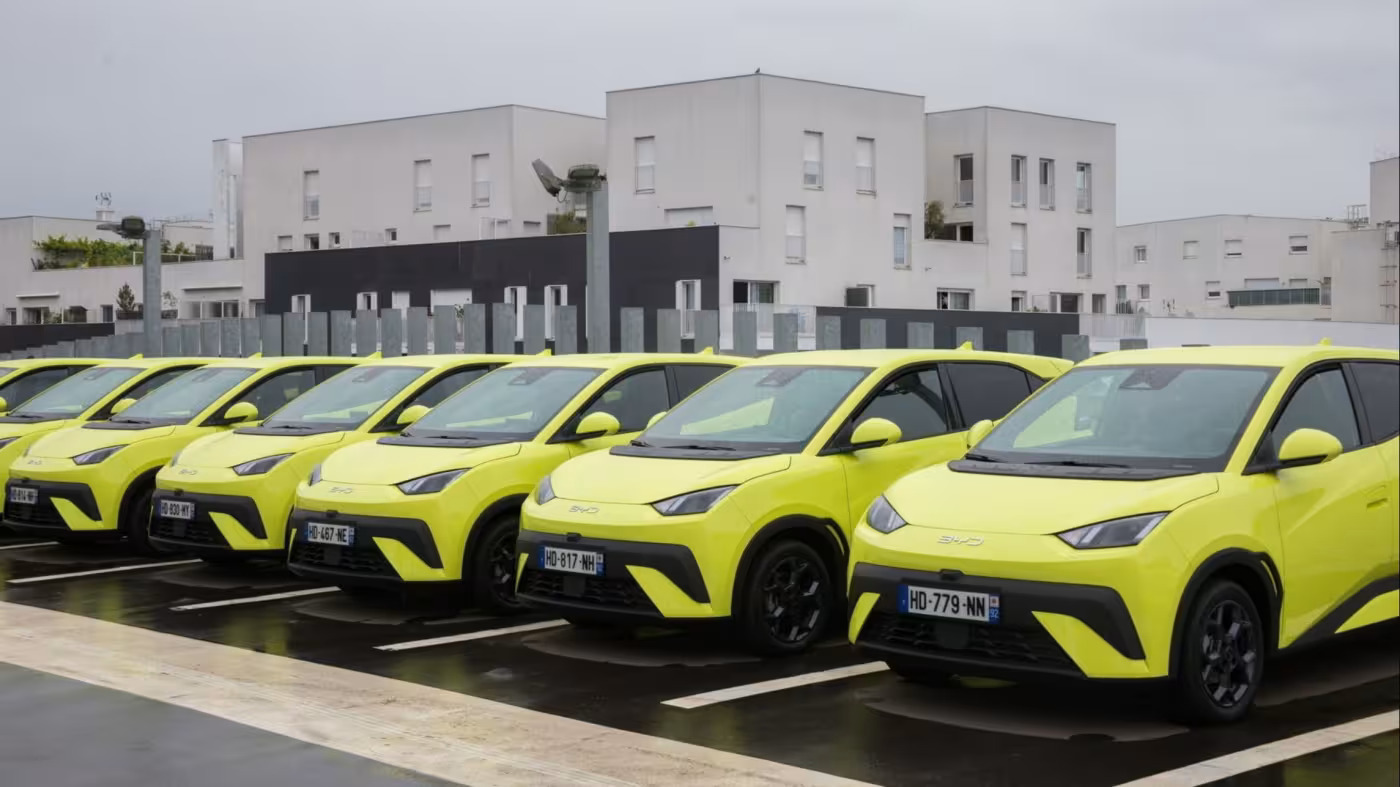
Chinese electric car company BYD Company Limited has sold more cars on the European market than its competitor Tesla Inc. for the first time, according to The Financial Times, IPN reports.
BYD registered 7,231 electric cars in Europe last month, compared with 7,165 registrations that Tesla did , according to Jato Dynamics, the automotive data intelligence company. Tesla’s monthly volume was down 49% year-on-year, while BYD reported a 169% increase.
The Chinese group’s registrations, including plug-in hybrid models, rose 359%.
The Chinese company’s expansion into Europe coincided with a drop in Tesla sales due to its outdated product portfolio and a backlash to Tesla owner Elon Musk’s meddling in regional politics.
“This is a turning point for the car market in Europe, especially considering that Tesla has been leading the European battery electric vehicle market for years, while BYD did not officially start its operations outside Norway and the Netherlands until late 2022,” said Jato Dynamics global analyst Felipe Munoz.
Tesla sales have continued to fall in key European markets despite a recent revamp of its car, the Tesla Model Y. Elon Musk similarly announced he was stepping down from his US government role to focus on running the automaker after first-quarter profits fell to their lowest level since the fourth quarter of 2020.
Tesla’s decline in Europe also comes as Renault, Stellantis and other brands have launched new models of more affordable battery-electric vehicles to meet stricter exhaust-emission regulations starting this year.
In April, carmakers Renault, Škoda, Volkswagen, Audi and BMW also outsold Tesla in electric cars.
Globally, BYD has overtaken Tesla as the world’s largest producer of electric vehicles, boosted by strong demand in the domestic market. But the Chinese group is a relative newcomer to Europe, and its rapid foray into foreign markets has sparked alarm among Western carmakers.
BYD and other Chinese groups have expanded their product range on the European mainland, boosting sales of plug-in hybrid vehicles, which are exempt from the EU’s tariffs of up to 45% on electric vehicles in China.
In recent years, BYD has launched eight models in more than 30 European countries, including the compact Seagull hatchback priced at €22990, with virtually no direct rivals in the segment.
The company plans to manufacture locally through its factories in Hungary and Turkey to cope with customs duties, but some of those ambitions have been embroiled in geopolitical tensions. The European Commission is investigating whether China granted unfair subsidies to the company’s first European factory in Hungary.
Its plan to build a factory in Mexico has similarly faced hurdles in getting approval from Chinese authorities amid concerns that its smart car technology could leak across the border to the US.
