
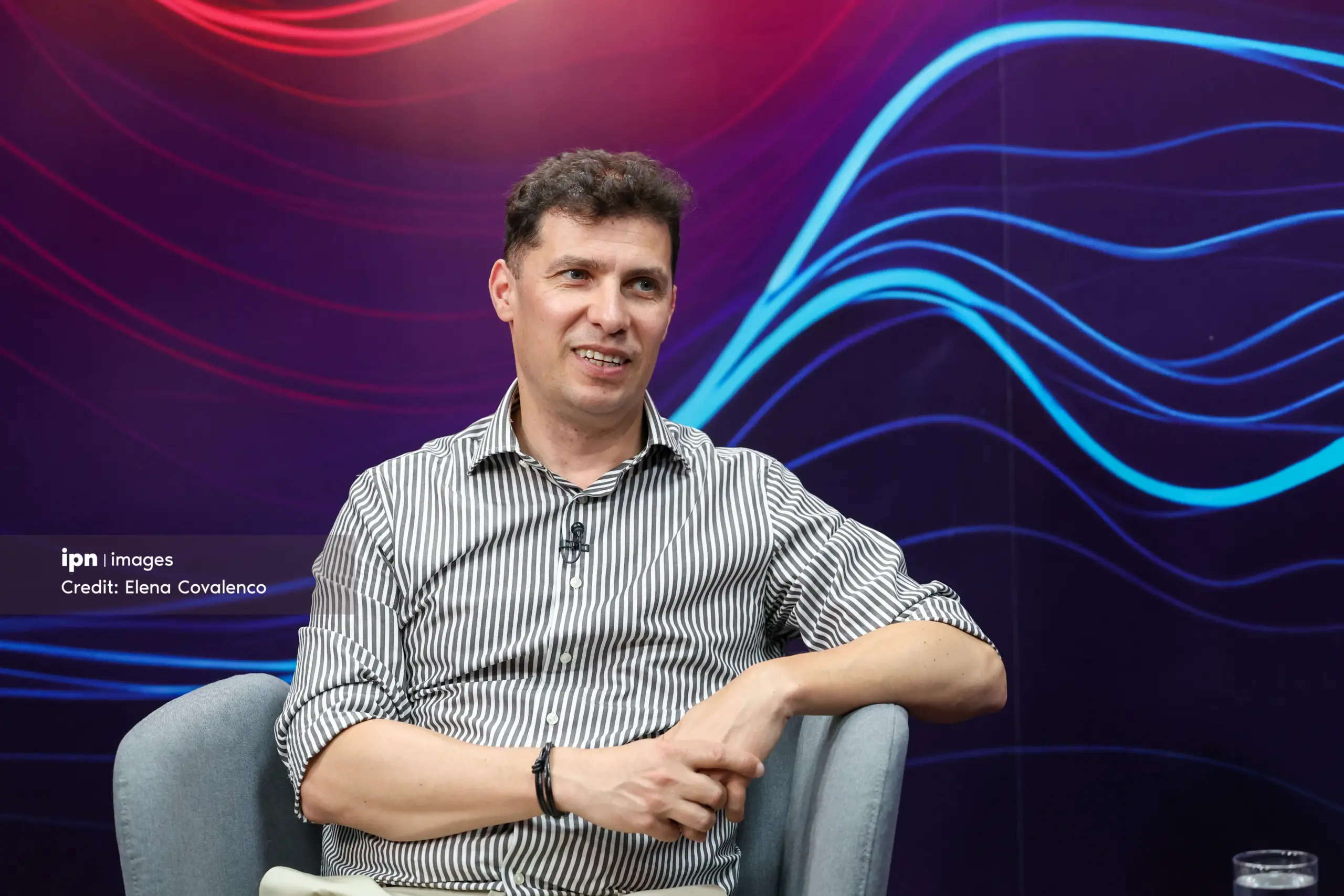
Adrian Posteuca: There is a big difference between being an image creator and an artist

Artificial intelligence is generating a lot of excitement: operations that were once difficult to perform are now just a click away, and the development in the field is becoming more fascinating every day. However, there are also many concerns, and it is natural that this should be the case, since some creative activities are increasingly replaced by digital technologies. How much is true and how much is exaggerated in the danger represented by artificial intelligence, we learned from Adrian Posteuca, an expert in creative technologies, in an interview for IPN.

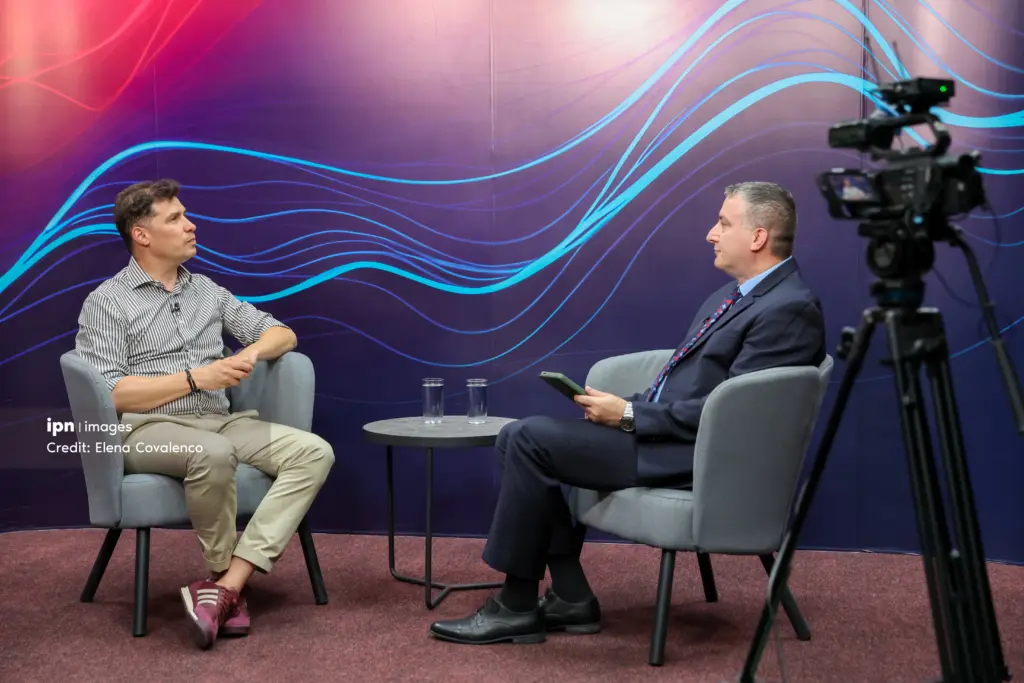
Ladies and gentlemen, good afternoon! The Creative Industries Festival brought to Chisinau professionals who explore how technology, art and innovation are changing the world we live in. Among the special guests of this festival is Adrian Posteuca, a specialist in new digital technologies, who spoke about the impact of artificial intelligence and new technologies on creativity. We continue the discussion that took place at the festival and in the IPN studio. Mr. Posteuca, welcome and thank you for accepting our invitation.

First of all, thank you for the invitation, it’s my first time in Chisinau, so I really like the atmosphere and this creative side.

Let’s see what happened at the Creative Industries Festival. You came right from there, you were on a panel and you also gave a presentation. I would like to ask you what was the most common concern or question among the participants?

One of the questions, and I believe the word is on everyone’s lips. I think there is no global conference that does not have the word AI in discussion. Certainly, the AI and the impact of AI on creative industries, whether we talk about media, whether we talk about art, whether we talk about culture, in the end, is very large. So the discussions are: will AI take our jobs, what happens with creativity, what happens with media, what happens with new formats and where does man find his place in this increasingly technologized world.

It’s normal for it to be like this and for these concerns about the future to exist. I would like to ask you if there is a change in the world we live in that people still fail to notice.

It is a change and the world is constantly changing. It is a change because this new technology, this new tool called artificial intelligence is completely different from all the tools we have had so far. And a simpler and more understandable explanation for the viewers is related to the fact that most of the technologies we have had so far have been and are deterministic.

That is, the moment you press a button on the machine, you know the engine will start. You know that you pressed the letter T on the typewriter, certainly the letter T appears on the paper. The same goes for the mobile phone. So it’s deterministic. You pressed T, T happens. You’re not interested in what happens behind. A technology that you understand more or less. On the other hand, artificial intelligence comes with a different approach, a probabilistic approach to technologies that until now were deterministic. Our world is deterministic.

You open the door, the door goes to the left or to the right, but you know what action you will take. Whereas, when you go on an exploration, into the forest, nothing awaits you. That’s how it happens, meaning you just equip yourself with the necessary skills to survive in the forest.

Artificial intelligence brings this new approach to our lives, a probabilistic approach. Very often, our deterministic-trained thinking is already transforming. We believe that what is there is determined by intelligence. It is rather a probability. Certainly, we also live in a probabilistic world where we have learned over millions of years of evolution that if we approach a lion and the lion comes towards us, the probability is that we will be attacked. But it is a paradigm shift at the level of human interactions.
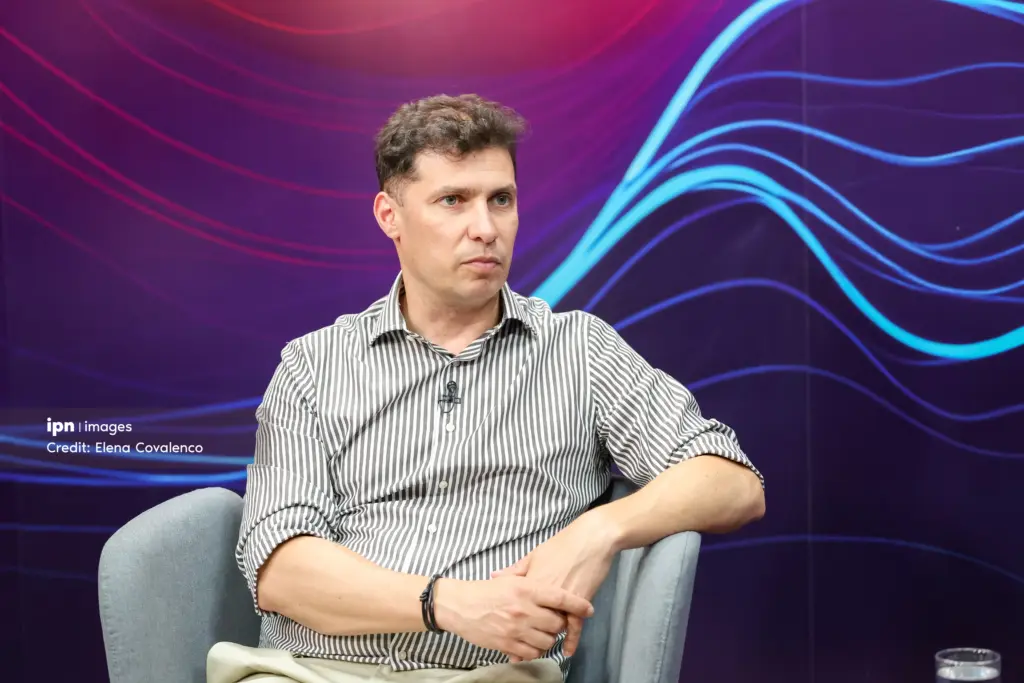
We’ve talked about all these concerns about artificial intelligence. I’d like to ask you, is there still some excitement?

There is enthusiasm, because this development creates new directions. I was even talking with one of the guests, one of the panelists, about the fact that at the moment, each of us can be a creator. We can be a creator of art, a creator of beauty, we can ultimately be an artist. If in the past you needed certain skills and specific tools and a specific education to become a painter, not necessarily visual, but of the hand and hours of training, today you can expect a beautiful image from just a few words.

I said that you can expect, it doesn’t mean that whatever you write to the artificial intelligence, it will give you a beautiful image. It’s probable to give you a beautiful image for you. Probable. But there’s a big difference between being an image creator and an artist.

Precisely for this answer of yours, I have another question. Because many fear that artificial intelligence could produce much faster and much cheaper than humans. The question related to this statement is: where does the advantage of the human factor in creation remain?

People will buy from people. People buy stories, not technology. And it’s one of the things I also said at the festival. People buy stories. The fact that journalism, stories, have survived hundreds of years, from written stories to radio, to television, now to the internet, brings us to the fact that stories have always survived. Only the way they are told changes. And then people will buy from people. Yes, there will be, let’s say, fast, quick products, that you need: to hang five paintings in the hallway of a hotel wall. You will make them with artificial intelligence.

However, behind this speed, there will always be artists who will be better rated precisely because their work is manual labor. Just as there will be films made with artificial intelligence, which you will watch, but you will know that it is artificial intelligence, at the same time, human labor, when you see a play, when you see a film played by people, will be much more valuable. I think we just need to slightly change our view of what human value means. Because human value does not ultimately mean to stamp a thousand envelopes, right? That’s not what the valuable work of an employee, let’s say, means.
Because by the nature of your specialization you look to the future, I would like to look to the future in a few years and ask you whether the biggest challenge will be technological or of mentality and adaptation to progress?

I believe it’s about mentality and adaptability. First of all, I think we still have an education, or we are trying to educate children in a precarious way, and I believe that today’s education is based very much on the retention of data and facts and things. Less on logic, on causality, on things that make you curious, that make you understand certain phenomena, that make you go further. Technology gives you information at a click away. You no longer need to remember them, but you will need to put them in your own context.

Certainly, there are now jobs where theoretically you should have compared things you studied in college with real things. Now, artificial intelligence does that for you. What you need to do is to bring this multidisciplinarity that every person has, because you should not only know from a single field, but you should know as much as possible in order to make correlations.

And because at the festival you most likely met specialists from all fields, from media, marketing, film, visual arts, I want to ask you what is the common point of their concerns? Where do these concerns meet in all these fields?

I believe that any creative industries festival must have the human being at its core. That is, what makes us human, what is beauty, regardless of whether the creative part comes with technology, comes with human manual craft, or whether there are different approaches to the way the human being is perceived. I believe that the human being, in any creative industry, should be at the center and must be at the center.

What technologies we use, whether we use leaf printing, as there was a lady with leaves, as there was a lady in the courtyard of Artcor, or whether we use, I don’t know, digital, every person and the way we make this public, this person feel better, is ultimately what we all try to feel better, to work less, to have more time for ourselves and to explore the world.

What advice do you have for a young person who wants a career in a creative industry, so that they are not overwhelmed by the changes that occur practically every hour?

I believe that the best advice is to be curious. To be curious, to learn from as many fields as possible, to be multidisciplinary, because the moment you become focused on something, you will have the misfortune of being trapped within some barriers. Generally, the more multidisciplinary you are, the more you understand from as many creative fields, from cinematography, to visual culture, to music, you will have a competitive advantage in prompting, in this part of interaction with artificial intelligence. Because artificial intelligence, I like to say, is as intelligent as the one who prompts it. There is no advantage of artificial intelligence other than that given by the prompter, by the one who creates the prompt.

And because we are at IPN and we are a news agency, you mentioned it before, but I would like to go into a little more detail, how do you see the future of journalism in the era of artificial intelligence?

I believe – having a background in journalism – that there will be, or perhaps already are, two types of journalism. A utilitarian journalism, which will be increasingly impacted by artificial intelligence, namely: weather-related data, financial data, sports scores, and all sorts of things that can be transformed, that is, they are utilitarian. And then there’s investigative journalism, the kind done by people for people, made from capturing visual information passed through the journalist’s filter and carried forward, which will continue to exist, only it will be augmented, it will be enhanced by the impact of artificial intelligence, from automatic subtitles, from searching in complex data, from data visualization, because it’s easy to tell 25% of 3 million that you can’t visualize, but if you see these numbers, these data visualized in 3D, in 2D, if you see them on screen or somehow in front of your eyes, you can realize the impact of some economic figures.

And then, I believe that technology, whether it is – today everyone is talking about artificial intelligence – but over time, there has been talk about augmented reality, about the metaverse, all are technologies that will impact the future, even that of journalism.

Mr. Adrian Posteuca, thank you very much for this interview. These are topics that concern us all, regardless of whether we work in a creative industry or not, and the future we are talking about is already happening, right now.


Ten ministers from the current executive will also be found in the Government proposed by the designated Prime Minister Vasile Tofan, while four portfolios will return to new members of the cabinet. At the same time, the Deputy Prime Ministers for reintegration and for European integration, Valeriu Chiveri and Cristina Gherasimov, will keep their positions, reports IPN.

For the position of Minister of Health, Alexandru Gasnas, presidential advisor, is appointed. Radu Musteata, the director of the National Agency for Food Safety, is proposed for the leadership of the Ministry of Agriculture and Food Industry, and for the position of Minister of Finance, Victoria Belous, a PAS deputy, who previously held the position of minister, is put forward.

Dan Suruceanu, a cultural manager and administrator, particularly known as the executive director of the Chisinau Arena multimedia and sports complex, is proposed to lead the Ministry of Culture.

Vasile Tofan announced that he has completed consultations with parliamentary factions, as well as with representatives of associations and organizations, and the government’s work program is in the finalization stage. “On July 21, I will go to Parliament with a team of good professionals, who will give all government institutions a fast pace of work and move things forward,” declared the designated candidate.

Vasile Tofan has been nominated for the position of Prime Minister by President Maia Sandu, at the proposal of the Action and Solidarity Party, following the resignation of Alexandru Munteanu. The government’s swearing-in session is scheduled for July 21.

0 FacebookTwitterPinterestEmail


Adrian Posteuca: There is a big difference between being an image creator and an artist

Artificial intelligence is generating a lot of excitement: operations that were once difficult to perform are now just a click away, and the development in the field is becoming more fascinating every day. However, there are also many concerns, and it is natural that this should be the case, since some creative activities are increasingly replaced by digital technologies. How much is true and how much is exaggerated in the danger represented by artificial intelligence, we learned from Adrian Posteuca, an expert in creative technologies, in an interview for IPN.

Ladies and gentlemen, good afternoon! The Creative Industries Festival brought to Chisinau professionals who explore how technology, art and innovation are changing the world we live in. Among the special guests of this festival is Adrian Posteuca, a specialist in new digital technologies, who spoke about the impact of artificial intelligence and new technologies on creativity. We continue the discussion that took place at the festival and in the IPN studio. Mr. Posteuca, welcome and thank you for accepting our invitation.

First of all, thank you for the invitation, it’s my first time in Chisinau, so I really like the atmosphere and this creative side.

Let’s see what happened at the Creative Industries Festival. You came right from there, you were on a panel and you also gave a presentation. I would like to ask you what was the most common concern or question among the participants?

One of the questions, and I believe the word is on everyone’s lips. I think there is no global conference that does not have the word AI in discussion. Certainly, the AI and the impact of AI on creative industries, whether we talk about media, whether we talk about art, whether we talk about culture, in the end, is very large. So the discussions are: will AI take our jobs, what happens with creativity, what happens with media, what happens with new formats and where does man find his place in this increasingly technologized world.

It’s normal for it to be like this and for these concerns about the future to exist. I would like to ask you if there is a change in the world we live in that people still fail to notice.

It is a change and the world is constantly changing. It is a change because this new technology, this new tool called artificial intelligence is completely different from all the tools we have had so far. And a simpler and more understandable explanation for the viewers is related to the fact that most of the technologies we have had so far have been and are deterministic.

That is, the moment you press a button on the machine, you know the engine will start. You know that you pressed the letter T on the typewriter, certainly the letter T appears on the paper. The same goes for the mobile phone. So it’s deterministic. You pressed T, T happens. You’re not interested in what happens behind. A technology that you understand more or less. On the other hand, artificial intelligence comes with a different approach, a probabilistic approach to technologies that until now were deterministic. Our world is deterministic.

You open the door, the door goes to the left or to the right, but you know what action you will take. Whereas, when you go on an exploration, into the forest, nothing awaits you. That’s how it happens, meaning you just equip yourself with the necessary skills to survive in the forest.

Artificial intelligence brings this new approach to our lives, a probabilistic approach. Very often, our deterministic-trained thinking is already transforming. We believe that what is there is determined by intelligence. It is rather a probability. Certainly, we also live in a probabilistic world where we have learned over millions of years of evolution that if we approach a lion and the lion comes towards us, the probability is that we will be attacked. But it is a paradigm shift at the level of human interactions.

We’ve talked about all these concerns about artificial intelligence. I’d like to ask you, is there still some excitement?

There is enthusiasm, because this development creates new directions. I was even talking with one of the guests, one of the panelists, about the fact that at the moment, each of us can be a creator. We can be a creator of art, a creator of beauty, we can ultimately be an artist. If in the past you needed certain skills and specific tools and a specific education to become a painter, not necessarily visual, but of the hand and hours of training, today you can expect a beautiful image from just a few words.

I said that you can expect, it doesn’t mean that whatever you write to the artificial intelligence, it will give you a beautiful image. It’s probable to give you a beautiful image for you. Probable. But there’s a big difference between being an image creator and an artist.

Precisely for this answer of yours, I have another question. Because many fear that artificial intelligence could produce much faster and much cheaper than humans. The question related to this statement is: where does the advantage of the human factor in creation remain?

People will buy from people. People buy stories, not technology. And it’s one of the things I also said at the festival. People buy stories. The fact that journalism, stories, have survived hundreds of years, from written stories to radio, to television, now to the internet, brings us to the fact that stories have always survived. Only the way they are told changes. And then people will buy from people. Yes, there will be, let’s say, fast, quick products, that you need: to hang five paintings in the hallway of a hotel wall. You will make them with artificial intelligence.

However, behind this speed, there will always be artists who will be better rated precisely because their work is manual labor. Just as there will be films made with artificial intelligence, which you will watch, but you will know that it is artificial intelligence, at the same time, human labor, when you see a play, when you see a film played by people, will be much more valuable. I think we just need to slightly change our view of what human value means. Because human value does not ultimately mean to stamp a thousand envelopes, right? That’s not what the valuable work of an employee, let’s say, means.

Because by the nature of your specialization you look to the future, I would like to look to the future in a few years and ask you whether the biggest challenge will be technological or of mentality and adaptation to progress?

I believe it’s about mentality and adaptability. First of all, I think we still have an education, or we are trying to educate children in a precarious way, and I believe that today’s education is based very much on the retention of data and facts and things. Less on logic, on causality, on things that make you curious, that make you understand certain phenomena, that make you go further. Technology gives you information at a click away. You no longer need to remember them, but you will need to put them in your own context.

Certainly, there are now jobs where theoretically you should have compared things you studied in college with real things. Now, artificial intelligence does that for you. What you need to do is to bring this multidisciplinarity that every person has, because you should not only know from a single field, but you should know as much as possible in order to make correlations.

And because at the festival you most likely met specialists from all fields, from media, marketing, film, visual arts, I want to ask you what is the common point of their concerns? Where do these concerns meet in all these fields?

I believe that any creative industries festival must have the human being at its core. That is, what makes us human, what is beauty, regardless of whether the creative part comes with technology, comes with human manual craft, or whether there are different approaches to the way the human being is perceived. I believe that the human being, in any creative industry, should be at the center and must be at the center.

What technologies we use, whether we use leaf printing, as there was a lady with leaves, as there was a lady in the courtyard of Artcor, or whether we use, I don’t know, digital, every person and the way we make this public, this person feel better, is ultimately what we all try to feel better, to work less, to have more time for ourselves and to explore the world.

What advice do you have for a young person who wants a career in a creative industry, so that they are not overwhelmed by the changes that occur practically every hour?

I believe that the best advice is to be curious. To be curious, to learn from as many fields as possible, to be multidisciplinary, because the moment you become focused on something, you will have the misfortune of being trapped within some barriers. Generally, the more multidisciplinary you are, the more you understand from as many creative fields, from cinematography, to visual culture, to music, you will have a competitive advantage in prompting, in this part of interaction with artificial intelligence. Because artificial intelligence, I like to say, is as intelligent as the one who prompts it. There is no advantage of artificial intelligence other than that given by the prompter, by the one who creates the prompt.

And because we are at IPN and we are a news agency, you mentioned it before, but I would like to go into a little more detail, how do you see the future of journalism in the era of artificial intelligence?

I believe – having a background in journalism – that there will be, or perhaps already are, two types of journalism. A utilitarian journalism, which will be increasingly impacted by artificial intelligence, namely: weather-related data, financial data, sports scores, and all sorts of things that can be transformed, that is, they are utilitarian. And then there’s investigative journalism, the kind done by people for people, made from capturing visual information passed through the journalist’s filter and carried forward, which will continue to exist, only it will be augmented, it will be enhanced by the impact of artificial intelligence, from automatic subtitles, from searching in complex data, from data visualization, because it’s easy to tell 25% of 3 million that you can’t visualize, but if you see these numbers, these data visualized in 3D, in 2D, if you see them on screen or somehow in front of your eyes, you can realize the impact of some economic figures.

And then, I believe that technology, whether it is – today everyone is talking about artificial intelligence – but over time, there has been talk about augmented reality, about the metaverse, all are technologies that will impact the future, even that of journalism.

Mr. Adrian Posteuca, thank you very much for this interview. These are topics that concern us all, regardless of whether we work in a creative industry or not, and the future we are talking about is already happening, right now.


The yellow fire hazard code has been extended until July 22. Meteorologists warn that the lack of precipitation and high temperatures will maintain an exceptional risk of vegetation fires, reports IPN.

The warning mainly targets the central area, but the municipality of Bălți and the northern districts of Glodeni and Soroca are also affected. In the southern area, the yellow code is valid until Cimislia, Basarabeasca and Taraclia.

In the context of maintaining an increased risk of fires, authorities urge the population to demonstrate maximum responsibility and to respect fire prevention rules. Rescuers recommend avoiding the use of open fire near forests, agricultural lands, and dry vegetation, prohibiting the burning of plant residues, garbage, and stubble, as well as avoiding the random throwing of cigarette butts or other lit objects. Any fire outbreak must be immediately reported to Service 112.

0 FacebookTwitterPinterestEmail


1 IANUARIE, 2025
1 IANUARIE, 2025