

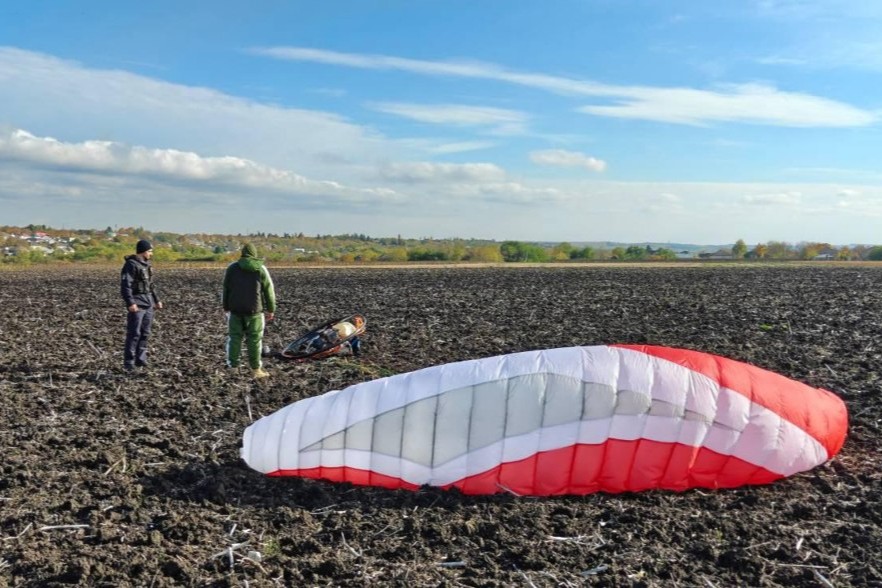
A Ukrainian man crossed the border illegally on a powered paraglider and sought asylum in Moldova

Photo credit: IGPF

A Ukrainian citizen illegally crossed the border into the Republic of Moldova using a powered paraglider. Border police found him approximately two kilometres from the border, where he requested asylum, IPN reports.

According to the General Inspectorate of Border Police, the incident took place along the Chernivtsi, Ukraine–Larga, Republic of Moldova route. Ukrainian border authorities informed their Moldovan counterparts that a person had been spotted illegally flying across the state border.

Acting on information received from their Ukrainian counterparts, border police launched a search and located the individual approximately two kilometres from the border. Later, during checks, the Ukrainian citizen requested asylum in the Republic of Moldova.

The Border Police are continuing their investigation to establish the full circumstances surrounding the illegal border crossing.


The November 15 elections to the People’s Assembly and for the post of Bashkan of Gagauzia should be treated as regional elections and held in accordance with the national electoral framework, under the supervision of the Central Electoral Commission. Historian Oleg Bercu expressed this view during the public debate “Historical Roots in the Present and Future of the Gagauz People,” organized by the IPN News Agency.

According to the historian, applying different electoral rules within the same country can make it difficult to ensure fair elections. He explained that elections in the Republic of Moldova must be conducted under a common set of rules established by national law. In his view, responsibility for administering elections in the autonomous region should lie with the central electoral authority, while the electoral body in Comrat should work in coordination with the Central Electoral Commission (CEC).

“We cannot have the rule of law when a different electoral law applies in certain parts of the Republic of Moldova. Under the Constitution and the Electoral Code, the Central Electoral Commission is the sole authority responsible for electoral processes nationwide. Accordingly, the electoral authority in Comrat must be subordinate to Chișinău, and elections in the autonomous region must be treated as regional elections,” explained Oleg Bercu, who holds a doctorate in history and is the author of the monograph “The Sociopolitical Evolution of the Gagauz Population from the Mid-Nineteenth to the Late Twentieth Century.”

The historian also explained the role of electoral oversight in preventing irregularities and increasing transparency in elections. He said the involvement of the Central Electoral Commission (CEC) would enable closer monitoring of the electoral process and reduce the risk of fraud. His remarks came after Moldova’s Parliament amended the electoral legislation and the CEC officially assumed responsibility for organizing elections in the region.

“Electoral processes must be overseen by the Central Electoral Commission (CEC), which will ensure that the law is applied consistently nationwide. This will also allow for closer oversight, reducing the risk of electoral fraud. There have been attempts to rig elections in the autonomous region in some cases. In a state governed by the rule of law, the law must prevail,” historian Oleg Bercu added.

The public debate “Historical Roots in the Present and Future of the Gagauz People” is the 66th event in the series “The Impact of the Past on Confidence-Building and Peacebuilding Processes”. The IPN News Agency organises this debate series with the support of Germany’s Hanns Seidel Foundation.


0 FacebookTwitterPinterestEmail


A Ukrainian man crossed the border illegally on a powered paraglider and sought asylum in Moldova

Photo credit: IGPF

A Ukrainian citizen illegally crossed the border into the Republic of Moldova using a powered paraglider. Border police found him approximately two kilometres from the border, where he requested asylum, IPN reports.

According to the General Inspectorate of Border Police, the incident took place along the Chernivtsi, Ukraine–Larga, Republic of Moldova route. Ukrainian border authorities informed their Moldovan counterparts that a person had been spotted illegally flying across the state border.

Acting on information received from their Ukrainian counterparts, border police launched a search and located the individual approximately two kilometres from the border. Later, during checks, the Ukrainian citizen requested asylum in the Republic of Moldova.

The Border Police are continuing their investigation to establish the full circumstances surrounding the illegal border crossing.


The legal status of Gagauzia, the implementation of language legislation, and the historical origins of the Gagauz people were the main topics discussed during the public debate “Historical Roots in the Present and Future of the Gagauz People,” organized by the IPN News Agency. Participants highlighted both the historical development of the Gagauz community and the distinctive features of the legal and institutional framework governing the region, against the backdrop of upcoming elections to the People’s Assembly and for the post of governor of the Autonomous Territorial Unit of Gagauzia.

At the start of the debate, expert Igor Botan outlined the responsibilities of Gagauzia’s main institutions. “Under the Law on the Special Legal Status of Gagauzia, the People’s Assembly is Gagauzia’s representative body, directly elected by the region’s residents and empowered to adopt legislation within its remit. Under the same law, the governor (Bashkan) is Gagauzia’s highest-ranking official and head of the region’s executive branch. All public administration authorities in Gagauzia are subordinate to the governor,” explained the project’s resident expert.

For his part, historian Oleg Bercu, who holds a doctorate in history, referred to the constitutional and legal framework governing Gagauz autonomy, established in 1994. According to Bercu, one of the problems that has emerged over time is the failure to fully uphold the status of the Romanian language in the region’s public institutions.

“In 1994, lawmakers decided to establish the autonomous territorial unit of Gagauzia. The Constitution of the Republic of Moldova itself stipulates that Gagauzia is an integral part of the country. Under the law, the languages used in Gagauzia are Gagauz, Romanian and Russian. In my view, the situation went off track, and the Republic of Moldova failed to ensure that public authorities in Gagauzia respected the status of the state language,” explained Oleg Bercu, author of the monograph “The Socio-Political Evolution of the Gagauz Population from the Mid-Nineteenth to the Late Twentieth Century.”

Discussing the identity of the Gagauz people, historian Ștefan Bejan explained that their resettlement in the Budjak region was tied to the interests of the Russian Empire. The imperial authorities sought to populate the territory with communities they regarded as loyal.

“There is no broad consensus on the origins of the Gagauz people. The most widely accepted theory, however, is that they emerged from a mingling of several Turkic peoples who settled in southern Dobruja and, under Byzantine influence, converted to Christianity and embraced Christian values. In 1812, the Russian Empire needed a loyal population to settle in Budjak, farm the land, and supply the army with everything it needed for future campaigns,” explained historian Ștefan Bejan, author of the monograph “The Gagauz: Origins, Development, and Settlement in Southern Bessarabia.”

The public debate “Historical Roots in the Present and Future of the Gagauz People” is the 66th in the series “The Impact of the Past on Trust-Building and Peacebuilding Processes.” The IPN News Agency organizes this debate series with the support of Germany’s Hanns Seidel Foundation.


0 FacebookTwitterPinterestEmail


1 IANUARIE, 2025
1 IANUARIE, 2025