



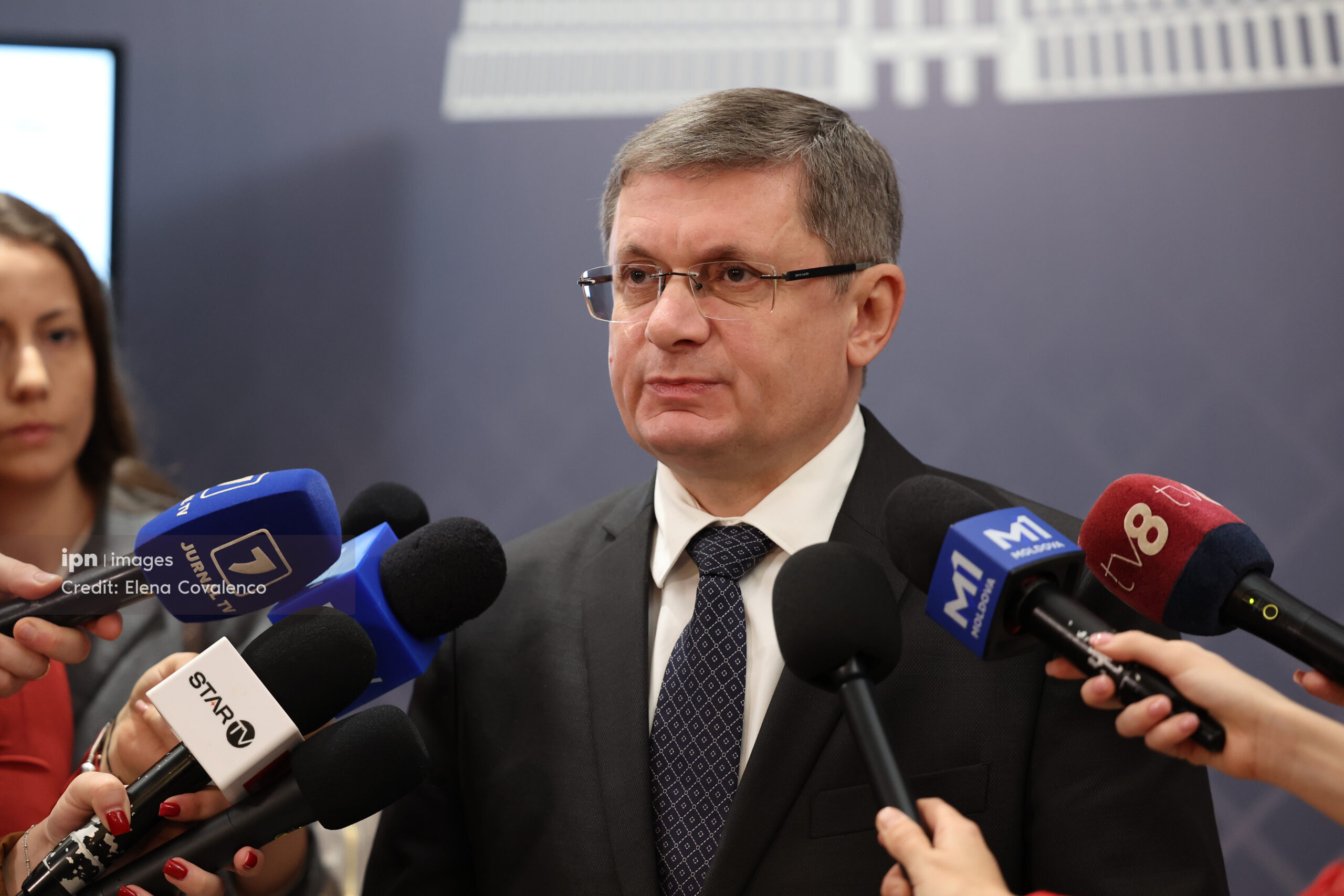
The President of the Parliament, Igor Grosu, believes that the Russian Federation is responsible for the energy crisis on the left bank of the Dniester, where gas supplies continue through a “less orthodox” scheme, and their payment remains unclear. According to him, in the long term the only sustainable solution is to adapt to market rules, as the current model, based on unlimited consumption and billions in debt, can no longer continue, reports IPN.
The head of the legislature stated that the crisis in the Transnistrian region was provoked on January 1, 2025, by the Russian Federation, coinciding with the disruption of gas supplies. The constitutional authorities agreed to continue the delivery of gas volumes on the left bank of the Dniester.
“I said – we understand the economic situation on the left bank and we will not create obstacles, we will not complicate the situation in which gas deliveries will continue. Well, this is not happening. It is done through a less orthodox scheme,” Igor Grosu declared during the show “Reality looks at you” on RealitateaTV.
Regarding who pays for the gas consumed on the left bank, the official said it would be about the Russian Federation. “I believe someone from the Russian Federation pays for it. Now we do not know, we can only guess. It is done slowly and from one day to the next,” noted the President of the Parliament.
He also referred to the continuous extension of the state of emergency in the economy in the Transnistrian region, emphasizing that it is hard to say how long this situation could be maintained. “Even for the Russian Federation, this regime from Tiraspol has come to be treated according to the principle – “the suitcase without a handle”, which is very complicated to carry, but also hard to abandon. There is no money, but you hold on, resist further – hence the precarious economic situation on the left bank,” mentioned Igor Grosu.
According to him, the authorities in Chisinau managed to identify resources with the support of the European Union, but Tiraspol refuses them, not out of their own decision, but according to the Kremlin’s instructions. In his opinion, the long-term solution is clear: adjusting to market rules. “You cannot hope that this model in which you endlessly consume energy resources and accumulate 11 billion debts can continue without limits. Such a model no longer exists,” said Igor Grosu.
