

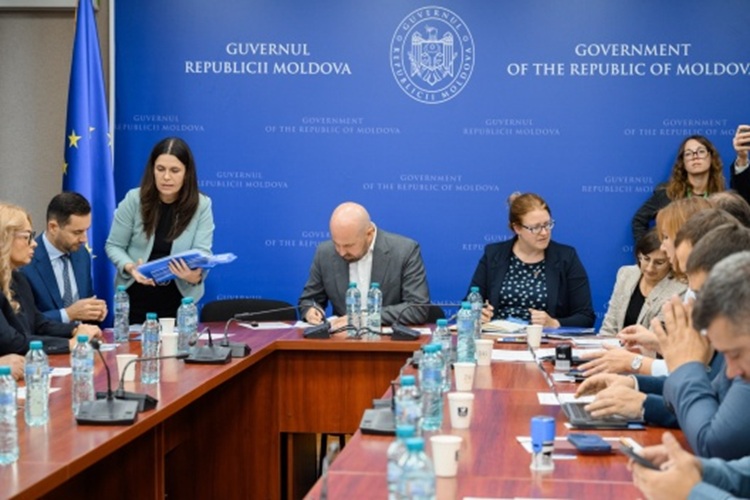
The agreement for the construction of a new water intake station from the Nistru river has been signed

Photo source: MIDR

The agreement for the construction of a new water intake station from the Nistru River within the framework of the Chisinau-Straseni-Calarasi main aqueduct construction project was signed on Tuesday in Chisinau. The document establishes the responsibilities of the 14 institutions and entities involved in the implementation of the project, reports IPN.

The Ministry of Infrastructure and Regional Development mentions that, in addition to the new water intake station, two pumping stations and connection pipes will be built. These will ensure water supply for both the city of Chisinau and the Straseni and Calarasi districts.

The agreement was signed within the framework of the “Open Urban Development Program” which benefits from a grant of 14 million euros, granted by the German Government through the KfW Development Bank.

Local public authorities and operators from Chisinau, Straseni, and Calarasi will contribute to the preparation of the infrastructure and the organization of future service management. Present at the signing of the agreement, the general mayor, Ion Ceban, requested the acceleration of the construction project for the new water intake station at Vadul lui Voda, taking into account the current year’s situation.

The program is complementary to the ongoing project “Improvement of water infrastructure in Central Moldova”, which involves the construction of the main water supply line from Chisinau-Straseni-Calarasi and its connection to the water network managed by the company “Apa-Canal” Chisinau, which will also operate the main water supply line. The total investment amounts to 45 million euros.


The agreement for the construction of a new water intake station from the Nistru river has been signed

Russia remains the main external threat to European democracy, alongside Belarus, China, Iran, and North Korea. This statement is found...

Acest material este disponibil doar pe bază de abonament.
Abonează-te pentru a avea acces la mai multe materiale și funcționalități exclusive!

0 FacebookTwitterPinterestEmail


The agreement for the construction of a new water intake station from the Nistru river has been signed

Photo source: MIDR

The agreement for the construction of a new water intake station from the Nistru River within the framework of the Chisinau-Straseni-Calarasi main aqueduct construction project was signed on Tuesday in Chisinau. The document establishes the responsibilities of the 14 institutions and entities involved in the implementation of the project, reports IPN.

The Ministry of Infrastructure and Regional Development mentions that, in addition to the new water intake station, two pumping stations and connection pipes will be built. These will ensure water supply for both the city of Chisinau and the Straseni and Calarasi districts.

The agreement was signed within the framework of the “Open Urban Development Program” which benefits from a grant of 14 million euros, granted by the German Government through the KfW Development Bank.

Local public authorities and operators from Chisinau, Straseni, and Calarasi will contribute to the preparation of the infrastructure and the organization of future service management. Present at the signing of the agreement, the general mayor, Ion Ceban, requested the acceleration of the construction project for the new water intake station at Vadul lui Voda, taking into account the current year’s situation.

The program is complementary to the ongoing project “Improvement of water infrastructure in Central Moldova”, which involves the construction of the main water supply line from Chisinau-Straseni-Calarasi and its connection to the water network managed by the company “Apa-Canal” Chisinau, which will also operate the main water supply line. The total investment amounts to 45 million euros.


Several organizations and representatives of the business environment have called for the revision of some provisions in the fiscal policy project for 2027, within the public consultations organized by the Parliamentary Commission for Economy, Budget and Finance. Among the contested measures are the increase in VAT and income tax, as well as the increase in excise duties applied to certain products, reports IPN.

The Executive Director of the Sugar Producers Union of Moldova, Inga Pascal, has requested the maintenance of the reduced VAT quota on sugar, given that the project envisages its increase from 8% to 20%. According to the calculations presented during the consultations, if the increase would be fully reflected in the final price, the sugar could become approximately 7% more expensive.

Dissatisfaction was also expressed by representatives of fruit and vegetable processors. Mircea Manole, the representative of the “Speranta-Cons” association, contested the increase in VAT for sweet corn from 8% to 20% and for peas to 12%, arguing that these products are used as raw materials by the local processing industry.

At the same time, Nadejda Rusu, representative of the Moldova Fruct Association, asked that the excise duty on diesel not be increased by 20% annually during the period 2027-2029 without a clear compensation mechanism. She also requested the maintenance of the current VAT rate for fruit and vine planting material and criticized the increase in income tax for peasant households.

In turn, Alexandru Badarau, the executive director of the Lavender Producers Association, estimated that the increase in VAT from 8% to 12%, in the absence of a compensation mechanism or reverse taxation, could mean at least 600-700 million lei that would temporarily remain in the budget, until the VAT is refunded to farmers. He said it is not clear when this amount will be refunded.

Another disputed provision targets savings and loan associations. Their representatives have drawn attention to the fact that income tax is set to increase from 0% to 18% and have called for the preservation of the tax benefit. They argued that these associations primarily serve the population and small businesses in rural areas, including individuals who do not have access to bank loans. The chairman of the parliamentary committee, Marcel Spatari, admitted that the impact of such a change is significant and said that the subject will be further analyzed.

And representatives of the beverage industry have requested a review of certain fiscal measures. They mention that the introduction of excise tax, along with the deposit system for packaging, could lead to a price increase of 30-34% and a reduction in consumption.

The fiscal policy project for 2027 is set to be examined in the second reading by Parliament. Until then, the proposals and objections raised during the consultations will be analyzed by the responsible authorities.

0 FacebookTwitterPinterestEmail


1 IANUARIE, 2025
1 IANUARIE, 2025