
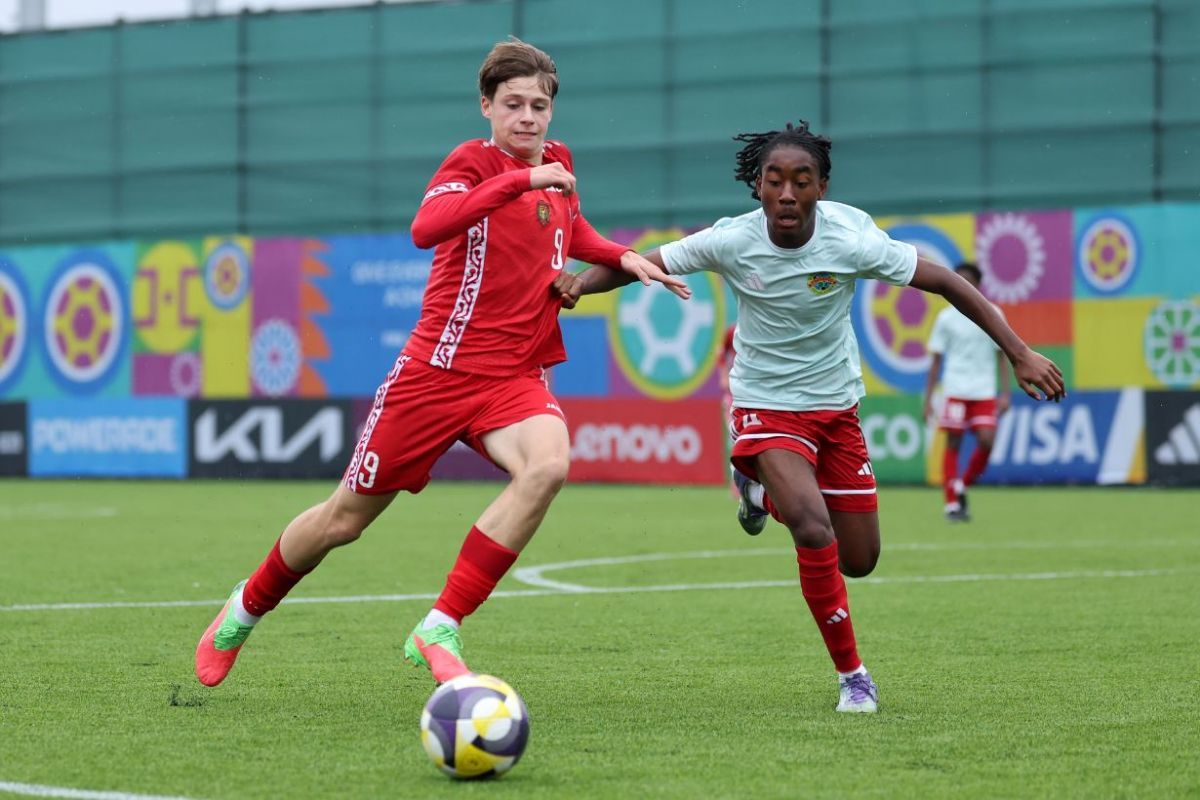
Moldova U-15 lose to Indonesia on penalties in the League C round of 32 at the World Cup and FIFA Festival
Acest material este disponibil doar pe bază de abonament.
Abonează-te pentru a avea acces la mai multe materiale și funcționalități exclusive!
Acest material este disponibil doar pe bază de abonament.
Abonează-te pentru a avea acces la mai multe materiale și funcționalități exclusive!
Accession to the European Union can transform the economy and create new opportunities for the citizens of Moldova, and Cyprus’s experience shows that the drive towards European integration brings long-term economic and social benefits. This is the message conveyed by Cyprus’s former Deputy Minister for European Affairs, Marilena Raouna, in an interview with IPN.
You have left the Cypriot Government and stepped down from your post as Deputy Minister for European Affairs. What are you focusing on professionally at the moment, and to what extent does your current role allow you to remain involved in European affairs?
Indeed, my term as Deputy Minister for European Affairs came to an end in late July. It was a three-year undertaking, as preparing for the Presidency of the Council of the EU is a complex, lengthy and demanding process. I am very pleased that, after two and a half years of intensive preparations and six months at the helm of the Council, Cyprus delivered tangible results for the European Union, its citizens and countries seeking EU membership, across every area on the agenda. We had a very clear vision: to strengthen Europe’s strategic autonomy.
I have fulfilled my mission, but I remain active in European affairs, a field in which I have worked for 20 years. During that time, I have worked both at the European Commission in Brussels and at every level of government in Cyprus. I continue to be involved in European affairs, particularly in matters relating to European Union enlargement, as this is an area of expertise for me.
I promised my family that, after three years of being absent—I have two young children—I would devote a few months to them while also working on other projects and preparing for the next steps in my career.
During the Cypriot Presidency of the Council of the EU, you launched the first round of negotiations with Moldova. What was the most difficult hurdle in convincing all Member States to support this position?
I have had the privilege of working very closely with Moldova, and I say this not merely out of politeness, but because it is how I genuinely feel. I visited Moldova a year before taking over the presidency of the Council of the EU, and I did not confine my visit to Chisinau. I worked with Deputy Prime Minister Gherasimov and the EU Delegation, visited villages outside the capital, and spoke with Moldovan citizens about their aspirations. I truly believed in the commitment and resilience of the Moldovan people, and in Moldova’s government.
We faced numerous challenges along the way, but thanks to the shared commitment of the Cypriot Presidency of the Council of the EU to delivering tangible results and of the Moldovan Government to implementing reforms, we managed to overcome these obstacles. One of the biggest hurdles at the outset was the lack of the unanimity required within the Council to convene an intergovernmental conference on accession. Nevertheless, we found a way to complete the technical work.
Thus, in the first three months of our presidency, we worked with the European Commission and the Moldovan government to complete all the technical work relating to every cluster of negotiating chapters. We also invited Deputy Prime Minister Gherasimov to attend a meeting of the Council’s Working Party on Enlargement and Countries Negotiating Accession to brief its members directly. In March, we held an informal meeting with Moldova and all 27 member states, at which we presented the results of this technical work.
When a member state’s political position shifted, we worked with its representatives to create the conditions needed to secure approval. By then, the technical work had already been completed, allowing us to open the first cluster of negotiating chapters, known as the Fundamentals. This marked an important milestone in Moldova’s accession to the European Union.
Moldova has already opened four clusters of negotiation chapters, but accession involves a much more extensive process. Which chapters are the most difficult, and what risks might arise during this process?
Following the conclusion of Cyprus’s presidency of the Council of the EU, three further clusters of negotiating chapters were opened, covering external relations, the internal market and competitiveness and inclusive growth. Work is now under way to prepare the letters to be sent for other clusters of chapters. The EU acquis is extensive in all these areas.
Although I will not single out any particular area, I will say that what matters is maintaining the momentum of reform in countries seeking EU membership. Another important aspect, and one in which Moldova has made significant progress, is alignment with the EU’s Common Foreign and Security Policy. This is also a very clear indicator of Moldova’s strategic alignment with the European Union. I hope that all negotiating clusters will be opened by the end of 2026.
Moldova has fulfilled its commitments, paving the way for the provisional closure of negotiating chapters to begin. This is a crucial stage in the process, but also a challenging one, requiring the candidate country to press ahead with reforms.
The process of accession to the European Union takes place over several years, during which time both the governments of the candidate country and the political priorities of the Member States may change. How can a candidate country ensure the continuity of reforms and maintain its European path in the long term, even in the face of such changes?
There is currently fresh momentum behind the European Union’s enlargement process, driven by Russia’s invasion of Ukraine. What matters now is to act swiftly, as we did during our presidency of the Council of the EU, because this momentum will not last forever.
There is a window of opportunity that could close. We do not know what political developments may unfold, either at the European level or in the domestic politics of the member states. That is why it is important to act swiftly to move accession negotiations forward. This was our goal for the Republic of Moldova during the Cypriot presidency of the Council of the EU, and we took the same approach with Montenegro. It was also during our presidency that, for the first time since 2009, a working group was set up to draft an accession treaty—in this case, for Montenegro.
This sends a very important signal: European Union enlargement is an achievable goal. For one thing, I believe it is essential that we continue to deliver tangible results. This must be a two-way process: when candidate countries fulfil their commitments, the European Union must, in turn, keep its promises. Each candidate country must advance on its own merits and on the strength of the reforms it implements, without its progress being tied to other accession processes. This principle is also essential to the European Union’s credibility.
Another important aspect is to explain to the citizens of candidate countries—including Moldovans, whom I respect for the resilience they have shown—the benefits of closer ties with the European Union and of pursuing a European path. This is a difficult and lengthy process, and citizens need to understand what they stand to gain. This is where gradual integration comes in, allowing them to experience the benefits of enlargement in their daily lives.
One example is the abolition of roaming charges under the “Roam Like at Home” scheme, which we have put in place. Just a few days ago, €157 million was also disbursed under the Growth Plan for Moldova. These funds are helping, among other things, to improve the country’s road infrastructure. All of this is happening before Moldova joins the European Union.
If Moldova’s reforms continue at their current pace, I believe the goal of joining the European Union by 2030 is challenging but realistic. We rarely see such a high level of commitment from a government as we do from the one in Chișinău. This commitment was also evident under very difficult circumstances, marked by repeated instances of foreign interference during the parliamentary elections.
In the context of Cyprus’s accession process, what is the most important lesson that Chisinau should learn in order to turn its goal of joining the EU into a reality?
For Cyprus, joining the European Union was the most significant development since gaining independence in 1960. That is how Cypriots see it, too. My message to the people of Moldova is that the European dream delivers everything it promises—and more. The European Union is not static, it grows and evolves over the years, continuing to expand. EU membership has transformed our country and its economy, spurred economic growth, created jobs and brought prosperity. It has also given young people and students opportunities to develop, whether through education or through access to jobs and the chance to advance their careers. The European Union is a place of boundless opportunity. My message is this: do not give up, however difficult the process may be, because, in the end, being part of the European family is worth it.
And Moldova, like Cyprus, believes in the European Union not merely as a means of joining the European single market or benefiting from the Erasmus programme, but also because membership represents an investment in security. This is something Moldova and Cyprus have in common. We find ourselves in a highly complex region, surrounded by difficult and aggressive neighbours. For us, the European Union offers the best guarantee of security for the future of our countries and our children.
Ms Raouna, thank you for this discussion!
It was a pleasure.
Maxim Bolohan, IPN
Acest material este disponibil doar pe bază de abonament.
Abonează-te pentru a avea acces la mai multe materiale și funcționalități exclusive!
A pedestrian was seriously injured after being struck by a car in the village of Sofia, in Drochia district. The driver, who police say is believed to be 14 years old, fled the scene, IPN reports.
According to the General Police Inspectorate, the accident occurred on Tuesday evening on the town’s main street. The driver fled the scene, while the victim was attended to by an ambulance crew.
Law enforcement officials say they are investigating the circumstances of the accident. Police also urge parents not to allow minors to drive vehicles they are not legally entitled to operate and to explain the risks and consequences of doing so.
Acest conținut este restricționat și poate fi accesat doar cu abonament.
Navigarea pe ipn.md este mai simplă dacă ai abonament.
Abonament - AICI
Acest conținut video este restricționat și poate fi accesat doar cu abonament.
Navigarea pe ipn.md este mai simplă dacă ai abonament.
Abonament - AICI

To provide the best experiences, we and our partners use technologies like cookies to store and/or access device information. Consenting to these technologies will allow us and our partners to process personal data such as browsing behavior or unique IDs on this site and show (non-) personalized ads. Not consenting or withdrawing consent, may adversely affect certain features and functions.
Click below to consent to the above or make granular choices. Your choices will be applied to this site only. You can change your settings at any time, including withdrawing your consent, by using the toggles on the Cookie Policy, or by clicking on the manage consent button at the bottom of the screen.