

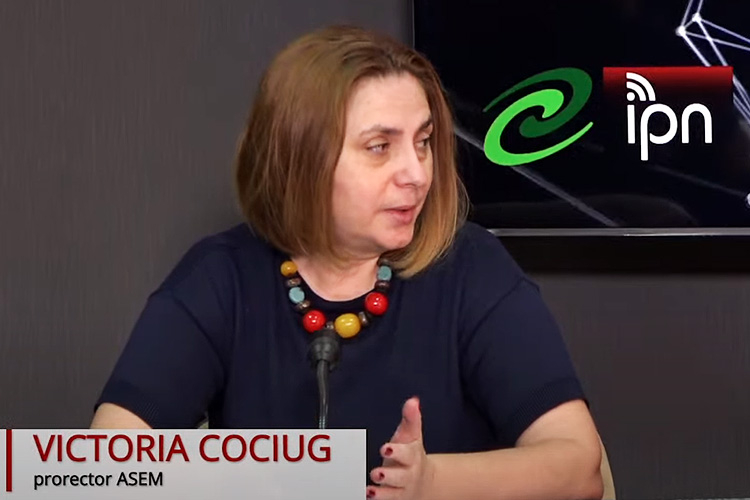
Victoria Cociug: European Commission’s money goes to salaries of researchers through Horizon Europe

The Republic of Moldova’s membership in Horizon Europe provides concrete benefits to the state budget, respectively, to the public sector employees, ASEN vice-rector Victoria Cociug stated in a public debate hosted by IPN News Agency. According to her, the salaries of researchers are paid from the European Commission’s funds, a part of the amount reaching the state budget through taxes.

The vice-rector of the Academy of Economic Studies noted that competing at European level with well-known researchers from highly developed states is the biggest challenge faced by researchers from the Republic of Moldova.

“Writing a project is not only about material aspects, but it is rather a challenge to try and see if you are capable enough to keep up with the great researchers of the world. Gaining experience in writing projects is a long-term process. The transfer of knowledge takes place in the communication with the evaluating European authorities. We are excited about these possibilities. We are glad that the recently formed Horizon Europe Office comes to our aid. It trains us, invites researchers to various project writing workshops involving personalities from abroad,” said the ASEM vice-rector.

She explained that the economic field is related to all the research fields. In this connection, the educational institution she represents applies for multiple projects within the EUs Framework Program for Research and Innovation.

“We can participate in various types of research, from medicine to green transition. The last project written and submitted by us is the microgrid project, which is not an economic project, but an economic impact study was conducted. All the areas that can be financed are presented by economists as they need funding. That’s why the economy can be found anywhere. But there is also specific economic research. It depends on the economy whether there will be money for research as well. So, there is a very close connection. That’s why, in the submitted projects, economic research is carried out quite frequently,” said Victoria Cociug.

According to data of the Horizon Europe National Office, the Republic of Moldova has obtained €5.38 million from the European Commission through this program. The ASEM vice-rector explained that the money reaches the state budget through contributions to social and medical insurance funds. Also, the European Union’s money is invested in research and studies that, in the long term, contribute to improving people’s quality of life.

“The salaries paid by the European Commission to researchers are paid here with 24%, which are distributed to the social fund that goes to pay pensions. From the same salaries, the medical insurance fund is supplemented by 9%. There are also the income taxes. The higher the researchers’ salaries, the higher the further transfers, which come from the European Commission and reach the state budget. But it does not go only to money. This money comes to create new knowledge or discovery. Our mission is to know how to develop it further. Once this ‘child’ is born, following a research project, it must be raised. Any discovered mechanism must be implemented at the local level so that everyone feels the benefits,” said the ASEM vice-rector.

The public debate entitled “European integration of the Republic of Moldova’s research sector” was the tenth installment of the project “Benefits of Moldova’s accession to the EU for people, community and country”, which is implemented with support from Soros Foundation Moldova.


Admission to vocational and technical education institutions in the Republic of Moldova has begun. This year, the Ministry of Education and Research is offering candidates 12,282 budget places in 79 institutions, and applications can be submitted both at the institutions’ headquarters and online, through the e-Admiture platform, IPN reports.

Candidates can choose between 13 centers of excellence, including two private ones, 34 colleges, six of which are private, the Integrated Law Enforcement Training Center, and 31 vocational schools. Of the state-funded places, 2,866 are for dual education, 732 more than last year.

The first stage of admission will be held until August 9 in colleges and centers of excellence, respectively until August 16 in vocational schools. The second stage is scheduled for August 13-23 for colleges and centers of excellence, and for vocational schools for August 20-28.

The Ministry announces that students who did not pass the gymnasium graduation exam can also participate in the admission competition for two-year programs, which offer them the opportunity to obtain a professional qualification.

In the two-year programs, most places were allocated for the qualification of car mechanic, followed by that of cook. A large number of places are also available for electric and gas welders-fitters, confectioners and seamstresses, professions for which the authorities still estimate a high demand on the labor market.

In the three-year programs, organized on the basis of secondary school studies, most budgetary places are available for IT qualifications, such as computer technical support operator and data entry and processing operator. This is followed by the specializations of auto electrician-electronician and auto mechanic, electrician and locksmith-electrician, as well as the professions of cook, waiter, construction electrician and photovoltaic system installer.

0 FacebookTwitterPinterestEmail


Victoria Cociug: European Commission’s money goes to salaries of researchers through Horizon Europe

The Republic of Moldova’s membership in Horizon Europe provides concrete benefits to the state budget, respectively, to the public sector employees, ASEN vice-rector Victoria Cociug stated in a public debate hosted by IPN News Agency. According to her, the salaries of researchers are paid from the European Commission’s funds, a part of the amount reaching the state budget through taxes.

The vice-rector of the Academy of Economic Studies noted that competing at European level with well-known researchers from highly developed states is the biggest challenge faced by researchers from the Republic of Moldova.

“Writing a project is not only about material aspects, but it is rather a challenge to try and see if you are capable enough to keep up with the great researchers of the world. Gaining experience in writing projects is a long-term process. The transfer of knowledge takes place in the communication with the evaluating European authorities. We are excited about these possibilities. We are glad that the recently formed Horizon Europe Office comes to our aid. It trains us, invites researchers to various project writing workshops involving personalities from abroad,” said the ASEM vice-rector.

She explained that the economic field is related to all the research fields. In this connection, the educational institution she represents applies for multiple projects within the EUs Framework Program for Research and Innovation.

“We can participate in various types of research, from medicine to green transition. The last project written and submitted by us is the microgrid project, which is not an economic project, but an economic impact study was conducted. All the areas that can be financed are presented by economists as they need funding. That’s why the economy can be found anywhere. But there is also specific economic research. It depends on the economy whether there will be money for research as well. So, there is a very close connection. That’s why, in the submitted projects, economic research is carried out quite frequently,” said Victoria Cociug.

According to data of the Horizon Europe National Office, the Republic of Moldova has obtained €5.38 million from the European Commission through this program. The ASEM vice-rector explained that the money reaches the state budget through contributions to social and medical insurance funds. Also, the European Union’s money is invested in research and studies that, in the long term, contribute to improving people’s quality of life.

“The salaries paid by the European Commission to researchers are paid here with 24%, which are distributed to the social fund that goes to pay pensions. From the same salaries, the medical insurance fund is supplemented by 9%. There are also the income taxes. The higher the researchers’ salaries, the higher the further transfers, which come from the European Commission and reach the state budget. But it does not go only to money. This money comes to create new knowledge or discovery. Our mission is to know how to develop it further. Once this ‘child’ is born, following a research project, it must be raised. Any discovered mechanism must be implemented at the local level so that everyone feels the benefits,” said the ASEM vice-rector.

The public debate entitled “European integration of the Republic of Moldova’s research sector” was the tenth installment of the project “Benefits of Moldova’s accession to the EU for people, community and country”, which is implemented with support from Soros Foundation Moldova.


In the illegal detention institutions of the Transnistrian region, 1,325 people were incarcerated at the beginning of 2026. According to a report by Promo-LEX, the incarceration rate in the Transnistrian region is approximately 296 detainees per 100,000 inhabitants, above the level on the right bank of the Dniester and more than twice as high as the average of the member states of the Council of Europe. Promo-LEX maintains that these data reflect the excessive and arbitrary use of detention in a system devoid of procedural guarantees, reports IPN.

The second monitoring report of the Promo-LEX Association on the human rights situation in the region, covering the period from April 1 to June 30, signals that individuals in detention are held in precarious conditions, marked by underfunding, lack of medication and limited access to medical care. The daily cost of maintaining a detainee is 157.3 lei, compared to 410.3 lei on the right bank of the Nistru, and the number of doctors and medical assistants in prisons has decreased by about 30% in the last three years.

At the same time, the report highlights the intensification of militarization and propaganda among children. Approximately 15 thousand children enrolled in kindergartens on the left bank of the Dniester and in the city of Bender participate in activities promoting military and Russian symbols. Only at the military-patriotic festival organized on May 8 in Tiraspol, 2,790 preschoolers and students participated.

According to Promo-LEX, Soviet rituals and symbols have been reintroduced in schools, including activities dedicated to the pioneer organization, and students have participated in thematic lessons and visits to museums with a propagandistic character. At the same time, hundreds of teenagers aged between 14 and 16 were involved in military-sport competitions that included military training exercises, shooting and tactical demonstrations.

The report also shows that ideological influence exceeds the limits of the region. During the period of May-June 2026, the first group of children from the Transnistrian region was sent to the “Artek” camp in occupied Crimea, an institution internationally sanctioned for its involvement in the deportation and alleged “reeducation” of Ukrainian children. Over the past nine years, more than 100 children from the region have participated in the programs of this center.

Promo-LEX also notes an intensification of anti-reintegration propaganda. According to the organization’s monitoring, the media controlled by Tiraspol promoted messages during the analyzed period suggesting that the reintegration of the Republic of Moldova would mean “genocide”, “extermination”, “occupation” or “forced romanization”, while the so-called “ministry of security” published a list of 19 independent media platforms, warning the population not to collaborate with them.

The Promo-LEX report concludes that the human rights situation in the Transnistrian region continues to deteriorate due to repressive measures, economic crisis, and intensifying propaganda, and the constitutional authorities must strengthen dialogue with the region’s inhabitants and prepare for a possible increase in public service requests from the right bank of the Dniester.

0 FacebookTwitterPinterestEmail


1 IANUARIE, 2025
1 IANUARIE, 2025