

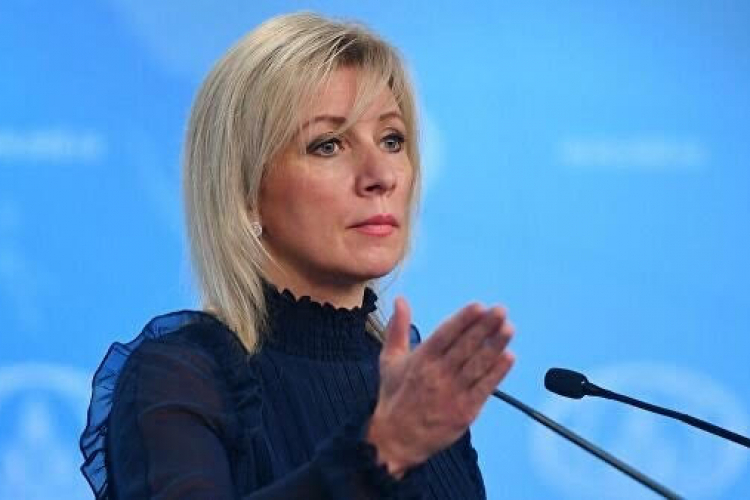
“Thank you, Mrs. Zaharova, for the lesson in imperial morality”. Op-Ed by Grigore Guzun

“Breaking news” from the Ministry of Truth in Moscow: Maria Zaharova has announced to us that NATO would be a “typical colonial empire” coming to “take resources, pit countries against each other, and leave behind chaos and military tension”. It is not the first time Russian officials make baseless statements, avoiding confronting the reality in their own country – a reality where foreign policy is not based on the principle of loyal cooperation between states, but on submission, aggression, and occupation.

1. When it comes to “empire” – let’s take it chronologically.

      The Soviet Union DID NOT launch accession chapters; it sent the ultimatum of June 26, 1940, and occupied Bessarabia with its army, proclaiming the Moldavian SSR on August 2, 1940. Armenia, Azerbaijan, Georgia had already been forcibly swallowed up as early as 1920-1922, under the umbrella of the Red Army. In contrast, in NATO you come if you want, after free elections, referendums, and 32 parliaments that have to ratify your request. Quite hard to confuse with tanks at 4 in the morning, isn’t it?

      2. About “plundering resources” – let’s remember the original.

      In the USSR, oil and gas were pumped from Azerbaijan, coal from Donbas, minerals from Armenia, fruits and vegetables from Moldova, tea and grapes from Georgia, but the added value and hard rubles were accumulated in Moscow. All high-ranking officials and enterprise directors were dispatched from Russia; most of them incompetent, they were nothing more than simple puppets of Moscow. This “colonialism” even bore the label “Made in Kremlin”.

      3. And after independence, the “great peacemaker” came with even more “peace”.

      – 1992: The Transnistria War, with the Russian army on the Dniester.

      – 2008: The War in Georgia.

      – 2014-2022: Crimea, Donbas and, ultimately, the large-scale invasion of Ukraine on February 24, 2022.

      – Meanwhile, “peacekeeping missions” that invariably end with the Russian flag fluttering over the neighbor’s territory. But supposedly, NATO is the problem.

      So, Mrs. Zaharova, thank you for the anti-colonialism lesson. When a country truly has a democratic choice, it flocks to Brussels, not Moscow. And if you’re still worried about the “risks” of cooperating with NATO, perhaps you can also explain the risks of cooperating with Russian tanks – we have already experienced them firsthand.


      The National Bank of Moldova organizes the financial education program “A Holiday Day at the NBM” /NBM / 09:00 AM/.

      The Integrity Council of the National Integrity Authority convenes in a meeting /ANI / 09:00 AM/.

      The parliamentary committee for European integration is hearing the semi-annual report on the fulfillment of payment conditions from the Reform Agenda related to the Growth Plan of the Republic of Moldova for the years 2025-2027 /Parliament, Europa Hall / 10:00 AM/.

      A court hearing is scheduled, at which the decision will be pronounced in the case where the Ministry of Justice is requesting the dissolution of the parties from the former political bloc “Victorie” /Court of Appeal Center / 10:30 AM/.

      The Audiovisual Council is convened for a meeting /CA /11:00 AM/.

      The Chisinau City Council meeting, which began on July 21, continues /Chisinau City Hall / at 01:00 PM/.

      0 FacebookTwitterPinterestEmail


      “Thank you, Mrs. Zaharova, for the lesson in imperial morality”. Op-Ed by Grigore Guzun

      “Breaking news” from the Ministry of Truth in Moscow: Maria Zaharova has announced to us that NATO would be a “typical colonial empire” coming to “take resources, pit countries against each other, and leave behind chaos and military tension”. It is not the first time Russian officials make baseless statements, avoiding confronting the reality in their own country – a reality where foreign policy is not based on the principle of loyal cooperation between states, but on submission, aggression, and occupation.

      1. When it comes to “empire” – let’s take it chronologically.

          The Soviet Union DID NOT launch accession chapters; it sent the ultimatum of June 26, 1940, and occupied Bessarabia with its army, proclaiming the Moldavian SSR on August 2, 1940. Armenia, Azerbaijan, Georgia had already been forcibly swallowed up as early as 1920-1922, under the umbrella of the Red Army. In contrast, in NATO you come if you want, after free elections, referendums, and 32 parliaments that have to ratify your request. Quite hard to confuse with tanks at 4 in the morning, isn’t it?

          2. About “plundering resources” – let’s remember the original.

          In the USSR, oil and gas were pumped from Azerbaijan, coal from Donbas, minerals from Armenia, fruits and vegetables from Moldova, tea and grapes from Georgia, but the added value and hard rubles were accumulated in Moscow. All high-ranking officials and enterprise directors were dispatched from Russia; most of them incompetent, they were nothing more than simple puppets of Moscow. This “colonialism” even bore the label “Made in Kremlin”.

          3. And after independence, the “great peacemaker” came with even more “peace”.

          – 1992: The Transnistria War, with the Russian army on the Dniester.

          – 2008: The War in Georgia.

          – 2014-2022: Crimea, Donbas and, ultimately, the large-scale invasion of Ukraine on February 24, 2022.

          – Meanwhile, “peacekeeping missions” that invariably end with the Russian flag fluttering over the neighbor’s territory. But supposedly, NATO is the problem.

          So, Mrs. Zaharova, thank you for the anti-colonialism lesson. When a country truly has a democratic choice, it flocks to Brussels, not Moscow. And if you’re still worried about the “risks” of cooperating with NATO, perhaps you can also explain the risks of cooperating with Russian tanks – we have already experienced them firsthand.


          Repair work on Mitropolit Dosoftei Street in the capital, on the section between Henri Coandă and Mihai Viteazul streets, will begin on Wednesday, July 22. According to municipal authorities, traffic will be partially restricted until August 30, with lanes being closed in stages, IPN reports.

          The work includes resurfacing the road, replacing curbs, repairing sidewalks, and creating new parking spaces.

          The city urges drivers to obey the temporary traffic signs in place during the construction work and to exercise caution in the construction zone.

          At the same time, drivers are urged to choose alternative routes whenever possible to avoid traffic jams and facilitate the progress of the work.

          0 FacebookTwitterPinterestEmail


          1 IANUARIE, 2025
          1 IANUARIE, 2025