

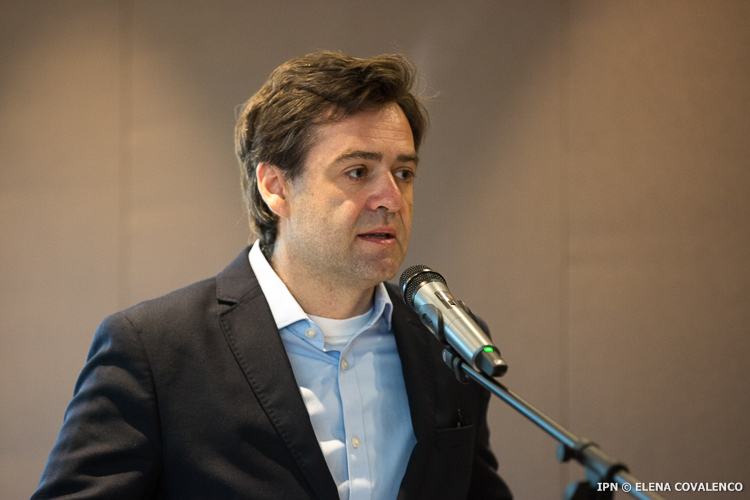
Moldova must persuade each EU member state of necessity of opening accession negotiations, Deputy Premier

The Republic of Moldova enjoys a big opportunity now, but also bears responsibility as regards the foreign policy as it needs to persuade the European institutions and each EU member state apart that it deserves to have the accession negotiations with the EU opened, Deputy Prime Minister Nicu Popescu, Minister of Foreign Affairs and European Integration, stated in a news conference in which he spoke about the important foreign policy events of the past few weeks, IPN reports.

The official said that at each stage Moldova now needs to persuade the European institutions and each EU member state apart how realistic the made changes and the steps taken on the path of accession to the EU are. “It is important to have a constant dialogue opened with absolutely each EU member state. For the purpose, in June we paid a number of visits so as to continue persuading each EU member state that the Republic of Moldova towards the end of this year will deserve being invited to open the accession negations with the EU,” stated Nicu Popescu.

According to the Deputy Premier, it is the moment of big opportunities. Over the past few months, some of the cooperation and European polices projects have been accelerated. The EU recently approved new sanctions against those who try to destabilize the situation in the Republic of Moldova. As a result, a number of individuals were put on the sanctions list this May. “At the end of May, together with the EU, we inaugurated a civilian partnership mission that will help our authorities to strengthen the institutions responsible for state security, including by developing our capacities to cope with hybrid threats,” said the official.

Nicu Popescu noted that the signing of an agreement between mobile network operators of Moldova and European partners is a great accomplishment. As a result, as from January 1 next year, the Moldovans who travel in most of the EU member states will benefit from much more advantageous roaming charges that will be gradually abolished.

The official also said that the NATO Summit will be held next week and this will include a ministerial meeting to which Moldova was invited. “For our country, the partnership with NATO is very important. It is a positive partnership that enables us to keep peace and calmness in the Republic of Moldova. We work with NATO to strengthen our capacities,” he stated, noting that NATO is an organization that, together with the EU, has ensured peace on the European continent, in the Euro-Atlantic area the past 70 years.


Chisinau does not risk running out of water, and currently there are no premises that could affect the capital’s water supply. The statement was made by the general mayor Ion Ceban during the operational meeting of the municipal services on Monday, after the Ministry of Environment warned that, due to the hydrological drought, the water intake station could become non-functional, if the level of the Nistru continues to decrease, reports IPN.

The Mayor specified that, over the weekend, the Commission for Exceptional Situations of Chisinau municipality approved the updated version of the civil protection plan regarding the water supply of the capital. Furthermore, specialists from Apa-Canal Chisinau have been delegated to constantly monitor the flow and water level of the Dniester, both in the central area and in the north of the country. According to Ion Ceban, in the last four days, there have been no deviations of the monitored indicators.

The mayor criticized the statements of the Ministry of Environment representatives and pointed out that the management of the Nistru river basin and water flows is the responsibility of the Government, not of the local authorities. He also announced that he requested the Prosecutor’s Office to be notified about the statements made by the representatives of the central authorities, which he considers likely to cause panic among the population.

The mayor’s reaction comes after the Minister of Environment, Gheorghe Hajder, stated that the water level in the Novodnestrovsk reservoir is decreasing due to drought and lack of precipitation in the Carpathians. According to the minister, if the level of the Nistru continues to decrease after July 31, the main pumps of the water intake station that supplies water to Chisinau could stop, as the installation can only operate from a certain water level. The minister also stated that the reserve system managed by Apa-Canal Chisinau is abandoned and it is unclear whether it can still be used.

Previously, the Ministry of Environment announced that the Republic of Moldova and Ukraine are facing a severe hydrological drought in the Dniester basin. The Ukrainian authorities proposed reducing the discharge from the Novodnestrovsk reservoir from 100 to 70 cubic meters per second, but, at the request of Chisinau, they agreed to maintain the current flow rate until July 31. At the end of the month, the two sides are to re-analyze the situation depending on the evolution of hydrological conditions.

0 FacebookTwitterPinterestEmail


Moldova must persuade each EU member state of necessity of opening accession negotiations, Deputy Premier

The Republic of Moldova enjoys a big opportunity now, but also bears responsibility as regards the foreign policy as it needs to persuade the European institutions and each EU member state apart that it deserves to have the accession negotiations with the EU opened, Deputy Prime Minister Nicu Popescu, Minister of Foreign Affairs and European Integration, stated in a news conference in which he spoke about the important foreign policy events of the past few weeks, IPN reports.

The official said that at each stage Moldova now needs to persuade the European institutions and each EU member state apart how realistic the made changes and the steps taken on the path of accession to the EU are. “It is important to have a constant dialogue opened with absolutely each EU member state. For the purpose, in June we paid a number of visits so as to continue persuading each EU member state that the Republic of Moldova towards the end of this year will deserve being invited to open the accession negations with the EU,” stated Nicu Popescu.

According to the Deputy Premier, it is the moment of big opportunities. Over the past few months, some of the cooperation and European polices projects have been accelerated. The EU recently approved new sanctions against those who try to destabilize the situation in the Republic of Moldova. As a result, a number of individuals were put on the sanctions list this May. “At the end of May, together with the EU, we inaugurated a civilian partnership mission that will help our authorities to strengthen the institutions responsible for state security, including by developing our capacities to cope with hybrid threats,” said the official.

Nicu Popescu noted that the signing of an agreement between mobile network operators of Moldova and European partners is a great accomplishment. As a result, as from January 1 next year, the Moldovans who travel in most of the EU member states will benefit from much more advantageous roaming charges that will be gradually abolished.

The official also said that the NATO Summit will be held next week and this will include a ministerial meeting to which Moldova was invited. “For our country, the partnership with NATO is very important. It is a positive partnership that enables us to keep peace and calmness in the Republic of Moldova. We work with NATO to strengthen our capacities,” he stated, noting that NATO is an organization that, together with the EU, has ensured peace on the European continent, in the Euro-Atlantic area the past 70 years.


The state of emergency in the economy of the Transnistrian region has been extended for another 30 days. The so-called supreme soviet of Tiraspol approved the “decree” issued by the region’s leader, Vadim Krasnoselski, regarding the maintenance of the measure, reports IPN.

According to the Tiraspol administration, the establishment of the special regime is determined by the decrease in productivity and the worsening of the economic situation in the region.

The state of emergency in the economy on the left bank of the Dniester was introduced for the first time in December 2024. After its expiration, the regime was re-established on December 18, 2025 and is subsequently extended every 30 days.

0 FacebookTwitterPinterestEmail


1 IANUARIE, 2025
1 IANUARIE, 2025