

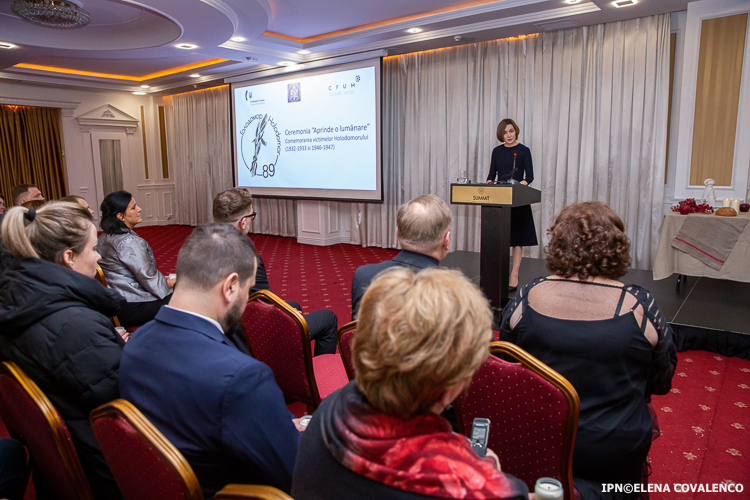
Maia Sandu: Holodomor victims must be commemorated, or else we risk seeing history repeat itself

The Holodomor, the organized famine, must be talked about in every school, written in every history textbook, memorial plaques with the names of every victim must be made. If we neglect this past, we risk not learning our lessons and ending up with history repeating itself, said Moldovan President Maia Sandu during a ceremony in remembrance of the Holodomor victims.

“For nine months now, Russia has been trying to subjugate the Ukrainian people through the most criminal and terrorist methods. Millions of people have fled their homes and country, millions more are without power and heating with bombs flying overhead. And killing two-day-old children. Has Russia achieved its goal by sowing so much misery? No!” declared Maia Sandu.

The Ukrainian Ambassador to Moldova Marko Shevchenko noted that as a result of the Holodomor organized by the Soviet authorities, at least four million Ukrainians died, and the experienced horrors left their mark on several generations of Ukrainians. “Absolutely unpredictably, even 90 years after the organized famine against Ukrainians, genocidal methods in the form of Russia’s full-scale war against Ukraine are still being used, which has demonstrated that Russia once again wants to destroy the Ukrainian nation, identity, culture and language”.

According to the ambassador, the Russian attacks on critical infrastructure are an attempt to freeze Ukrainians and force them to flee abroad. Almost five million Ukrainians have already left the country. Moldova is also feeling the consequences of these attacks. “I have no doubt that all the criminal plans of the aggressor will fail. Unlike in the 1930s, when Western governments preferred to keep silent about the Holodomor, today Ukraine has the support of the entire civilized world”, he concluded.


Today the Holodomor is recognized as a genocide of the Ukrainian people by 23 countries of the world, including the U.S. and Canada, but also as a crime against humanity by the Parliamentary Assembly of the Council of Europe and the European Parliament.


The exhibition “Scent of Warm Bread. Bread in the Iron Age” is inaugurated /National Museum of History of Moldova (July 22 – September 4) / 02:00 PM/.

The exhibition “Urban Archaeology and the Hidden Memory of Chisinau” continues /National Museum of History of Moldova /July 17-November 30/.

The contemporary art exhibition-competition continues: The municipal salon within the “Te salut, Chisinau!” Festival, the VI edition, dedicated to the 590th anniversary of the city /Constantin Brancusi Exhibition Center /July 8-26/.

The documentary exhibition “Echo from the past, for present and future” continues, dedicated to the memory of the victims of Stalinist deportations and one of the most tragic episodes in the history of Bessarabia /BNRM /July 3-August 3/.

The exhibition “The Thread of Identity! The traditional Romanian costume in book illustrations made by plastic artists from the Republic of Moldova” continues /BNRM /June 25-August 15/.

The graphic exhibition by Lica Sainciuc continues, opened as part of the Creative Industries Festival /Lutnita Gallery /June 5 – July 31/.

0 FacebookTwitterPinterestEmail


Maia Sandu: Holodomor victims must be commemorated, or else we risk seeing history repeat itself

The Holodomor, the organized famine, must be talked about in every school, written in every history textbook, memorial plaques with the names of every victim must be made. If we neglect this past, we risk not learning our lessons and ending up with history repeating itself, said Moldovan President Maia Sandu during a ceremony in remembrance of the Holodomor victims.

“For nine months now, Russia has been trying to subjugate the Ukrainian people through the most criminal and terrorist methods. Millions of people have fled their homes and country, millions more are without power and heating with bombs flying overhead. And killing two-day-old children. Has Russia achieved its goal by sowing so much misery? No!” declared Maia Sandu.

The Ukrainian Ambassador to Moldova Marko Shevchenko noted that as a result of the Holodomor organized by the Soviet authorities, at least four million Ukrainians died, and the experienced horrors left their mark on several generations of Ukrainians. “Absolutely unpredictably, even 90 years after the organized famine against Ukrainians, genocidal methods in the form of Russia’s full-scale war against Ukraine are still being used, which has demonstrated that Russia once again wants to destroy the Ukrainian nation, identity, culture and language”.

According to the ambassador, the Russian attacks on critical infrastructure are an attempt to freeze Ukrainians and force them to flee abroad. Almost five million Ukrainians have already left the country. Moldova is also feeling the consequences of these attacks. “I have no doubt that all the criminal plans of the aggressor will fail. Unlike in the 1930s, when Western governments preferred to keep silent about the Holodomor, today Ukraine has the support of the entire civilized world”, he concluded.


Today the Holodomor is recognized as a genocide of the Ukrainian people by 23 countries of the world, including the U.S. and Canada, but also as a crime against humanity by the Parliamentary Assembly of the Council of Europe and the European Parliament.


Children from the diaspora aged 7 to 12 will have the opportunity to discover Chisinau through a series of free educational and creative activities. From August 10 to 15, they will take part in tours of the capital, meetings with writers, and creative workshops organized by the “B. P. Hasdeu” Municipal Library under the auspices of the Chisinau City Hall, according to IPN.

Representatives of the institution note that the “At Home in Chisinau” summer camp offers a captivating journey into the city’s history and culture. Over the course of six days, children will explore iconic sites in the capital and discover legends and stories about Chisinau. The program also includes meetings with artisans, artistic activities, and traditional games.

With the exception of guided tours, all activities will take place at the main branch of the “B.P. Hasdeu” Municipal Library. Registration for the summer camp is open until August 7 and can be completed by filling out the online form.

The first edition, which took place online, was attended by 20 children from Germany, Italy, France, and Ireland.

0 FacebookTwitterPinterestEmail


1 IANUARIE, 2025
1 IANUARIE, 2025