

Liquidating three banks is a solution for overcoming crisis in banking system

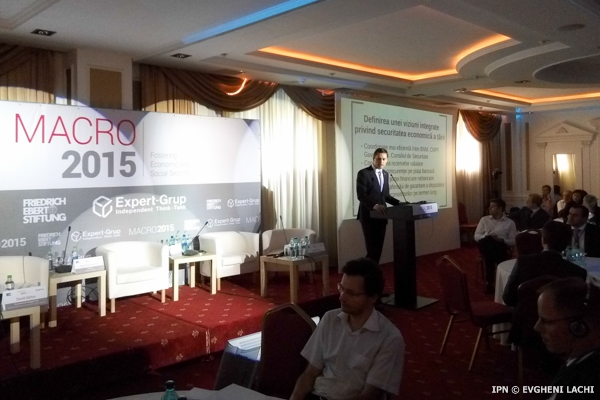
Adrian Lupusor, executive director of the Independent Analytical Center “Expert-Grup”, said an immediate solution for overcoming the crisis in the banking system of Moldova is to liquidate the three trouble-causing banks – Banca de Economii, Banca Sociala and Unibank. If these banks are liquidated, all the deposits must be paid back and the persons responsible for the crisis must be held accountable. The financial-banking regulatory system should be reformed. Such statements were made in the opening of the annual international conference MACRO-2015 “Promotion of economic and social security amid major risks”, IPN reports.

The “Expert-Grup” executive director said that Moldova faces unprecedented risks caused by the internal situation, namely the political instability, endemic corruption and vulnerability of the economic sector, and by the external one – the crisis in Ukraine and Russia, which bring serious threats to the economic and social security of the state. The fundamental elements that ensure the security of the state, such as confidence in politicians, have been lately compromised.

Adrian Lupusor noted that one of the manifestations of these problems is the crisis that appeared in the banking sector, especially at the three aforementioned banks, following the regulation failure in the sector. There are also factors that led to this crisis and there is no political will for removing them. This can lead to a repeat of the current situation.

The expert also said that Moldova faces a shortage of human capital, which is of poor quality. This reduces the potential of implementing the Association Agreement with the EU. The political elites, instead of serving as a driving force for doing reforms, represent in fact the main hindrances that determine the polarization of society. The local and parliamentary elections turned from solutions into a cause that led to the worsening of problems. As a result, confidence in the state institutions decreases.

According to Adrian Lupusor, an external anchor should appear to exert pressure on the Moldovan political class so that this deepens reforms. The whole public sector in Moldova must be subject to an audit so as to increase responsibility and the pressure on the part of society on regulatory institutions.

The expert also said that to overcome the situation created in the banking sector, the independence of the National Bank must be strengthened as the crisis wouldn’t have appeared if the central bank had been immune to particular political interference. The connection of the banking system with offshore companies must be banned by law, while the security institutions should more efficiently coordinate their activities. Among other measures that should be taken are to strengthen the foreign exchange reserves and to increase the bank deposit guarantees.


Official documents issued in the Republic of Moldova and Germany may now be used in each other’s countries with only an apostille, without the need for the legalization procedure. The measure enters into force following the Federal Republic of Germany’s withdrawal of the reservation it made in 2007 when the Republic of Moldova acceded to the Hague Apostille Convention, IPN reports.

The Ministry of Foreign Affairs states that the decision was made following steps taken by Deputy Prime Minister Mihai Popsoi, Minister of Foreign Affairs, during his May 18–19 meeting with his German counterpart, Johann David Wadephul.

The ministry emphasizes that the new system will eliminate the need to visit multiple institutions or diplomatic missions to have documents legalized, which will reduce both the time required and the costs incurred by citizens. The simplified procedure will apply to official documents such as birth, marriage, divorce, and death certificates, criminal records, academic diplomas, and diploma supplements.

The Hague Convention on the Apostille entered into force for the Republic of Moldova on March 16, 2007. With its implementation in relations with Germany, the Republic of Moldova will benefit from the same simplified procedure for the recognition of official documents as it does with all 130 states and entities that are parties to the convention.

0 FacebookTwitterPinterestEmail


Liquidating three banks is a solution for overcoming crisis in banking system

Adrian Lupusor, executive director of the Independent Analytical Center “Expert-Grup”, said an immediate solution for overcoming the crisis in the banking system of Moldova is to liquidate the three trouble-causing banks – Banca de Economii, Banca Sociala and Unibank. If these banks are liquidated, all the deposits must be paid back and the persons responsible for the crisis must be held accountable. The financial-banking regulatory system should be reformed. Such statements were made in the opening of the annual international conference MACRO-2015 “Promotion of economic and social security amid major risks”, IPN reports.

The “Expert-Grup” executive director said that Moldova faces unprecedented risks caused by the internal situation, namely the political instability, endemic corruption and vulnerability of the economic sector, and by the external one – the crisis in Ukraine and Russia, which bring serious threats to the economic and social security of the state. The fundamental elements that ensure the security of the state, such as confidence in politicians, have been lately compromised.

Adrian Lupusor noted that one of the manifestations of these problems is the crisis that appeared in the banking sector, especially at the three aforementioned banks, following the regulation failure in the sector. There are also factors that led to this crisis and there is no political will for removing them. This can lead to a repeat of the current situation.

The expert also said that Moldova faces a shortage of human capital, which is of poor quality. This reduces the potential of implementing the Association Agreement with the EU. The political elites, instead of serving as a driving force for doing reforms, represent in fact the main hindrances that determine the polarization of society. The local and parliamentary elections turned from solutions into a cause that led to the worsening of problems. As a result, confidence in the state institutions decreases.

According to Adrian Lupusor, an external anchor should appear to exert pressure on the Moldovan political class so that this deepens reforms. The whole public sector in Moldova must be subject to an audit so as to increase responsibility and the pressure on the part of society on regulatory institutions.

The expert also said that to overcome the situation created in the banking sector, the independence of the National Bank must be strengthened as the crisis wouldn’t have appeared if the central bank had been immune to particular political interference. The connection of the banking system with offshore companies must be banned by law, while the security institutions should more efficiently coordinate their activities. Among other measures that should be taken are to strengthen the foreign exchange reserves and to increase the bank deposit guarantees.


Maritime schools could be opened in Moldova following the full transposition of relevant European legislation. The statement was made by Deputy Prime Minister Vladimir Bolea, Minister of Infrastructure and Regional Development, who noted that there is growing interest in such programs, including from Ukrainian citizens affected by the war, according to IPN.

Vladimir Bolea stated that the new regulations will allow seaman’s books to be issued based on studies completed in the Republic of Moldova at authorized institutions.

The minister told the press that, at present, no ships are sailing under the flag of the Republic of Moldova, but the authorities are working to transpose European legislation and develop the legal framework necessary for the development of this sector.

According to him, the state and the Naval Agency could generate significant revenue both from ships sailing under the Moldovan flag and from institutions that train seafarers.

0 FacebookTwitterPinterestEmail


1 IANUARIE, 2025
1 IANUARIE, 2025