

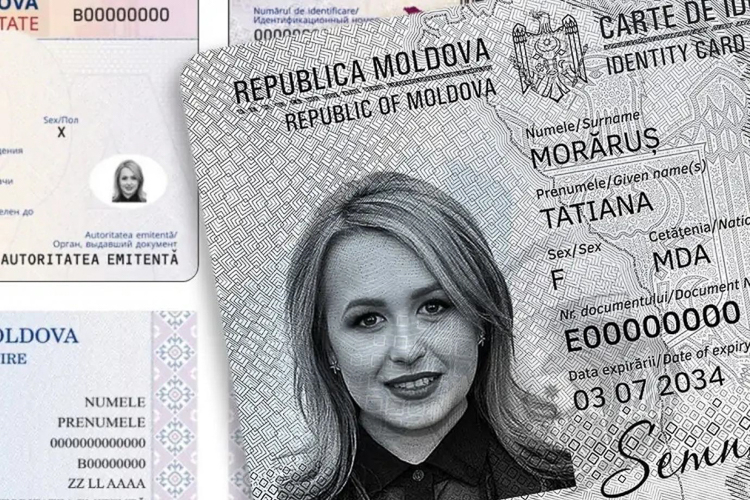
Information on the citizen’s domicile and surname excluded from the ID card

The new ID card will no longer contain the person’s home address and patronymic. The changes are contained in a draft law on amending some normative acts related to the issuance of the ID card, IPN reports.

The ID card will no longer contain information on the person’s domicile or temporary residence, including temporary residence. The author of the draft argues that the exclusion of these data will relieve holders of the obligation to exchange documents every time they change their place of residence. The data that will not be included in the physical document will be accessible in the State Population Register via the interoperability platform (MConnect).

The holder’s patronymic information will also not be included in the ID card.

The draft also provides for an exemption from the state tax for the registration of domicile for children up to 14 years of age who do not have identity documents. The document also contains provisions aimed at exempting foreign or stateless children who have entered the territory of the Republic of Moldova without being accompanied by an adult or have been left on the territory of the Republic of Moldova without a legal document from the state tax.

Persons belonging to national minorities will also have the right to use their names in the form accepted in their mother tongue. When foreigners’ surnames and forenames are reproduced in residence cards, they shall not be translated or transliterated, but shall be transcribed according to their spelling into the Latin spelling of the national passport or travel document issued by the competent foreign authorities.

In addition to the beneficiary’s personal data, the ID card also contains an electronic signature, valid for 5 years, which will allow access to the data in electronic format.

According to data provided by the Public Services Agency, about 50 thousand people have applied for identity cards so far. Identity cards will be issued free of charge to one million people, the costs being covered by the ASP budget.

The document, drafted by the Public Services Agency in partnership with the Ministry of Internal Affairs, is to be examined by the full Parliament.


The exhibition “Urban Archaeology and the Hidden Memory of Chisinau” continues /National Museum of History of Moldova /July 17-November 30/.

The contemporary art exhibition-competition continues: The municipal salon within the “Te salut, Chisinau!” Festival, the VI edition, dedicated to the 590th anniversary of the city /Constantin Brancusi Exhibition Center /July 8-26/.

The documentary exhibition “Echo from the past, for present and future” continues, dedicated to the memory of the victims of Stalinist deportations and one of the most tragic episodes in the history of Bessarabia /BNRM /July 3-August 3/.

The exhibition “The Thread of Identity! The traditional Romanian costume in book illustration made by plastic artists from the Republic of Moldova” continues /BNRM /June 25-August 15/.

The graphic exhibition by Lica Sainciuc continues, opened as part of the Creative Industries Festival /Lutnita Gallery /June 5 – July 31/.

0 FacebookTwitterPinterestEmail


Information on the citizen’s domicile and surname excluded from the ID card

The new ID card will no longer contain the person’s home address and patronymic. The changes are contained in a draft law on amending some normative acts related to the issuance of the ID card, IPN reports.

The ID card will no longer contain information on the person’s domicile or temporary residence, including temporary residence. The author of the draft argues that the exclusion of these data will relieve holders of the obligation to exchange documents every time they change their place of residence. The data that will not be included in the physical document will be accessible in the State Population Register via the interoperability platform (MConnect).

The holder’s patronymic information will also not be included in the ID card.

The draft also provides for an exemption from the state tax for the registration of domicile for children up to 14 years of age who do not have identity documents. The document also contains provisions aimed at exempting foreign or stateless children who have entered the territory of the Republic of Moldova without being accompanied by an adult or have been left on the territory of the Republic of Moldova without a legal document from the state tax.

Persons belonging to national minorities will also have the right to use their names in the form accepted in their mother tongue. When foreigners’ surnames and forenames are reproduced in residence cards, they shall not be translated or transliterated, but shall be transcribed according to their spelling into the Latin spelling of the national passport or travel document issued by the competent foreign authorities.

In addition to the beneficiary’s personal data, the ID card also contains an electronic signature, valid for 5 years, which will allow access to the data in electronic format.

According to data provided by the Public Services Agency, about 50 thousand people have applied for identity cards so far. Identity cards will be issued free of charge to one million people, the costs being covered by the ASP budget.

The document, drafted by the Public Services Agency in partnership with the Ministry of Internal Affairs, is to be examined by the full Parliament.


The National Anticorruption Center initiated 428 criminal cases in the first six months of the year and sent about half of the investigated files to court. Also, the Agency for the Recovery of Criminal Assets seized 382 assets worth over 236 million lei, reports IPN.

According to the data in the activity report presented at the meeting of the CNA College, during this period, another 447 corruption offenses were documented, and 500 people were recognized as suspects.

On the asset recovery component from offenses, the courts have confirmed previous seizures on goods worth over 221 million lei. At the same time, ARBI issued 15 freezing orders on assets, with a total value of over 22.7 million lei.

The CNA has also reported on activities carried out in the field of corruption prevention. In the first six months of the year, the institution examined 616 regulatory projects, of which 538 were subjected to anti-corruption expertise to identify risks that could favor acts of corruption.

0 FacebookTwitterPinterestEmail


1 IANUARIE, 2025
1 IANUARIE, 2025