

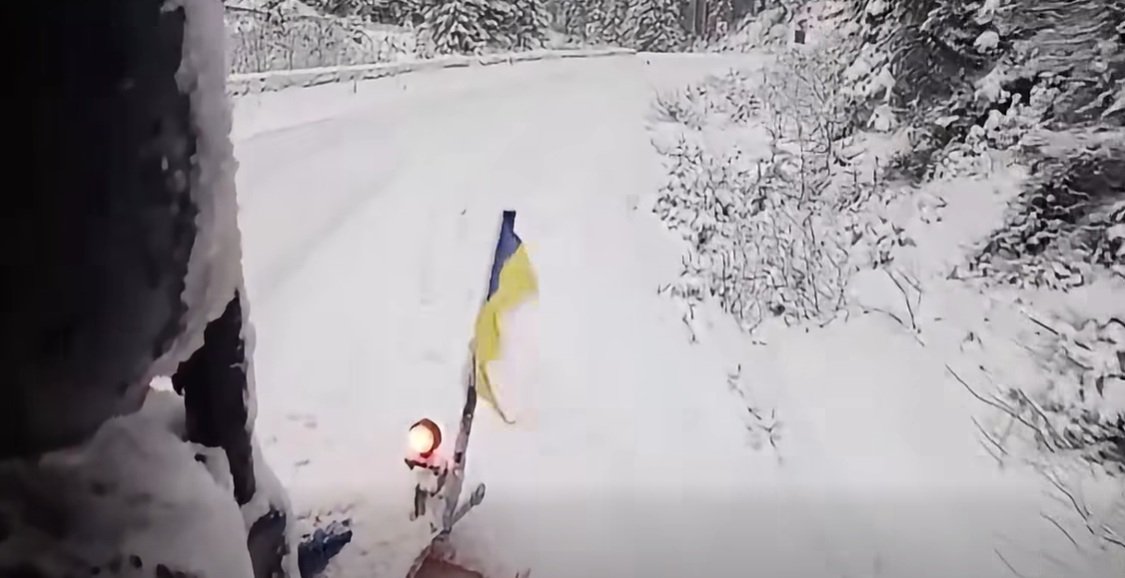
Heavy snowfall on the Transalpina. The road has been closed to traffic

Photo credit: DRDP Craiova/screenshot

Traffic has been completely shut down on the Transalpina road in Romania due to heavy snowfall. According to the Craiova Regional Directorate of Roads and Bridges (DRDP Craiova), the decision took effect at 10:30 AM and covers an 18-kilometer stretch between Obarsia Lotrului and Curpat, reports IPN.

The restriction will remain in place until weather conditions improve. The area in question, the DRDP Craiova statement further notes, is characterized by sharp curves and steep gradients. Moreover, there is no mobile phone signal in the area, and the risk of vehicles becoming stranded in the snow is very high.
Additionally, there are no homes or inhabited buildings along this stretch of the road.

As snowfall continues, snow-clearing equipment has been withdrawn from the road. Operations will resume once conditions allow crews to work safely. Authorities urge drivers to observe the restrictions in place and not attempt to enter the closed section of road.

0 FacebookTwitterPinterestEmail


Heavy snowfall on the Transalpina. The road has been closed to traffic

Photo credit: DRDP Craiova/screenshot

Traffic has been completely shut down on the Transalpina road in Romania due to heavy snowfall. According to the Craiova Regional Directorate of Roads and Bridges (DRDP Craiova), the decision took effect at 10:30 AM and covers an 18-kilometer stretch between Obarsia Lotrului and Curpat, reports IPN.

The restriction will remain in place until weather conditions improve. The area in question, the DRDP Craiova statement further notes, is characterized by sharp curves and steep gradients. Moreover, there is no mobile phone signal in the area, and the risk of vehicles becoming stranded in the snow is very high.
Additionally, there are no homes or inhabited buildings along this stretch of the road.

As snowfall continues, snow-clearing equipment has been withdrawn from the road. Operations will resume once conditions allow crews to work safely. Authorities urge drivers to observe the restrictions in place and not attempt to enter the closed section of road.


Farmers in the Republic of Moldova will have access to a system that connects them with researchers, agricultural advisers and educational institutions to help them find solutions to agricultural challenges and adopt new technologies. The Agricultural Knowledge and Innovation System (AKIS) was launched on Monday by the Ministry of Agriculture and Food Industry and the Agricultural and Rural Advisory Centre, IPN reports.

AKIS is a framework for collaboration between those who generate agricultural knowledge and those who use it. It aims to facilitate the transfer of research findings to farmers while also bringing the challenges they face to the fore, so that proposed solutions can better meet their practical needs.

“The knowledge is there, but it is not being shared. Research findings are slow to make their way from the laboratory to the field and into farmers’ hands”, explained Rodica Resitca, head of the Research, Training and Agricultural Advisory Services Directorate at the Ministry of Agriculture and Food Industry. She noted that the system would include training for farmers and advisers, on-farm advisory services, demonstration plots and innovation groups. These initiatives will enable farmers, researchers and advisers to work together to identify and test solutions to practical problems.

The system will bring together public authorities, universities, research institutions, professional associations, private companies and development partners. Agricultural advisers will play a key role, serving as a link between researchers and farmers. The first round of selection for advisers to be included in the AKIS list is scheduled for December. In addition, from 2027, the Agricultural and Rural Advisory Centre will also operate through its regional centres in Balti and Cahul.

Minister of Agriculture and Food Industry Eugeniu Osmochescu said the new system would make it easier for farmers to access European research and development programmes. He highlighted Horizon Europe in particular, which has a proposed budget of €158 billion for the next funding cycle, starting in 2028. “We must do everything we can—now, in 2026, and in 2027 and 2028—to bring in as much knowledge as possible and make the most of everything available to us”, the minister said.

Deputy Secretary General of the Government Lilia Dabija explained that the launch of AKIS is one of the 153 measures the Republic of Moldova has committed to under the Growth Plan, all of which must be implemented by December this year. She noted that, if this measure is confirmed as completed, the country will receive €11.6 million in EU budget support. According to Dabija, the funding will support regional development, infrastructure projects and information systems. “Our motto in government is: the Republic of Moldova delivers, the European Union disburses”, she said.

The AKIS system was launched at the 2026 “AgroCunoștințe” National Forum, held from 17 to 23 November in Balti, Cahul and Chisinau. During the regional meetings, researchers presented proven solutions to agricultural challenges, including maize hybrids, soil conservation methods and drought-resistant crops, which can be adopted as early as the next growing season.

0 FacebookTwitterPinterestEmail


1 IANUARIE, 2025
1 IANUARIE, 2025