

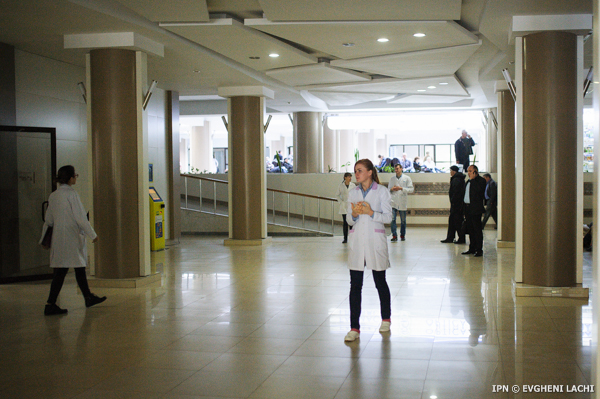
Health system will be adjusted to climate change

The health facilities in 2016- 2020 will be fully connected to sustainable water supply and sewerage systems. They will be outfitted with equipment for collecting and neutralizing medical waste called autoclaves. A number of 25 energy efficiency projects are to be implemented in a number of medical institutions. The objectives are stipulated in the sector climate change adjustment stagey that was worked out by the Ministry of Health, IPN reports.

Besides, there will be launched the automated information system in primary medical care with the electronic register of patients. This system will help improve the existing data collection and monitoring systems, including about nutritional surveillance and non-transmitted disease. There will also be developed the system for monitoring hospital admissions in relation to heat waves and air pollution.

“The strengthening of the resilience of health facilities and population to climate change will help eliminate the threats to human rights, namely the right to life, the right to the highest physical health standards and the right to safe and hygienic working conditions,” said the Ministry of Health.

The implementation of the sector strategy will necessitate additional costs for providing the health facilities with efficient mechanism for the prevention, early warning, management and overcoming of extreme weather phenomena, strengthening the system for preventing infectious diseases influenced by climate change and for developing ‘green’ medical services. The strategy will be implemented by the medical-sanitary authorities responsible for carrying out the measures stipulated in the plan of action, with the assistance of the Ministry of Health.

Climate change is an unprecedented challenge faced by modern society. Measures need to be taken to mitigate the effects at global and local levels.

Moldova’s economy, even if it is a small one, experiences the same problems as the large and developed countries because its adjustment capacities are limited owing to the financial constraints. Climate change represents a risk to the sustainable development of the country. That’s why the mitigation and adjustment measures must become a priority of the national policies, said the Ministry.

In December 2014, the Government of Moldova approved the national climate change adjustment strategy until 2020 and its plan of action.


In recent weeks, the leadership of Gagauzia presents the electoral legislation reform as an attack from Chisinau on the special status of the autonomous region. From this perspective, the Parliament of the Republic of Moldova would “withdraw” from the Popular Assembly of Gagauzia the right to independently establish the rules of its own elections, would introduce a discriminatory linguistic condition for candidates for the position of governor, and would intentionally delay the setting of the election date for the head of the autonomous region, amplifying the political crisis in the region.

In reality, it’s about a more complex process: some of the changes are the direct result of the Constitutional Court’s decision on July 9, 2026, which established that the Parliament, not the People’s Assembly, should regulate electoral legislation. Other controversial provisions, especially the language requirement, are introduced for the first time and are already being challenged at the Constitutional Court. And the vacancy of the governor’s position is related to a conviction in a criminal case, not procedural delays. At the same time, the central authorities’ communication regarding the details of the reform is not fully transparent, which leaves room for mutual accusations.

What happened?

On July 9, 2026, the Constitutional Court of the Republic of Moldova declared unconstitutional the provisions that allowed the Gagauz People’s Assembly to independently establish the mechanisms for organizing its own elections. The Court decided that electoral legislation can only be regulated by the Parliament of the Republic of Moldova.

Three weeks later, on July 27, a bill was registered in Parliament by the PAS deputy Igor Chiriac, which provides for the creation of a permanent electoral body for the autonomous region and the transition from the single-member system to the proportional one for the election of the Popular Assembly.

On July 31, the project was approved in the first reading with 52 votes from the PAS deputies, and on August 24 — in the second reading.

Meanwhile, the institutional crisis in Gagauzia has intensified. On July 31, the session of the People’s Assembly, during which the issue of elections for the position of governor was to be discussed, failed due to lack of quorum. On August 17, the People’s Assembly declared the position of governor vacant, following the sentencing of former governor Evghenia Guțul to seven years in prison in a case involving the illegal financing of a party and receiving money from Ilan Șor’s group.

On August 28, the electoral period officially began in autonomy. The elections for the People’s Assembly are scheduled for November 15, 2026, and the electoral campaign will begin on October 16.

What changes in the electoral rules?

The reform approved by Parliament introduces several important changes.

In Gagauzia, a permanent Central Electoral Council is to be established, consisting of 7-11 members, unlike the current practice, when electoral bodies are constituted for each separate ballot.

The People’s Assembly is set to transition from the majority system, based on single-member constituencies, to the proportional system. However, the elections of November 15, 2026 will be conducted under the old system.

Also, the concept of “regional elections” is introduced, which will include in a common legal framework the election of the governor, the elections for the People’s Assembly, and regional referendums.

One of the most controversial changes is the introduction, for the first time, of the obligation for those running for the position of governor to know the state language — the Romanian language.

The Comrat Narrative: “our autonomy is being taken away”

The leadership of Gagauzia maintains that the reform diminishes the competencies of the autonomous region and affects its special status. Representatives of the Popular Assembly have called for the involvement of European structures and insisted on more extensive public and legal consultations before changing the legislation.

One of the main points of contention remains the language requirement for candidates for the position of governor.

Deputy Igor Dodon, the president of the Socialist Party, has appealed to the Constitutional Court, arguing that this provision contravenes the Law on the special legal status of Gagauzia, which establishes the requirement of knowing the Gagauz language, and not the state language.

Until the Constitutional Court makes a decision, the legality of applying this requirement in the case of the autonomous region with special legal status remains an open question.

Who sets the rules?

From a legal standpoint, the decision of the Constitutional Court on July 9 establishes that the regulation of electoral legislation falls under the competence of the Parliament of the Republic of Moldova.

At the same time, the legislation provides for the consultation of Gagauzia when projects that affect its status and competencies are adopted.

Therefore, the dispute is no longer just about who has the right to regulate elections. The Court has already answered this question.

The issue is also to what extent consultations with the autonomous region were respected before the adoption of the amendments.

Thus, the current conflict surpasses the strictly electoral issue.

This is a dispute about where the competences of Chisinau end and where the autonomy of Gagauzia begins.

And the way this border will be established in practice will again largely depend on the Constitutional Court.

“The linguistic requirement represents discrimination against Gagauzia”

The author of the bill, Igor Chiriac, argues that the requirement for Romanian language proficiency for candidates for the position of governor is not a measure specifically directed against the autonomous region, but a standard applied nationally for all important public roles: “it is a standard not only for the region, but for all elections,” said Igor Chiriac.

From this perspective, the requirement falls under a general principle: the head of a region, who by the nature of his role interacts with central authorities, must know the state language.

However, this argument has a weak point, invoked by Igor Dodon: The law regarding the special legal status of Gagauzia stipulates the knowledge of the Gagauz language and not the state language. This very discrepancy is currently being contested at the Constitutional Court.

Until the Court’s ruling, the question of whether such a national standard can be applied to an autonomous region with special legal status remains open. It is not a clarified legal fact, but the subject of a constitutional dispute.

In this context, it should be noted that the former governor Evghenia Gutul predominantly used Russian in her public appearances.

“The position of governor is intentionally kept vacant”

The facts do not confirm the version according to which the central authorities would intentionally delay the resolution of the problem.

The position became vacant following the final conviction in a criminal case: Evghenia Gutul was detained in March 2025 and subsequently sentenced to seven years in prison for illegal financing of a party and receiving funds from a group associated with Ilan Șor.

A real delay does exist, however, but this occurred within Gagauzia.

On July 31, the plenary session of the People’s Assembly, during which the official vacancy of the position was to be declared and the date of the new elections discussed, failed due to lack of quorum.

The position of governor was officially declared vacant only on August 17th.

And until the end of August, the date for the elections for the new governor had not yet been set. This is the only element of the situation where the accusation of “procrastination” can be related to the procedures within the autonomous region, and not to the central authorities.

The geopolitical context

The linguistic and procedural dispute unfolds in a much broader geopolitical context.

On one hand, the President of the Parliament, Igor Grosu, associates the opposition of the Popular Assembly against the reform with Moscow’s influence.

On the other hand, the Government of the Republic of Moldova, led by Prime Minister Vasile Tofan, is betting on bringing the autonomous region closer to Turkey as an alternative attraction center.

On July 30th, Tofan called Gagauzia an “important asset”, capable of building “bridges” with Turkey.

And on August 20, Igor Grosu received a Turkish parliamentary delegation, led by Kürşad Zorlu, and proposed the expansion of Turkish projects in the region.

From 1994 to the present, Turkey has implemented approximately 500 projects in the Republic of Moldova, worth over 80 million dollars, and trade exchanges between the two countries exceeded one billion euros in 2025.

At the same time, the leadership of the People’s Assembly is seeking support on the European dimension as well. Valentin Gaidarji appealed to the European Union, OSCE and the Council of Europe in the context of the dispute between Comrat and Chisinau.

Conclusion

The essential question is not who is “right” — Chisinau, invoking the decision of the Constitutional Court and the principle of a unified electoral legislation, or Comrat, insisting on its special status and the right to consultations.

Both arguments have a real basis and are provided for by different rules, which are now in contradiction. It is precisely this contradiction, and not necessarily the ill-will of one of the parties, that lies at the root of the current crisis.

Much more important is how this contradiction will be resolved in practice: whether the Constitutional Court will rule on the language requirement before the start of the election campaign, on October 16; whether the date of the elections for the position of governor will be determined and according to which procedures; as well as how consistent future consultations between the Parliament and the Gagauz People’s Assembly regarding the details of the reform will be.

The answers to these questions will determine whether the November 15 elections for the Gagauz People’s Assembly will remain a simple electoral vote or will transform into a new stage of confrontation between the autonomous region and the central authorities.

0 FacebookTwitterPinterestEmail


Health system will be adjusted to climate change

The health facilities in 2016- 2020 will be fully connected to sustainable water supply and sewerage systems. They will be outfitted with equipment for collecting and neutralizing medical waste called autoclaves. A number of 25 energy efficiency projects are to be implemented in a number of medical institutions. The objectives are stipulated in the sector climate change adjustment stagey that was worked out by the Ministry of Health, IPN reports.

Besides, there will be launched the automated information system in primary medical care with the electronic register of patients. This system will help improve the existing data collection and monitoring systems, including about nutritional surveillance and non-transmitted disease. There will also be developed the system for monitoring hospital admissions in relation to heat waves and air pollution.

“The strengthening of the resilience of health facilities and population to climate change will help eliminate the threats to human rights, namely the right to life, the right to the highest physical health standards and the right to safe and hygienic working conditions,” said the Ministry of Health.

The implementation of the sector strategy will necessitate additional costs for providing the health facilities with efficient mechanism for the prevention, early warning, management and overcoming of extreme weather phenomena, strengthening the system for preventing infectious diseases influenced by climate change and for developing ‘green’ medical services. The strategy will be implemented by the medical-sanitary authorities responsible for carrying out the measures stipulated in the plan of action, with the assistance of the Ministry of Health.

Climate change is an unprecedented challenge faced by modern society. Measures need to be taken to mitigate the effects at global and local levels.

Moldova’s economy, even if it is a small one, experiences the same problems as the large and developed countries because its adjustment capacities are limited owing to the financial constraints. Climate change represents a risk to the sustainable development of the country. That’s why the mitigation and adjustment measures must become a priority of the national policies, said the Ministry.

In December 2014, the Government of Moldova approved the national climate change adjustment strategy until 2020 and its plan of action.


The death toll from the landslides and floods in Nepal last week has reached 903. Authorities in Kathmandu have also updated the list of missing persons, which now numbers 4,247 people, reports BBC, quoted by IPN.

Among the missing persons, over 3,600 are Nepalese citizens, and nearly 600 are foreign citizens. The lists include 933 employees of hydroelectric projects, 102 military personnel, police officers, and customs service employees. Hundreds of workers are being searched for in the tunnels of hydroelectric plants affected by floods.

The rescue operations have entered their sixth day and are being carried out under difficult conditions. Many roads have been destroyed by the waters, and in hard-to-reach areas, helicopters are being used for the transportation of intervention teams, medicines, and other first aid materials.

The unidentified bodies, brought downstream by the waters, are temporarily buried, as there are no available spaces in the morgues. DNA samples have been taken for their identification, which will be compared with those of the relatives of the missing. In the localities severely affected by the floods, hundreds of people have been evacuated and are living in temporary camps.

The disaster also affected the Tibet region, on the Chinese side of the border, where authorities reported 16 deaths and 546 missing persons. The search operations continue, but the chances of finding survivors decrease with each passing day. In some areas, the layer of mud exceeds one meter, and meteorologists warn that the rains will continue, further complicating interventions.

0 FacebookTwitterPinterestEmail


1 IANUARIE, 2025
1 IANUARIE, 2025