




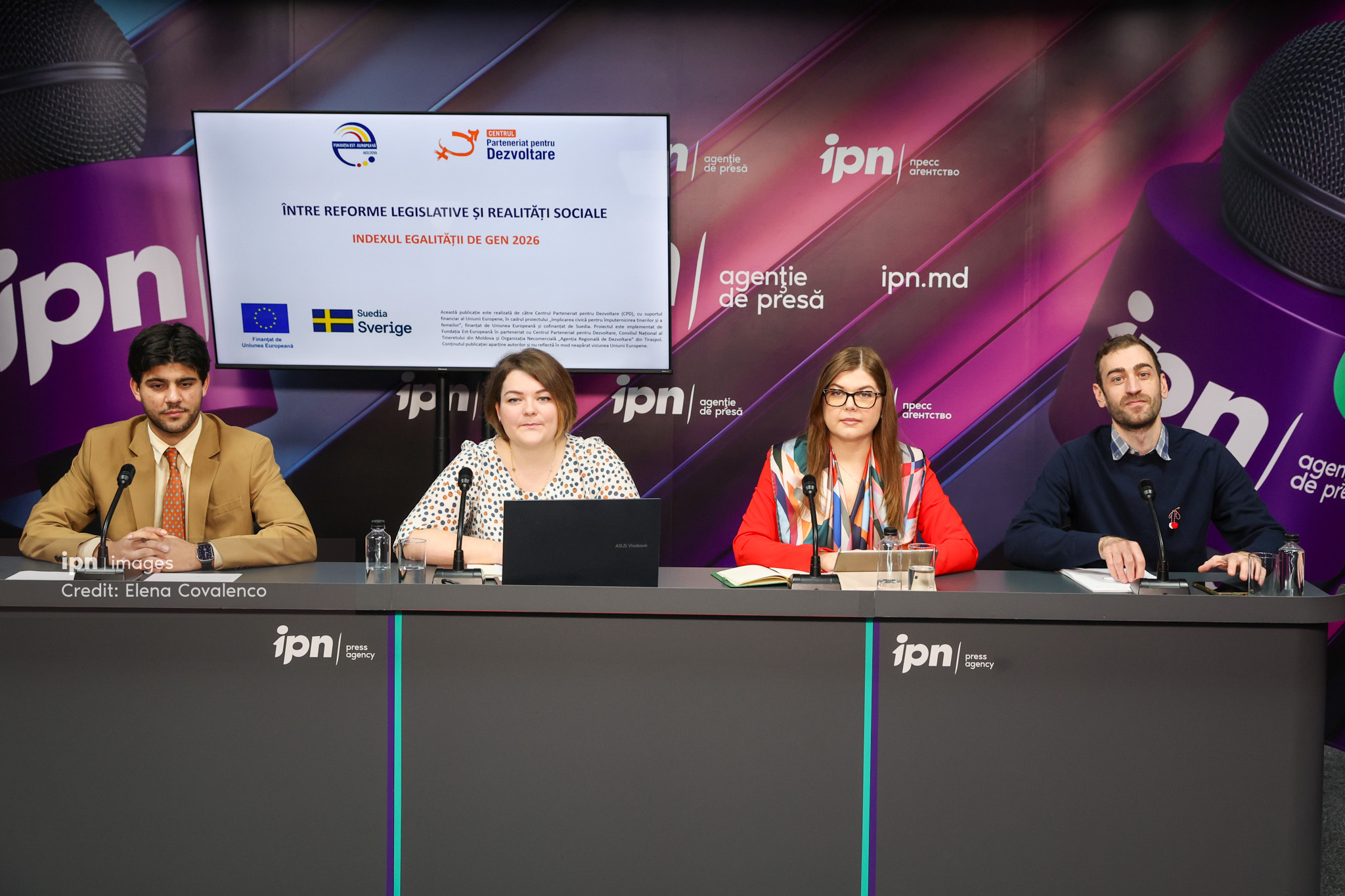
Gender stereotypes in Moldova remain stable compared to last year, with some perceptions more accentuated and others more attenuated. Although stereotypes related to the traditional roles of women in the family persist, there is an improvement in the perception of their involvement in politics. On the other hand, perceptions about women’s ability to hold leadership positions remain strongly anchored. The findings are found in the Gender Equality Index, launched annually by the Partnership for Development Center, on the eve of March 8th.
In a press conference at IPN, CPD Program Director Alexandra Ermolenco announced that the overall gender equality index reached 61 points out of 100 in 2026, registering an increase of one point compared to the previous year. According to her, the most significant progress was recorded in the area of access to resources, with an increase of five points, and in the labor market, where the index increased by four points.
The positive developments are mainly due to the reduction of the gender gap in pensions and the increase in women’s participation in the labor market. According to the report, the proportion of women with children up to six years old active in the labor market has reached 50.7%, and informal work has seen a significant decrease among both women and men.
However, the Gender Equality Index also signals some negative developments. Women’s representation in politics has slightly decreased, and their share in leadership roles, including within the cabinet of ministers, remains low.
The President of the Gender Equality Platform, Cristina Snegur, emphasized that among the key priorities for eliminating gender inequality is combating gender-based violence, which limits women’s participation in social and public life. Also, another important objective is promoting women’s economic participation, by implementing the principle of “equal pay for equal work”.
At the same time, the Gender Equality Platform advocates for the protection of women’s reproductive rights, promoting access to sexual education, reproductive health services and contraception methods.
The Youth Policy Coordinator of the National Youth Council of Moldova, Grigore Rinja, mentioned that the rate of NEET youth – those who are not engaged in education, employment, or professional training – has dropped from 27.4% in 2019 to 20.3% in 2024. However, the phenomenon particularly affects young women, due to household responsibilities.
The Executive Director of the Center for Policies and Reforms, Andrei Lutenco, emphasized that the recommendations from the civil society manifesto must be integrated into public policies, and after the adoption of legislative measures, the allocation of necessary resources for their implementation is crucial.
Note: IPN Agency offers the right to reply to persons who consider themselves targeted in news reports based on the statements of the organizers of this press conference, including by facilitating the organization of another press conference under similar conditions.
