

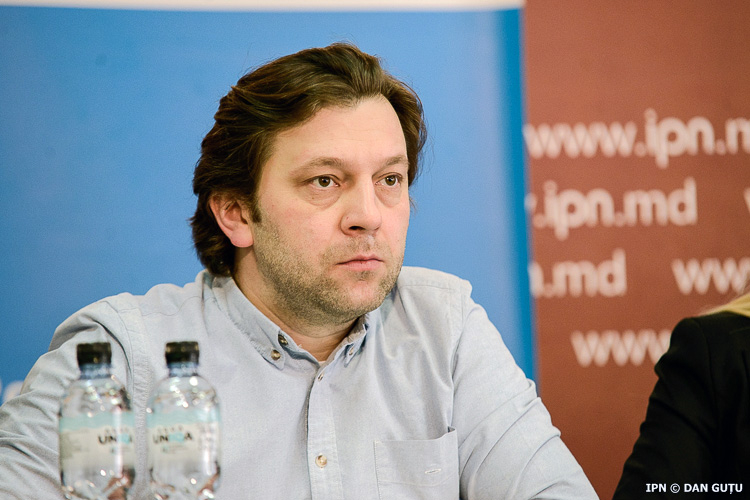
Dumitru Alaiba: Current Government made sufficient efforts to isolate itself

Dumitru Alaiba, MP of the group of the Action and Solidarity Party of the ACUM bloc, said the foreign policy should be based on the people’s interests, not vice versa. He doubts that the current Government can ensure balanced relations with everyone as it made sufficient efforts to isolate itself. He stated his opinions in a public debate entitled “Balanced foreign policy: capacities, advantages, risks” that was staged by IPN News Agency and Radio Moldova.

“It is not true that attempts to pursue an unbalanced foreign policy were made a month ago as the Government of Maia Sandu made effort for our country to have good relations with all the partners. I will dare to add that a balanced policy does not necessarily mean 50 to 50,” he said, noting the figures concerning Moldova’s exports should be taken into account when speaking about the foreign policy and these show that about 70% of the exports are oriented to the EU, while less than 20% to Russia.

The MP said the current Government isolates itself. “It made effort to have particular relations with Russia, but we do not see the efforts needed to maintain and promote the interests of our entrepreneurs in the West, the European Union as even the entrepreneurs from the Transnistrian region realized that there is their future and there is their business potential. Why should we deny what the people clearly prove by figures produced by the National Bureau of Statistics,” stated Dumitru Alaiba. According to him, necessary discussions on the issue weren’t held and a series of opportunities in this regard were missed.

Replying to Socialist MP Alexandr Nesterovskii’s assertion that Moldova developed best when it didn’t cooperate with the IMF, Dumitru Alaiba said the IMF comes to countries that are in a precarious economic and macro-financial condition. “That’s why the success in ensuring a stable economy is indeed limited, but primarily owing to the irresponsible politicians from here. Nevertheless, there are such countries as Ireland and Latvia that were helped by the IMF to overcome the crisis,” noted the MP.

He expressed his skepticism at the possibility of Russia providing a loan to Moldova in the near future. According to him, Russia’s foreign assistance totals slightly over US$ 1 billion and it is highly improbable that Russia would cut the budgets of other recipients of financing for directing half of the sum to Moldova. “We do not know the lending conditions, the repayment period and if the interest rates are preferential. Most probably, this loan is not convenient for us. We can get such loans under preferential conditions from somewhere else,” he stated, noting it is not right to say that the country is begging. “The money coming from the West is provided for doing reforms and the goal of the elected officials is to do reforms. That’s why the foreign assistance should be subject to conditionality.”

The PAS MP considers a balanced foreign policy should be aimed at increasing the wellbeing of the people, at bringing the migrants home, etc. But the foreign policy in Moldova is the expression of the indecision of a lot of politicians who probably do not have the vision needed to understand what they actually want to do.”

The debate titled “Balanced foreign policy: capacities, advantages, risks” was the 122nd installment of the series of debates “Developing political culture through public debates” that is supported by the German foundation Hanns Seidel.


Official documents issued in the Republic of Moldova and Germany may now be used in each other’s countries with only an apostille, without the need for the legalization procedure. The measure enters into force following the Federal Republic of Germany’s withdrawal of the reservation it made in 2007 when the Republic of Moldova acceded to the Hague Apostille Convention, IPN reports.

The Ministry of Foreign Affairs states that the decision was made following steps taken by Deputy Prime Minister Mihai Popsoi, Minister of Foreign Affairs, during his May 18–19 meeting with his German counterpart, Johann David Wadephul.

The ministry emphasizes that the new system will eliminate the need to visit multiple institutions or diplomatic missions to have documents legalized, which will reduce both the time required and the costs incurred by citizens. The simplified procedure will apply to official documents such as birth, marriage, divorce, and death certificates, criminal records, academic diplomas, and diploma supplements.

The Hague Convention on the Apostille entered into force for the Republic of Moldova on March 16, 2007. With its implementation in relations with Germany, the Republic of Moldova will benefit from the same simplified procedure for the recognition of official documents as it does with all 130 states and entities that are parties to the convention.

0 FacebookTwitterPinterestEmail


Dumitru Alaiba: Current Government made sufficient efforts to isolate itself

Dumitru Alaiba, MP of the group of the Action and Solidarity Party of the ACUM bloc, said the foreign policy should be based on the people’s interests, not vice versa. He doubts that the current Government can ensure balanced relations with everyone as it made sufficient efforts to isolate itself. He stated his opinions in a public debate entitled “Balanced foreign policy: capacities, advantages, risks” that was staged by IPN News Agency and Radio Moldova.

“It is not true that attempts to pursue an unbalanced foreign policy were made a month ago as the Government of Maia Sandu made effort for our country to have good relations with all the partners. I will dare to add that a balanced policy does not necessarily mean 50 to 50,” he said, noting the figures concerning Moldova’s exports should be taken into account when speaking about the foreign policy and these show that about 70% of the exports are oriented to the EU, while less than 20% to Russia.

The MP said the current Government isolates itself. “It made effort to have particular relations with Russia, but we do not see the efforts needed to maintain and promote the interests of our entrepreneurs in the West, the European Union as even the entrepreneurs from the Transnistrian region realized that there is their future and there is their business potential. Why should we deny what the people clearly prove by figures produced by the National Bureau of Statistics,” stated Dumitru Alaiba. According to him, necessary discussions on the issue weren’t held and a series of opportunities in this regard were missed.

Replying to Socialist MP Alexandr Nesterovskii’s assertion that Moldova developed best when it didn’t cooperate with the IMF, Dumitru Alaiba said the IMF comes to countries that are in a precarious economic and macro-financial condition. “That’s why the success in ensuring a stable economy is indeed limited, but primarily owing to the irresponsible politicians from here. Nevertheless, there are such countries as Ireland and Latvia that were helped by the IMF to overcome the crisis,” noted the MP.

He expressed his skepticism at the possibility of Russia providing a loan to Moldova in the near future. According to him, Russia’s foreign assistance totals slightly over US$ 1 billion and it is highly improbable that Russia would cut the budgets of other recipients of financing for directing half of the sum to Moldova. “We do not know the lending conditions, the repayment period and if the interest rates are preferential. Most probably, this loan is not convenient for us. We can get such loans under preferential conditions from somewhere else,” he stated, noting it is not right to say that the country is begging. “The money coming from the West is provided for doing reforms and the goal of the elected officials is to do reforms. That’s why the foreign assistance should be subject to conditionality.”

The PAS MP considers a balanced foreign policy should be aimed at increasing the wellbeing of the people, at bringing the migrants home, etc. But the foreign policy in Moldova is the expression of the indecision of a lot of politicians who probably do not have the vision needed to understand what they actually want to do.”

The debate titled “Balanced foreign policy: capacities, advantages, risks” was the 122nd installment of the series of debates “Developing political culture through public debates” that is supported by the German foundation Hanns Seidel.


Maritime schools could be opened in Moldova following the full transposition of relevant European legislation. The statement was made by Deputy Prime Minister Vladimir Bolea, Minister of Infrastructure and Regional Development, who noted that there is growing interest in such programs, including from Ukrainian citizens affected by the war, according to IPN.

Vladimir Bolea stated that the new regulations will allow seaman’s books to be issued based on studies completed in the Republic of Moldova at authorized institutions.

The minister told the press that, at present, no ships are sailing under the flag of the Republic of Moldova, but the authorities are working to transpose European legislation and develop the legal framework necessary for the development of this sector.

According to him, the state and the Naval Agency could generate significant revenue both from ships sailing under the Moldovan flag and from institutions that train seafarers.

0 FacebookTwitterPinterestEmail


1 IANUARIE, 2025
1 IANUARIE, 2025