

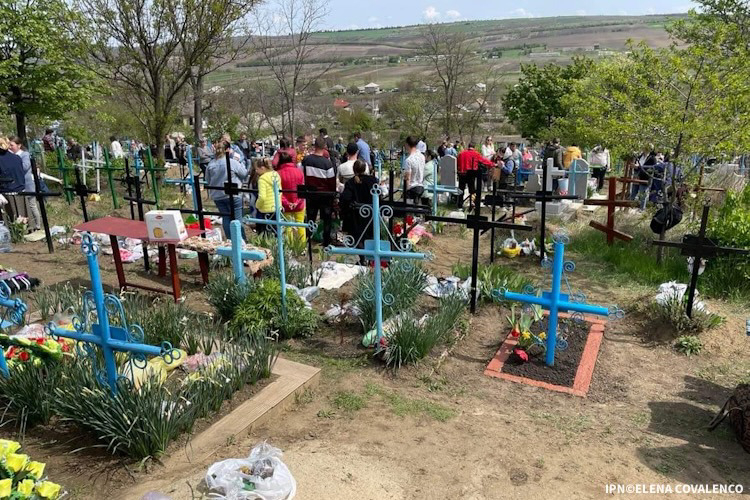
At Easter of the Kind-Hearted, Moldovans remember their dead

On the Second Sunday of Easter and the next Monday, Orthodox Christians in Moldova and Romania remember their dead relatives and friends. The holiday is known as Paștele Blajinilor, literally translated as Easter of the Kind-Hearted, a reference to the kind souls of those who passed away. Borrowed from Church Slavonic, the word blajin may also mean blessed or redeemed.

Contacted by IPN, Archimandrite Nectarie Gherman, deputy rector of the Moldovan Academy of Orthodox Theology, said this celebration reflects both the joy of Christ’s Resurrection and the expectation of the promised resurrection of the dead at the end of time.

At Easter of the Kind-Hearted, believers first go to the church to pray, then to the graves of their dead, where they bring flowers and small offerings. They light candles and pray for the souls to rest in peace.

These memorial days are to be spent “in peace and faith”. “We go to the cemetery decently dressed, we pray, we sing Christ is Risen. It is forbidden to hold boisterous parties, dances and festivities. We honor our ancestors, first of all, by mentioning them in the holy prayers, by the alms we give in their name, by visiting and the graves and maintaining them. After the liturgy, the priest also tours the graveyard to perform funeral services in the presence of the relatives and sing together with them Christ is Risen, followed by Eternal Remembrance”, said Nectarie Gherman.

Prayers play an important role at Easter of the Kind-Hearted. “We ask God to forgive them their trespasses, to let them repose, and give them a place with the saints in the Heavenly Garden. At the same time, through prayer we maintain our spiritual connection with our loved ones who are no longer with us”, the priest emphasized.

On these days alms are given, especially to the needy, and they not to be exchanged among relatives.


Official documents issued in the Republic of Moldova and Germany may now be used in each other’s countries with only an apostille, without the need for the legalization procedure. The measure enters into force following the Federal Republic of Germany’s withdrawal of the reservation it made in 2007 when the Republic of Moldova acceded to the Hague Apostille Convention, IPN reports.

The Ministry of Foreign Affairs states that the decision was made following steps taken by Deputy Prime Minister Mihai Popsoi, Minister of Foreign Affairs, during his May 18–19 meeting with his German counterpart, Johann David Wadephul.

The ministry emphasizes that the new system will eliminate the need to visit multiple institutions or diplomatic missions to have documents legalized, which will reduce both the time required and the costs incurred by citizens. The simplified procedure will apply to official documents such as birth, marriage, divorce, and death certificates, criminal records, academic diplomas, and diploma supplements.

The Hague Convention on the Apostille entered into force for the Republic of Moldova on March 16, 2007. With its implementation in relations with Germany, the Republic of Moldova will benefit from the same simplified procedure for the recognition of official documents as it does with all 130 states and entities that are parties to the convention.

0 FacebookTwitterPinterestEmail


At Easter of the Kind-Hearted, Moldovans remember their dead

On the Second Sunday of Easter and the next Monday, Orthodox Christians in Moldova and Romania remember their dead relatives and friends. The holiday is known as Paștele Blajinilor, literally translated as Easter of the Kind-Hearted, a reference to the kind souls of those who passed away. Borrowed from Church Slavonic, the word blajin may also mean blessed or redeemed.

Contacted by IPN, Archimandrite Nectarie Gherman, deputy rector of the Moldovan Academy of Orthodox Theology, said this celebration reflects both the joy of Christ’s Resurrection and the expectation of the promised resurrection of the dead at the end of time.

At Easter of the Kind-Hearted, believers first go to the church to pray, then to the graves of their dead, where they bring flowers and small offerings. They light candles and pray for the souls to rest in peace.

These memorial days are to be spent “in peace and faith”. “We go to the cemetery decently dressed, we pray, we sing Christ is Risen. It is forbidden to hold boisterous parties, dances and festivities. We honor our ancestors, first of all, by mentioning them in the holy prayers, by the alms we give in their name, by visiting and the graves and maintaining them. After the liturgy, the priest also tours the graveyard to perform funeral services in the presence of the relatives and sing together with them Christ is Risen, followed by Eternal Remembrance”, said Nectarie Gherman.

Prayers play an important role at Easter of the Kind-Hearted. “We ask God to forgive them their trespasses, to let them repose, and give them a place with the saints in the Heavenly Garden. At the same time, through prayer we maintain our spiritual connection with our loved ones who are no longer with us”, the priest emphasized.

On these days alms are given, especially to the needy, and they not to be exchanged among relatives.


Maritime schools could be opened in Moldova following the full transposition of relevant European legislation. The statement was made by Deputy Prime Minister Vladimir Bolea, Minister of Infrastructure and Regional Development, who noted that there is growing interest in such programs, including from Ukrainian citizens affected by the war, according to IPN.

Vladimir Bolea stated that the new regulations will allow seaman’s books to be issued based on studies completed in the Republic of Moldova at authorized institutions.

The minister told the press that, at present, no ships are sailing under the flag of the Republic of Moldova, but the authorities are working to transpose European legislation and develop the legal framework necessary for the development of this sector.

According to him, the state and the Naval Agency could generate significant revenue both from ships sailing under the Moldovan flag and from institutions that train seafarers.

0 FacebookTwitterPinterestEmail


1 IANUARIE, 2025
1 IANUARIE, 2025