

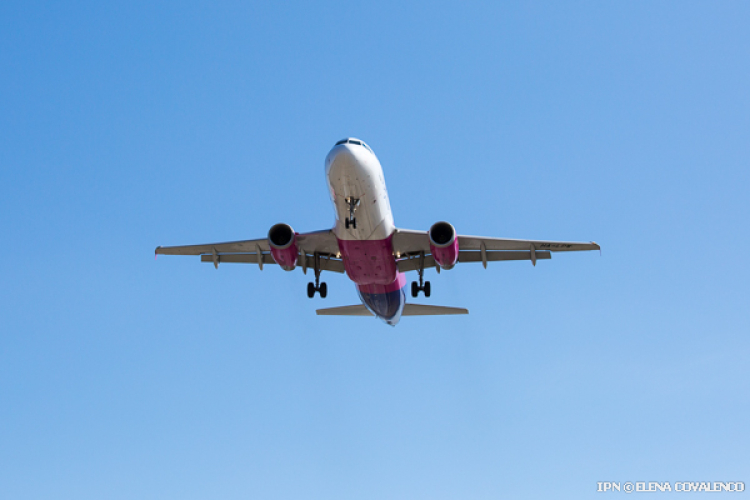
Wizz Air’s decision smells of business rather than of safety, aviation expert

If there had been indeed a significant security risk, the airline would have immediately stopped the flights and wouldn’t have waited for two weeks so as not to need to pay cancelation damages. This smells of business rather than of safety, said an aviation expert who commented for RFE/RL’s Moldovan Service on Wizz Air’s decision to suspend flights to and from Chisinau as from March 14, IPN reports.

“Based on the recent developments in Moldova and on ongoing consultations with different authorities and local and international agencies, Wizz Air took the final, but responsible decision to suspend its flights to Chisinau as from March 14. There is now an increased, but not imminent risk in the country’s airspace. The airline constantly monitors the events and, if need be, will take additional measures to ensure the safety of its passengers and crews,” the company said on February 27.

Speaking anonymously, aviation experts from Budapest told RFE/RL’s Moldovan Service that the low-cost company’s decision is most probably not based on security in reality, but rather on business or other reasons.

The experts noted that Wizz Air announced the cancelation of flights to and from Chisinau by two weeks beforehand so that it is not obliged to pay damages to passengers and such a move also suggests that it goes to business, not to security reasons.

If the Moldovan airspace had been risky indeed, the International Air Transport Association and the International Civil Aviation Organization would have issued a recommendation and all the airlines would have followed this recommendation without hesitation.

RFE also discussed with other airlines that operate flights to Chisinau. Austrian Airlines said its program of flights to and from Chisinau remained unchanged. The Austrian company noted it is monitoring closely the situation at domestic level as the safety of its passengers and crews remains its priority.

Representatives of a Romanian airline said, in conditions of anonymity, that risks have existed since the Russian invasion of Ukraine was launched on February 24, 2022, while the opponent company probably decided to withdraw from Chisinau for commercial reasons. “We realize and see the risks related to Transnistria. They are not new. It is a unilateral decision and we do not have another explanation than the commercial one,” said the sources to who journalists of RFE spoke.


The Ministry of Defense aims to ensure that, by 2028, at least 60% of priority critical infrastructure areas are protected by drone detection and neutralization systems. Currently, according to the authorities, coverage with such systems is limited. This provision is included in the government’s action plan titled “European Economy, Efficient State,” IPN reports.

According to the document, the National Army will be modernized by developing surveillance, radar, and early-warning capabilities, as well as by equipping it with anti-drone systems. Plans also include modernizing military communications and command-and-control systems, as well as strengthening cybersecurity.

The program also calls for increased military mobility through the development of logistical, medical, and transportation capabilities to enable the rapid deployment of forces.

By 2028, the government plans to complete the military camp in Bacioi and modernize at least 18 military facilities. By that time, the radar and early warning system is expected to reach a technical readiness level of at least 35% and a staffing level of at least 55%.

In the area of national resilience, the authorities aim to fully operationalize the State Register of Defense Resources and digitize the records of human, material, and technical resources. In addition, at least two major interagency exercises will be organized annually.

0 FacebookTwitterPinterestEmail


Wizz Air’s decision smells of business rather than of safety, aviation expert

If there had been indeed a significant security risk, the airline would have immediately stopped the flights and wouldn’t have waited for two weeks so as not to need to pay cancelation damages. This smells of business rather than of safety, said an aviation expert who commented for RFE/RL’s Moldovan Service on Wizz Air’s decision to suspend flights to and from Chisinau as from March 14, IPN reports.

“Based on the recent developments in Moldova and on ongoing consultations with different authorities and local and international agencies, Wizz Air took the final, but responsible decision to suspend its flights to Chisinau as from March 14. There is now an increased, but not imminent risk in the country’s airspace. The airline constantly monitors the events and, if need be, will take additional measures to ensure the safety of its passengers and crews,” the company said on February 27.

Speaking anonymously, aviation experts from Budapest told RFE/RL’s Moldovan Service that the low-cost company’s decision is most probably not based on security in reality, but rather on business or other reasons.

The experts noted that Wizz Air announced the cancelation of flights to and from Chisinau by two weeks beforehand so that it is not obliged to pay damages to passengers and such a move also suggests that it goes to business, not to security reasons.

If the Moldovan airspace had been risky indeed, the International Air Transport Association and the International Civil Aviation Organization would have issued a recommendation and all the airlines would have followed this recommendation without hesitation.

RFE also discussed with other airlines that operate flights to Chisinau. Austrian Airlines said its program of flights to and from Chisinau remained unchanged. The Austrian company noted it is monitoring closely the situation at domestic level as the safety of its passengers and crews remains its priority.

Representatives of a Romanian airline said, in conditions of anonymity, that risks have existed since the Russian invasion of Ukraine was launched on February 24, 2022, while the opponent company probably decided to withdraw from Chisinau for commercial reasons. “We realize and see the risks related to Transnistria. They are not new. It is a unilateral decision and we do not have another explanation than the commercial one,” said the sources to who journalists of RFE spoke.


Prime Minister Vasile Tofan calls for a review of the salary system in the public sector, amid controversies regarding salaries and bonuses in some institutions. By the end of the month, the Secretary General of the Government, Alexei Buzu, must present proposals to eliminate abuses, including by capping some incomes and eliminating some bonuses, reports IPN.

“The revolt is understandable. I too am outraged, because we are not a wealthy state. We do not have an excess of resources that would allow us to tolerate abuses in this area”, the Prime Minister declared at the first government meeting.

Vasile Tofan emphasized that regaining citizens’ trust is essential for implementing reforms. According to him, the Government cannot ask people to accept difficult measures while tolerating abuses in public institutions.

At the same time, the Prime Minister announced that he will tighten the rules regarding business trips abroad of public authority representatives. He stated that he will approve these visits more rigorously and that he aims to even reduce his own foreign trips, as part of the measures to combat the waste of public funds.

The chief executive mentioned that necessary trips for negotiations, attracting investments, and cooperation with external partners will continue, however, visits without a clear justification will be limited.

0 FacebookTwitterPinterestEmail


1 IANUARIE, 2025
1 IANUARIE, 2025