

Why did number of students in universities decrease? Analysis

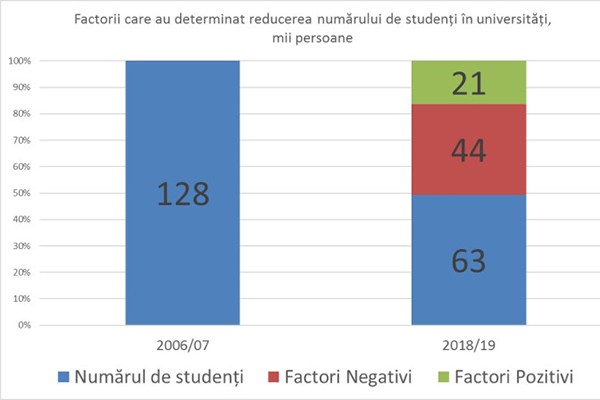
The number of students during the past 12 years has halved, from 128,000 in 2006-2007 to 63,000 in the 2018-2019 academic year, expert of the Institute for Development and Social Initiative “Viitorul” Veaceslav Ionita says in an analysis to which IPN makes reference.

According to the expert, the reduction is due to two groups of factors. The first group consists of such negative factors as the demographic evolutions, lower birth rate and migration. These led to a 2/3 reduction in the number of students, which is a decline of 42,000-45,000 persons, and to a decrease of over 130,000 in the number of children during the past 10-12 years. Consequently, the lack of children generated a lack of students.

The second group, of positive factors, led to a 1/3 reduction in the number of students, which is a decline of 20,000-23,000 persons. Even if the number of students decreased considerably due to these factors, they are considered positive. These include the improvement of the Baccalaureate examination process and the switchover to the two-level university education system.

According to Veaceslav Ionita, the improvement in the Baccalaureate examination process reduced the number of students in universities by about 5,000. The universities that were in pursuit of contracts eliminated any admission filter and accepted everyone as their students. The admission rate was close to 100%, which is illogical. The Baccalaureate exams became the filer that substituted the lack of selection at universities. Some 80-95% of the students who pass the Baccalaureate exams go to study at a university. So, the Baccalaureate exam became a kind of admission exam at universities.

The expert noted the switchover to the two-level university system solved another problem of higher education, namely the exam pass rate. Wishing not to lose the contracts with students, the universities ensured an exam pass rate of almost 100% even if some of the students could be absent. This turned the higher education into an orchard for growing diplomas. The institution of the two-level system became another filter that helps select the students. Thus, only 30-40% of the students who complete the first cycle of university education decide to continue their studies.

Veaceslav Ionita noted the positive factors created two administrative filters by which up to 23,000 students are excluded. These filters replace the complete lack of selection filters at universities. If these two filters hadn’t existed, we could have said that the university education in Moldova perished.


The Ministry of Infrastructure and Regional Development initiates traffic on the national road M3, bypassing the locality of Slobozia Mare in the Cahul district /National road M3, direction from Vulcanesti to Slobozia / at 09:00 AM/.

The operational meeting of the municipal services is taking place /Chisinau City Hall /11:00 AM/.

The session of the Chisinau Municipal Council continues, started on July 21 /Chisinau City Hall / 01:00 PM/.

0 FacebookTwitterPinterestEmail


Why did number of students in universities decrease? Analysis

The number of students during the past 12 years has halved, from 128,000 in 2006-2007 to 63,000 in the 2018-2019 academic year, expert of the Institute for Development and Social Initiative “Viitorul” Veaceslav Ionita says in an analysis to which IPN makes reference.

According to the expert, the reduction is due to two groups of factors. The first group consists of such negative factors as the demographic evolutions, lower birth rate and migration. These led to a 2/3 reduction in the number of students, which is a decline of 42,000-45,000 persons, and to a decrease of over 130,000 in the number of children during the past 10-12 years. Consequently, the lack of children generated a lack of students.

The second group, of positive factors, led to a 1/3 reduction in the number of students, which is a decline of 20,000-23,000 persons. Even if the number of students decreased considerably due to these factors, they are considered positive. These include the improvement of the Baccalaureate examination process and the switchover to the two-level university education system.

According to Veaceslav Ionita, the improvement in the Baccalaureate examination process reduced the number of students in universities by about 5,000. The universities that were in pursuit of contracts eliminated any admission filter and accepted everyone as their students. The admission rate was close to 100%, which is illogical. The Baccalaureate exams became the filer that substituted the lack of selection at universities. Some 80-95% of the students who pass the Baccalaureate exams go to study at a university. So, the Baccalaureate exam became a kind of admission exam at universities.

The expert noted the switchover to the two-level university system solved another problem of higher education, namely the exam pass rate. Wishing not to lose the contracts with students, the universities ensured an exam pass rate of almost 100% even if some of the students could be absent. This turned the higher education into an orchard for growing diplomas. The institution of the two-level system became another filter that helps select the students. Thus, only 30-40% of the students who complete the first cycle of university education decide to continue their studies.

Veaceslav Ionita noted the positive factors created two administrative filters by which up to 23,000 students are excluded. These filters replace the complete lack of selection filters at universities. If these two filters hadn’t existed, we could have said that the university education in Moldova perished.


Gagauzia must participate in the formation of the regional electoral body by nominating candidates, and the Central Electoral Commission should examine and approve these nominations, asserts the President of the Gagauz People’s Assembly, Valentin Gaidarji. In the case of substantiated objections, the CEC would have to request the nomination of other candidates, reports IPN.

According to Gaidarji, this mechanism would represent a compromise between Chisinau and Comrat and would ensure a balance between the interests of the state and the region. “It is precisely this mechanism, in our belief, that needs to be stipulated in the Law on the special status of Gagauzia,” stated the APG president at an event held in Comrat.

He mentioned that the members of the regional electoral body must be professionals, know the Gagauz language, live in the region, and be familiar with the regional legislation and the specifics of autonomy.

Referring to the electoral system for the election of the People’s Assembly, Valentin Gaidarji said that the principal position of the APG is to maintain the majority system, on the basis of which deputies are elected in single-member constituencies.

The position comes in the context where the Presidency has announced that, in discussions with deputies from Comrat, the conduct of elections for APG based on the proportional electoral system was addressed, as part of a uniform electoral system throughout the territory of the Republic of Moldova.

0 FacebookTwitterPinterestEmail


1 IANUARIE, 2025
1 IANUARIE, 2025