

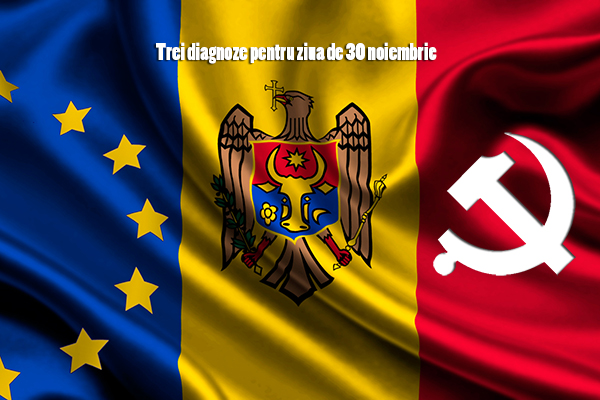
Three diagnoses made for November 30 elections

IPN analysis. The parliamentary elections do not represent only the percentage accumulated by the contenders on the election day. The recent election campaign revealed a number of particularities that characterize our society, which the new Government should take account of. In fact, the people should also pay attention to them.

The elections took place and their main intrigue – whether the current pro-European coalition will remain in power or not – was solved in their favor. While the winners are holding negotiations to agree the new format of their association and to divide the governmental portfolios, a number of important aspects remained in the shadow of the public opinion and it would be a mistake to ignore them.

‘Russian belt’

The electoral geography of the past elections was interesting. The parties supporting the eastern development course obtained an average majority all over the country, starting with the districts Falesti, Sangerei, and Floresti. A specific, ‘pro-Russia’ belt was created in the southern region Gagauzia and in the districts Taraclia and Basarabeasca. The central part of the country and Chisinau voted for the pro-European parties.

In most of the districts, the number of votes obtained by the supporters of one foreign course or the other does not exceed two thirds. There is a certain contrast only in Gagauzia, where the Eastern course was supported by over 80% of the voters. In fact, the results of these elections in the autonomous unit were similar to those of the scandalous referendum held this February, when 98% of the Gagauz voters disputed the official course to the EU set by the Moldovan Government. The critics of the local referendum spoke then about the virtual character of the results and possible falsifications. But the November 30 elections confirmed that the realities in Gagauzia are different from the national ones.

Currently, Gagauzia distinguishes itself not only as an autonomous unit with special powers, but also by its political orientation. This is a territory where the population thinks in a different way and has its own goals, including related to the foreign policy. Such a state of affairs should make the central authorities think about a very complicated and even dangerous matter – the state loyalty of the local population. This is a situation when the image of the leader of another state becomes the most important argument for choosing an option for the absolute majority of the population of the region. This is a not at all positive diagnosis for the central authorities. And the new Government will have to take this into account.

The policy that will be pursued towards Gagauzia is another issue, but it is absolutely evident that the neglect of this problem can have serious consequences for the state.

National interests and world destinies

The last elections were perceived mainly in the context of the struggle between the two development paths – the European one and the Russian one. Moreover, we can say that the West and the East struggled for influence on Moldova, while the Moldovans made their choice amid this geopolitical struggle. The contenders devoted the largest part of their electoral activities to this theme.

Consequently, the foreign policy practically shadowed all the other themes concerning the internal policy that are basic in the electoral struggle in the same European states.

Were there many discussions about the priorities and imperfections of the tax system? Who discussed the program to support the small and medium-sized businesses seriously? Or did somebody speak about the necessity of improving the legislation on the protection of consumer rights? Instead of assessing the projects to internally improve our society, we easily became involved in discussions about the world geopolitics and the destinies of Europa and Russia.  

Surely, we will not detach ourselves from the geopolitical factor. But the fact that we used up for it all out attention is a diagnosis for our political culture and a proof that we cannot appropriately appreciate our national interests.

Only one thing gives reasons for joy – that they didn’t raise the issue of national self-determination in these elections, of which almost everyone is tired. Nobody also fueled the interminable discussions on the linguistic issue. Anyway, this is progress.

Last chance

The pro-European parties preserved the power and this is indisputably their political victory. But in electoral sense, they suffered a defeat. A simple calculation shows that if we add the votes given to the Communist Reformists, the Bloc “Moldova’s Choice – the Customs Union” and some of the anti-Europeans parties, which didn’t pass the election threshold, to those won by the Socialists and the Communists, the picture will be different. If we also add the tens of thousands of invalid ballots given to ‘Renato Usatyi’, the scales will incline in favor of the Eastern course.

The election results seem even more discouraging for the authorities because they were achieved after five years of government during which they had all the possibilities to convince the people that the pro-European policy should be a priority. But the main contribution to the won victory was made not by the efficient government of the country, but by the political instruments used to exert influence on the political opponents. Not by the justice secretor reform, but by the creation of the clone of the PCRM. Not by the fight against corruption, but by the division of the pro-Russian voters. Not by guaranteeing the freedom of the media, but by excluding a popular election runner from the ballot.

The limited legitimacy of the new-old power represents a diagnosis of its professionalism and competence, of its political will and (ir)responsibility towards the population. Like it or not, but the pro-European parties got another chance to convince the population, during the next four years, of the importance of their goals and of their ability to achieve them. If they do not manage to do this, there is no certainty that the political methods will work in the next elections as well.

Veaceslav Craciun, IPN


(NEW) Prime Minister Vasile Tofan convenes the Government meeting in the context of developments in the energy field, including the situation on the diesel and natural gas markets /Government House, entrance from Pușkin Street /9:00 AM/.

The National Commission for Consultations and Collective Negotiations convenes a meeting /Government House, entrance from Banulescu-Bodoni street /at 09:00 AM/.

The Audiovisual Council convenes a meeting /CA /at 09:00 AM/.

The Superior Council of Magistracy is convened for a meeting /CSM /at 09:30 AM/.

The National Bank of Moldova is conducting a workshop on understanding the data from the Annual Financial Stability Report /BNM /at 09:30 AM/.

Parliament is convened for a plenary session /at 10:00 AM./

The INFONET Alliance is hosting a conference on the topic: “Accessibility Is Not a Choice! It Is the Right to Be Seen: Raising Awareness and Learning from the Community of People with Hearing Disabilities” /Online /at 10:00 AM/.

The Moldovan Football Federation is organizing a press conference dedicated to the European Beach Soccer Championship – Euro Beach Soccer League, Division A, and Women’s Euro Beach Soccer League, 2026 edition /Orange Arena, La Izvor Park /at 10:00 AM/.

The Standing Committee for Rules, Appointments, Immunity, and Ethics of the Deputies within the Popular Assembly of Gagauzia organizes public hearings on the project to amend Article 1 of the UTA Gagauzia Law and on the Regulations of the Popular Assembly of Gagauzia /Popular Assembly, Comrat /at 10:00 AM/.

GALINA CIGHIR is holding a press conference titled: “Land for the AOVA Animal Shelter” /IPN Agency Conference Room, Teatrului Alley, 2/2, 3rd floor, online at www.ipn.md, FB.com/ipn.md, YouTube /at 11:00 AM/.

IPN Press Agency invites media representatives to a public debate on the topic: “How Should the Effectiveness of Local Public Administration Reform Be Assessed: Through Costs, Service Quality, or the Level of Territorial Development?” Participants: Alexandru Tanase, former president of the Constitutional Court; Iurie Tap, Ph.D. in Administrative Sciences /IPN Agency Conference Room, Teatrului Alley, 2/2, 3rd floor; online at www.ipn.md, FB.com/ipn.md, YouTube /12:00 PM/.

(NEW) Prime Minister Vasile Tofan holds a press conference /Government House, entrance from Pushkin Street /1:00 PM/.

The Chisinau City Council meeting, which began on July 21, continues /Chisinau City Hall /at 01:00 PM/.

Moldova Innovation Technology Park is hosting the event: “Artificial Intelligence, already applied in real products and services”, during which the results of the MITP Residents Survey on the evolution of the IT sector in the Republic of Moldova are presented /Orange kITchen, Calea Iesilor Street, 8, 7th floor /at 01:30 PM/.

The Ministry of Education and Research is organizing public consultations on the establishment of the College of Psychologists in the Republic of Moldova /Government House, entrance from Banulescu-Bodoni Street /at 02:00 PM/.

The National Agency for Energy Regulation convenes a meeting /ANRE /at 03:00 PM/.

The Central Election Commission is holding a meeting /CEC /at 04:00 PM/.

0 FacebookTwitterPinterestEmail


Three diagnoses made for November 30 elections

IPN analysis. The parliamentary elections do not represent only the percentage accumulated by the contenders on the election day. The recent election campaign revealed a number of particularities that characterize our society, which the new Government should take account of. In fact, the people should also pay attention to them.

The elections took place and their main intrigue – whether the current pro-European coalition will remain in power or not – was solved in their favor. While the winners are holding negotiations to agree the new format of their association and to divide the governmental portfolios, a number of important aspects remained in the shadow of the public opinion and it would be a mistake to ignore them.

‘Russian belt’

The electoral geography of the past elections was interesting. The parties supporting the eastern development course obtained an average majority all over the country, starting with the districts Falesti, Sangerei, and Floresti. A specific, ‘pro-Russia’ belt was created in the southern region Gagauzia and in the districts Taraclia and Basarabeasca. The central part of the country and Chisinau voted for the pro-European parties.

In most of the districts, the number of votes obtained by the supporters of one foreign course or the other does not exceed two thirds. There is a certain contrast only in Gagauzia, where the Eastern course was supported by over 80% of the voters. In fact, the results of these elections in the autonomous unit were similar to those of the scandalous referendum held this February, when 98% of the Gagauz voters disputed the official course to the EU set by the Moldovan Government. The critics of the local referendum spoke then about the virtual character of the results and possible falsifications. But the November 30 elections confirmed that the realities in Gagauzia are different from the national ones.

Currently, Gagauzia distinguishes itself not only as an autonomous unit with special powers, but also by its political orientation. This is a territory where the population thinks in a different way and has its own goals, including related to the foreign policy. Such a state of affairs should make the central authorities think about a very complicated and even dangerous matter – the state loyalty of the local population. This is a situation when the image of the leader of another state becomes the most important argument for choosing an option for the absolute majority of the population of the region. This is a not at all positive diagnosis for the central authorities. And the new Government will have to take this into account.

The policy that will be pursued towards Gagauzia is another issue, but it is absolutely evident that the neglect of this problem can have serious consequences for the state.

National interests and world destinies

The last elections were perceived mainly in the context of the struggle between the two development paths – the European one and the Russian one. Moreover, we can say that the West and the East struggled for influence on Moldova, while the Moldovans made their choice amid this geopolitical struggle. The contenders devoted the largest part of their electoral activities to this theme.

Consequently, the foreign policy practically shadowed all the other themes concerning the internal policy that are basic in the electoral struggle in the same European states.

Were there many discussions about the priorities and imperfections of the tax system? Who discussed the program to support the small and medium-sized businesses seriously? Or did somebody speak about the necessity of improving the legislation on the protection of consumer rights? Instead of assessing the projects to internally improve our society, we easily became involved in discussions about the world geopolitics and the destinies of Europa and Russia.  

Surely, we will not detach ourselves from the geopolitical factor. But the fact that we used up for it all out attention is a diagnosis for our political culture and a proof that we cannot appropriately appreciate our national interests.

Only one thing gives reasons for joy – that they didn’t raise the issue of national self-determination in these elections, of which almost everyone is tired. Nobody also fueled the interminable discussions on the linguistic issue. Anyway, this is progress.

Last chance

The pro-European parties preserved the power and this is indisputably their political victory. But in electoral sense, they suffered a defeat. A simple calculation shows that if we add the votes given to the Communist Reformists, the Bloc “Moldova’s Choice – the Customs Union” and some of the anti-Europeans parties, which didn’t pass the election threshold, to those won by the Socialists and the Communists, the picture will be different. If we also add the tens of thousands of invalid ballots given to ‘Renato Usatyi’, the scales will incline in favor of the Eastern course.

The election results seem even more discouraging for the authorities because they were achieved after five years of government during which they had all the possibilities to convince the people that the pro-European policy should be a priority. But the main contribution to the won victory was made not by the efficient government of the country, but by the political instruments used to exert influence on the political opponents. Not by the justice secretor reform, but by the creation of the clone of the PCRM. Not by the fight against corruption, but by the division of the pro-Russian voters. Not by guaranteeing the freedom of the media, but by excluding a popular election runner from the ballot.

The limited legitimacy of the new-old power represents a diagnosis of its professionalism and competence, of its political will and (ir)responsibility towards the population. Like it or not, but the pro-European parties got another chance to convince the population, during the next four years, of the importance of their goals and of their ability to achieve them. If they do not manage to do this, there is no certainty that the political methods will work in the next elections as well.

Veaceslav Craciun, IPN


The organization of events dedicated to the 35 years of independence puts pressure on the budget of the Ministry of Culture. The institution has requested the redistribution of 10 million lei from subsidies for theaters and concert institutions, but the Ministry of Finance asks for the identification of other resources so as not to affect their activity, reports IPN.

The Ministry of Finance has drawn attention, in the process of approving the national program “The Independence that unites us. Moldova-35”, that the actions dedicated to the anniversary must be carried out without affecting the financial commitments already assumed in the field of culture. The institution mentioned that the events are to be financed from the approved budgets of the responsible authorities, without additional allocations from the state budget.

According to the explanatory note of the Government’s decision project, in the budget of the Ministry of Culture for the year 2026, 29.5 million lei were approved for the conduct of cultural activities, of which 10 million lei were additionally allocated for actions dedicated to the celebrations marking the 35th anniversary of the proclamation of independence.

Subsequently, the allocations for cultural activities were reduced to 29 million lei. As of June 8, 2026, the budget for these activities was executed at 84.8%, and the remaining amount had reached approximately 4.4 million lei.

In this context, the Ministry of Culture has requested the authorization for the redistribution of 10 million lei from the account of subsidies allocated for supporting the activities of theater-concert institutions, to cover the expenses related to cultural events that were not initially planned.

The Ministry of Finance did not support this solution, noting that when drafting the budget for the year 2026, subsidies for theater-concert institutions were increased by 56 million lei, including for covering personnel expenses generated by the change in the regulatory framework. The institution warned that the redistribution of the 10 million lei could affect the activity of the institutions and recommended the Ministry of Culture to identify other resources available within its own budget, by redistributing savings from other measures or expenditure items.

According to the data presented in the project, as of June 8, the Ministry of Culture had available allocations worth 477.9 million lei for the cultural sector, after executing about 41.4% of the total budget allocated to the sector. The Ministry of Finance indicated that among the sources that could be analyzed for redistribution are the Culture Fund, where approximately 26.3 million lei were available, but also the National Program “Access to Culture”, with about 10 million lei unused at that moment.

The total cost of the entire national program “Independence that unites us. Moldova-35” is not indicated in the draft government decision. The document only establishes that each responsible institution will ensure the financing of actions from the account and within the limits of the approved budgets, without requesting additional financial means for the amendment of the State Budget Law for the year 2026.

The program “Independence that unites us. Moldova-35” includes 28 actions, among which are festive events in the Great National Assembly Square, military parade, exhibitions, concerts, documentaries, educational activities, the “Maria Biesu” International Opera and Ballet Festival, the European Heritage Days, and the National Carpet Fair “Covorul Dorului”.

0 FacebookTwitterPinterestEmail


1 IANUARIE, 2025
1 IANUARIE, 2025