

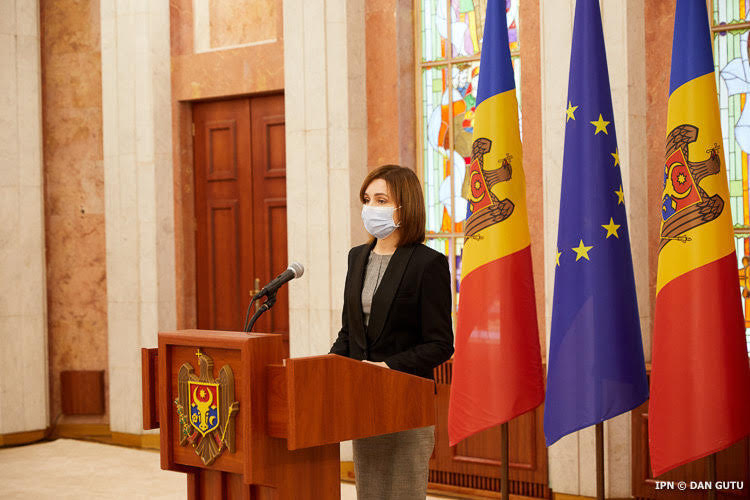
Presidential administration does not make use of ultimatums, statement

“The presidential administration does not make use of ultimatums and it already informed about this earlier,” the institution’s spokeswoman Sorina Ștefârță stated for IPN when she was asked to comment on the statements made by the Socialist leader, Igor Dodon.

Sorina Ștefârță noted that this week President Maia Sandu is having consultations with civil society, law experts and a number of social players. The presidential administration will provide details later.

The president of the Party of Socialists Igor Dodon on March 1 said that in accordance with the decisions taken by the party’s National Council on February 27, the PSRM will continue the consultations with the parliamentary parties this week so as to identify the best methods for overcoming the crisis. The Socialists called on President Maia Sandu to sign the decree to nominate the candidate for premiership who was proposed by the parliamentary majority until March 9. Otherwise, they will resort to determined actions to stop the political chaos.


In the summer of 2021, the Party of Action and Solidarity received an unprecedented mandate from the citizens. For the first time in many years, a single political formation controlled the Presidency, the Parliament and the Government, without the constraints of a coalition. Voters did not only vote for European integration, but also for a new way of governance: professional institutions, meritocracy, combating corruption, reforming justice and building a functional state. The mandate given to PAS was historic precisely because it provided all the necessary tools to demonstrate that the Republic of Moldova can be governed differently.

Almost five years later, PAS continues to dominate the political scene and remains the main promoter of European integration. However, the geopolitical advantage it gained after the outbreak of the war in Ukraine can no longer compensate for the lack of convincing results in administration. When citizens begin to judge power through the prism of everyday life and not through the international context, questions inevitably return about the competence of governance, the efficiency of institutions and the executive’s ability to transform electoral promises into public policies.

Here begins the real crisis of the monochrome government. It is not a parliamentary crisis nor a constitutional one. PAS still has the necessary majority to control the political agenda. The crisis is one of credibility. It is a slow erosion of public trust, caused by the accumulation of controversial decisions, delays in reforms and the impression that power no longer operates according to the standards it has promised itself.

The repeated changes of governments and successive reshuffles have become the expression of this difficulty. Normally, changing a cabinet is a natural tool of a democracy. However, when the same parliamentary majority repeatedly changes its own executive teams, the question arises whether the problem lies with the ministers or the governance model. A party that has built its identity on professionalism and competence cannot endlessly explain failures by changing individuals, without responsibility inevitably reaching the center of political decision-making.

Even the promise of depoliticizing institutions has not gone unchallenged. Controversies over public office appointments, accusations of political patronage and journalistic investigations into remuneration and conflicts of interest have tarnished the moral image of a formation that built its legitimacy precisely on its difference from the old political class. Even though some cases have been investigated and have led to resignations, the public perception is that the ethical standards promised in 2021 are no longer applied with the same rigor.

The centralization of decision-making, useful in a period of regional crisis, begins to show its limits in a stage where the administration must deliver concrete results. The more power is concentrated, the harder it is to disperse responsibility for failures. Instead of associating the success of reforms with leadership, more and more administrative difficulties are directly attributed to it.

The same strategic deficit is visible in the management of the most sensitive internal files. In relation to the Transnistrian region and the Gagauz autonomy, the management of immediate effects predominates, while the prospect of a coherent political solution remains unclear. The application of the law is indispensable, but without a broader political and identity strategy, there is a risk that tensions may be exploited by forces interested in maintaining instability.

However, the greatest vulnerability created by the current government far exceeds these administrative issues. It concerns the credibility of the European project itself. In the Republic of Moldova, European integration is almost exclusively associated with PAS in public perception. This excessive personalization creates a major risk: every administrative failure of the government is perceived by a part of society not only as a failure of the party, but as a failure of the European option itself. Instead of disappointment being directed against a specific government, it risks being transferred to the strategic direction of the state.

This may be the most serious political consequence of recent years. Europe does not lose credibility because of Brussels, but because of the inability of the political class in Chisinau to demonstrate that European reforms produce more efficient institutions and better governance. If the citizen does not see the difference between yesterday’s administration and today’s, then the European discourse risks being perceived as mere electoral rhetoric. Under such conditions, Eurosceptic forces do not need to build sophisticated arguments; they exploit the dissatisfaction generated by governance itself and turn it into an indictment against European integration.

To this vulnerability, another strategic error is added. Instead of building as broad a political and identity front as possible in support of the Western course, PAS preferred to marginalize or keep the unionist current at the periphery of political life. In electoral terms, this option can be explained by the desire to attract a more diverse electorate. However, strategically, it has reduced the ability of the pro-Western camp to rely on one of its most consistent components.

Unionism, regardless of each individual’s electoral choices, represents the segment of society that has consistently and unequivocally supported European integration, adherence to Romanian values, and the strengthening of ties with Romania. Instead of transforming this resource into a strategic ally for the modernization and Europeanization of the Republic of Moldova, those in power have often preferred to treat it as an inconvenient subject, pushing it out of public debate so as not to disturb a perceived more moderate electorate. The result is paradoxical: the government has narrowed its own political support base at a time when it would have needed a broader mobilization of all pro-Western forces.

More seriously, by systematically avoiding the theme of cultural and historical unity with Romania and by promoting an exclusively civic formula of political identity, PAS has left a significant space unoccupied. This void does not consolidate the European project, but creates frustrations in a part of the electorate that has always considered that the approach to the European Union and the approach to Romania are complementary processes, not competitive ones. A government that distances itself from its own natural allies inevitably reduces the capacity of society to resist disinformation and polarization campaigns.

In this context, each administrative mistake produces disproportionate political effects. The opposition, deeply heterogeneous and lacking a common project, does not win through its own merits, but through the mistakes of the adversary. The government becomes the main supplier of arguments for those who contest the western direction of the Republic of Moldova. Thus, the electoral competition risks turning into an emotional referendum not on the performance of a cabinet, but on the entire European project.

The recent history of the Republic of Moldova demonstrates that major protests do not erupt solely due to economic difficulties. They arise when a significant part of society comes to the conclusion that the power no longer respects its own commitments and no longer meets the expectations that brought it to governance. In such a situation, any new economic or social crisis can become the catalyst for a broad mobilization, and the beneficiaries will not necessarily be the most competent or the most democratic political actors.

This is the real danger. In the Republic of Moldova, the European option does not only represent a foreign policy project, but also the main geopolitical demarcation line between belonging to the Western political and value space and orientation towards the sphere of influence of the Russian Federation. From this perspective, Eurosceptic manifestations are often associated, in the internal political debate, with the promotion of a closer approach to Moscow’s geopolitical projects and with the support of the concept of the “Russian world”. Precisely for this reason, when disappointment with the government is transferred to the European project, the consequences go beyond changing a parliamentary majority: they can fuel political currents that challenge the Western orientation of the state and advocate for a strategic reorientation.

The paradox is that such a development would not primarily be generated by the efficiency of anti-Western propaganda, but by the government’s inability to demonstrate, through concrete results, the advantages of the European model. No external adversary can more effectively compromise the credibility of the European path than an administration that fails to transform promised reforms into functional institutions, prosperity, and public trust. When Europe comes to be identified exclusively with the performance of a single government, each administrative failure risks fueling not only opposition to the ruling party, but also skepticism towards the strategic choice of the Republic of Moldova itself.

They appear when society concludes that power no longer corresponds to its own promises. In such a situation, any new economic or social crisis can become the catalyst for a broad mobilization, and the beneficiaries will not necessarily be the most competent or the most democratic political actors.

This is the real danger. If disappointment with the government continues to be confused with disappointment with European integration, the Republic of Moldova may enter a stage where Euroscepticism will increase not due to the success of anti-Western propaganda, but as a result of its own governance errors. No external adversary can compromise the European cause more efficiently than an administration that fails to demonstrate the practical superiority of the European model through results, competence and integrity.

PAS still lacks the parliamentary majority and the necessary resources to change this trend. But the time for geopolitical explanations is nearing its end. In the next stage, citizens will judge solely on results. And if the current government fails to regain its credibility through genuine reforms and by rebuilding a broad coalition of all pro-European forces, the risk will not only be a change in power. The stakes are much higher: the erosion of public trust in the very European direction of the Republic of Moldova and the weakening of the strategic consensus built with great efforts over the last decades.

0 FacebookTwitterPinterestEmail


Presidential administration does not make use of ultimatums, statement

“The presidential administration does not make use of ultimatums and it already informed about this earlier,” the institution’s spokeswoman Sorina Ștefârță stated for IPN when she was asked to comment on the statements made by the Socialist leader, Igor Dodon.

Sorina Ștefârță noted that this week President Maia Sandu is having consultations with civil society, law experts and a number of social players. The presidential administration will provide details later.

The president of the Party of Socialists Igor Dodon on March 1 said that in accordance with the decisions taken by the party’s National Council on February 27, the PSRM will continue the consultations with the parliamentary parties this week so as to identify the best methods for overcoming the crisis. The Socialists called on President Maia Sandu to sign the decree to nominate the candidate for premiership who was proposed by the parliamentary majority until March 9. Otherwise, they will resort to determined actions to stop the political chaos.


The Prime Minister of Bavaria, Markus Söder, will make his first visit to the Republic of Moldova on Friday. The German official will be received by President Maia Sandu at the State Residence, and the discussions will focus on bilateral cooperation, investment opportunities, and strengthening relations between the Republic of Moldova and the member states of the European Union, reports IPN.

According to the Presidency, the visit takes place in the context of the Republic of Moldova’s efforts to strengthen its ties with EU states and attract foreign investment. Cooperation with Bavaria could contribute to the integration of Moldovan companies into the value chains of the German land.

After the meeting, Maia Sandu and Markus Söder will hold a joint press conference.

Bavaria is the largest state in Germany by area and one of the most powerful industrialized economies in Europe, with developed sectors such as the automotive industry and advanced technologies.

0 FacebookTwitterPinterestEmail


1 IANUARIE, 2025
1 IANUARIE, 2025