

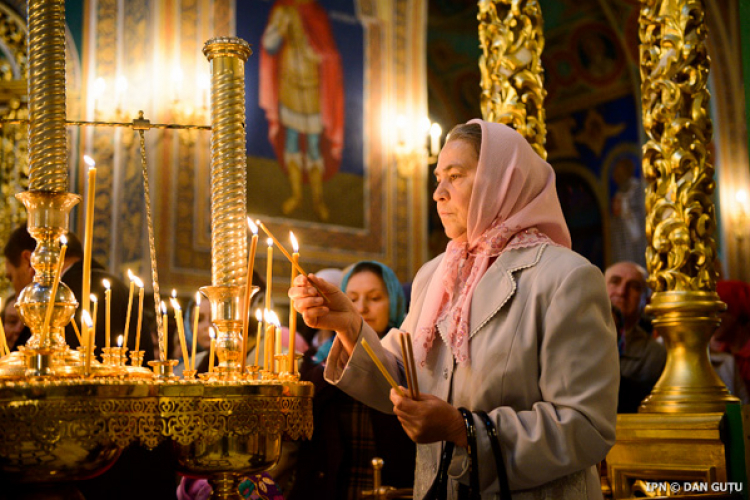
Nativity Fast begins

Orthodox Christians who use the old-style church calendar are entering as of today, November 28, the period of the Nativity Fast, also known as the Winter Lent. The Nativity Fast has a fixed duration of 40 days and will last until January 6, when the eve of the Birth of Jesus Christ is celebrated.

Asked by IPN, the parish priest of the “Întâmpinarea Domnului” church within the State University of Moldova, Octavian Moşin, said that fasting is an exercise, not an end in itself. It should not be associated with sadness, but rather with repentance. The Christians should approach fasting as a 40 day step-by-step course, while every step would make them more worthy of the celebration of the Birth of the Savior, the priest said.

Christians are urged to abstain from animal products, from evil thoughts, to go to church more often and to repent. Octavian Moşin said that fish is allowed on Saturdays, Sundays and during Christian holidays, until January 2. From January 2 to Christmas, the fasting gets stricter.

Christians who want to engage in communion can do it every weekend and on holidays, when the liturgies will be celebrated.

The parish priest of the “Întâmpinarea Domnului” said that the New Year has nothing in common with the Christian holiday cycle and is a secular holiday. Because it occurs during the fasting period, it is recommended that people celebrate it without excesses.


Prime Minister Vasile Tofan will make his first official visit abroad since taking office on Thursday. The Premier will go to Romania, where he will be received at the Victoria Palace by his acting counterpart, Ilie Bolojan, reports IPN.

According to a government statement, the two officials will discuss strategic projects of common interest, with a direct impact on the citizens on both sides of the Prut, economic cooperation and security developments in the region. The meeting will be followed by press statements.

During the visit, Vasile Tofan will also meet with the President of Romania, Nicusor Dan, as well as with the representatives of the leadership of the Parliament in Bucharest. Additionally, the Prime Minister will have a discussion with the representatives of the Basarabeni Businessmen’s Club, focused on attracting investments and supporting the business environment.

0 FacebookTwitterPinterestEmail


Nativity Fast begins

Orthodox Christians who use the old-style church calendar are entering as of today, November 28, the period of the Nativity Fast, also known as the Winter Lent. The Nativity Fast has a fixed duration of 40 days and will last until January 6, when the eve of the Birth of Jesus Christ is celebrated.

Asked by IPN, the parish priest of the “Întâmpinarea Domnului” church within the State University of Moldova, Octavian Moşin, said that fasting is an exercise, not an end in itself. It should not be associated with sadness, but rather with repentance. The Christians should approach fasting as a 40 day step-by-step course, while every step would make them more worthy of the celebration of the Birth of the Savior, the priest said.

Christians are urged to abstain from animal products, from evil thoughts, to go to church more often and to repent. Octavian Moşin said that fish is allowed on Saturdays, Sundays and during Christian holidays, until January 2. From January 2 to Christmas, the fasting gets stricter.

Christians who want to engage in communion can do it every weekend and on holidays, when the liturgies will be celebrated.

The parish priest of the “Întâmpinarea Domnului” said that the New Year has nothing in common with the Christian holiday cycle and is a secular holiday. Because it occurs during the fasting period, it is recommended that people celebrate it without excesses.


The Hydrometeorological Service in the Transnistrian region has established a yellow and orange hydrological danger code on the Dniester, valid from July 29 to August 7, due to the decrease in water level. According to the administration in Tiraspol, the orange code indicates “an increased risk of producing effects with significant impact”, reports the IPN correspondent from the Transnistrian region.

The decision comes after Chisinau extended until July 31 the hydrological warning regarding the reduced flow of the Nistru and other rivers. The yellow code is in effect in the Naslavcea-Dubasari sector, while between Dubasari and Tudora the orange code is maintained, where the water flow represents only 25-30% of the multiannual average.

In the context of the low level of the Nistru, the Government of the Republic of Moldova has instituted a hydrological alert for 30 days. The measure allows for quick interventions to manage water consumption and protect supply sources, so that drinking water for the population, medical institutions, and social ones remains a priority.

According to the Ministry of Environment, the reduction in the flow of the Nistru is caused by the lack of precipitation and unfavorable hydrometeorological conditions, with the risk of affecting the water intake structures and the water supply in the localities dependent on the river.

0 FacebookTwitterPinterestEmail


1 IANUARIE, 2025
1 IANUARIE, 2025