

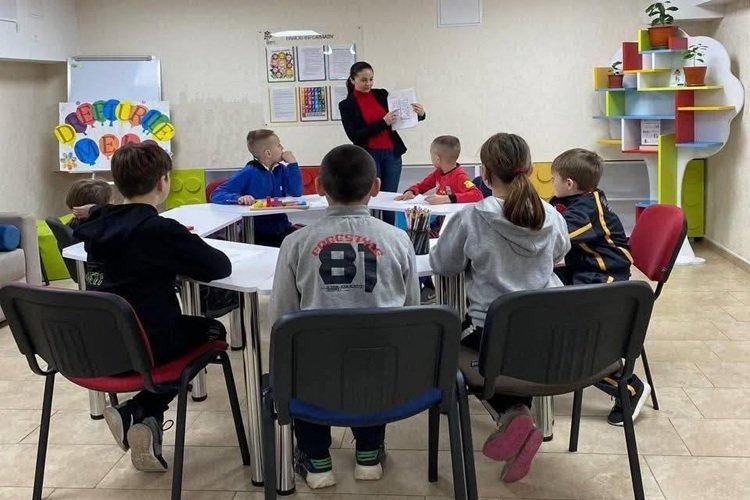
More and more children in Chisinau are taking part in extracurricular educational activities

Photo credit: DGETS

One in three children in Chisinau takes part in at least one school-based extracurricular activity. In addition, around 15,300 children attend programmes offered by the city’s 14 extracurricular education institutions, with participation rising by approximately 12% over the past five years. The figures were presented at the first Municipal Forum on Extracurricular Education, organised by the General Directorate of Education, Youth and Sport, IPN reports.

Andrei Pavaloi, deputy head of the Education Department, highlighted the need to adapt educational offerings to children’s current interests and needs. He said that extracurricular centres and sports schools should broaden their range of activities, introduce new fields of study and keep pace with technological and social changes to attract as many children as possible.

Speaking at the event, Mayor Ion Ceban said that extracurricular activities give children opportunities to grow and discover their interests, regardless of their talents or family circumstances. He stressed that education does not end when classes are over, and that after-school activities help children develop skills in a wide range of fields, from technology and sport to culture.

MP Angela Cutasevici highlighted the role of extracurricular education in children’s personal development. She noted that these activities help children discover their talents, build self-confidence and chart their own path. Participation in structured activities also helps protect children from risks such as isolation, cyberbullying and violence by offering them healthy ways to spend their free time.

For her part, Lucia Cepraga, Vice-Rector of Ion Creangă State Pedagogical University, noted that extracurricular activities complement the learning process and spark children’s interest in research, art, and technology. They also help foster a sense of responsibility, develop social skills, and instill values such as respect and teamwork.

There are 14 extracurricular education centres in the municipality of Chisinau, where children can take part in free activities in dance, music, robotics and programming, chess, ecology, photography and other fields.


Comparing elections in Gagauzia with those in the Transnistrian region is both legitimate and necessary, as it highlights the differences between the two regions and their levels of electoral competition. Expert Igor Botan expressed this view during the public debate “Distinctive Features of the 2026 Election for Governor of Gagauzia,” organized by the IPN News Agency. According to Boțan, while two-thirds of constituencies in the Transnistrian region had only one candidate standing in elections to the so-called Supreme Soviet, Gagauzia has now registered an average of four candidates per seat in its People’s Assembly, with eight contenders running for the office of Bashkan, or governor.

“I believe that comparing elections in the Transnistrian region and the autonomous region of Gagauzia is entirely legitimate and, in my view, even advisable,” the expert said. He explained that the two regions had developed under different conditions. According to him, the Transnistrian region, backed by the Russian Federation, came to control 40% of the Republic of Moldova’s industrial capacity, while Gagauzia was legally established under the Law on Special Legal Status as a predominantly agricultural region with no industry. Igor Botan also noted that as far back as around eight years ago, representatives of the Gagauz administration acknowledged that living standards in the region were already higher than those in the Transnistrian region.

Discussing electoral competition, the expert noted that in last year’s “elections” to the so-called Supreme Soviet in the Transnistrian region, only one candidate was registered in two-thirds of the constituencies. In the remaining constituencies, there were two candidates each. In Gagauzia, by contrast, an average of four candidates were registered in each of the 35 electoral constituencies. In previous elections, the number ranged from two to six or even seven candidates per constituency. Igor Boțan also stressed that the race for the post of bashkan includes candidates with political experience, among them former members of Parliament and representatives of the regional administration.

The expert believes that restoring stability in Gagauzia is in the interests of both the region’s residents and the Republic of Moldova as it pursues European integration. “The best way forward for the region’s development—and one that serves the interests of the Republic of Moldova as a whole—is for the situation in Gagauzia to return to normal,” he said.

He explained that the central authorities must ensure the region’s balanced development and uphold the principles of the European Charter of Local Self-Government. The law on Gagauzia’s special status, adopted in 1994, was intended to protect the Gagauz language and culture and enable the community to make decisions at the regional level on matters within its jurisdiction.

Regarding the strained relations between Chișinău and Comrat, Igor Boțan believes the central authorities bear a substantial share of the responsibility. “The central authorities bear much of the blame, and I mean all 12 parliamentary terms we have had, as well as the 23rd government,” the expert said. He noted that, in more than 30 years of autonomy, the development and use of the Gagauz language in public life and administration have never been fully ensured. He also recalled the warning issued by UNESCO’s Secretary-General during a visit to the Republic of Moldova in July about the risk of the Gagauz language disappearing.

Another factor that has shaped the situation in the region, in the expert’s view, is the Russian Federation’s involvement through the media, propaganda, and support for candidates during election campaigns. Igor Botan recalled the 2015 elections, when Russian officials reportedly backed one particular candidate out of ten contenders promoting similar messages. Although changes to electoral legislation have limited opportunities for direct foreign interference, the expert believes that loopholes remain, including in campaign financing.

To improve relations between the central and regional authorities, Igor Botan proposes establishing a permanent mechanism for dialogue and coordination. This would allow regional decisions to be checked for compliance with national legislation and help prevent further tensions.

The public debate “Distinctive Features of the 2026 Election for Governor of Gagauzia” is the 363rd event in the series “Fostering Political Culture through Public Debates.” The IPN News Agency organizes this debate series with the support of Germany’s Hanns Seidel Foundation.

0 FacebookTwitterPinterestEmail


1 IANUARIE, 2025
1 IANUARIE, 2025