

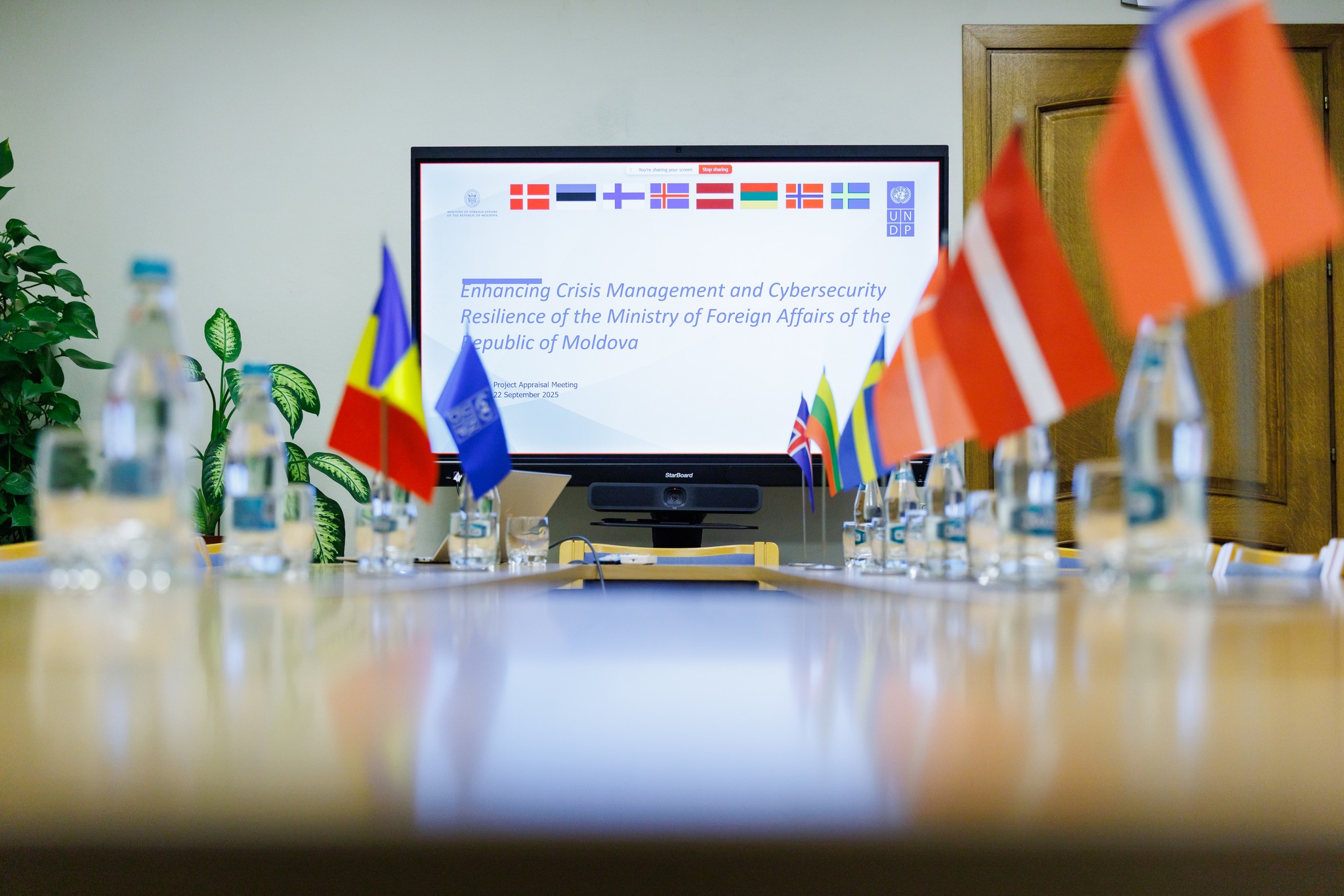
Moldova is strengthening its cybersecurity with the support of the Nordic and Baltic countries

Sursa foto: UNDP

The Ministry of Foreign Affairs of the Republic of Moldova will strengthen its cybersecurity and modernize its crisis management infrastructure, with the support of a joint project launched by eight Nordic and Baltic countries. The initiative, implemented by UNDP, is expected to be completed by 2028, reports IPN.

Valeriu Mija, State Secretary at the MAE, expressed his gratitude for the support provided, and mentioned that as a result of the implementation of the MAE’s institutional capacity project, they will be modernized in accordance with international and EU standards. He also emphasized that the institution will be able to respond effectively to international crisis situations affecting Moldovan citizens and challenges, ensuring better real-time coordination with international partners.

“The authorities of the Republic of Moldova fully acknowledge that modern institutional competencies and crisis management capabilities have become important elements of diplomatic interactions, in order to successfully respond to the new challenges we all face on the international stage,” the Secretary of State further stated.

In turn, the Danish Ambassador to Moldova, Søren Jensen, speaking on behalf of the eight states, emphasized that the project is part of efforts to increase the country’s resilience to hybrid threats. “Europe’s security and resilience go hand in hand with Moldova’s security and resilience. We support Moldova’s ambitions to become an EU member state and we commit to contributing to the strengthening of its institutional capacities,” the diplomat affirmed.

At the same time, the ambassador emphasized that the project is part of the extensive support provided by the eight Nordic and Baltic countries to Moldova to increase its resilience against Russia’s hybrid attacks. “Having secure digital systems, resilience against cyber and hybrid threats, and solid democratic governance are objectives that we share with Moldova and are ready to support,” the official noted.

The support for this initiative is based on a memorandum previously signed by the foreign ministers of the Nordic and Baltic states during a visit to Chisinau. Within the framework of the project, a roadmap will be developed for improving cybersecurity and modernizing digital systems, while the spaces dedicated to crisis management will be renovated and equipped with modern equipment. The countries that launched the project are: Denmark, Estonia, Finland, Iceland, Latvia, Lithuania, Norway, and Sweden.


Moldova is strengthening its cybersecurity with the support of the Nordic and Baltic countries

The President of the European Council, António Costa, has pledged strong support for Romania in the context of recent overflights...

Acest material este disponibil doar pe bază de abonament.
Abonează-te pentru a avea acces la mai multe materiale și funcționalități exclusive!

0 FacebookTwitterPinterestEmail


Moldova is strengthening its cybersecurity with the support of the Nordic and Baltic countries

Sursa foto: UNDP

The Ministry of Foreign Affairs of the Republic of Moldova will strengthen its cybersecurity and modernize its crisis management infrastructure, with the support of a joint project launched by eight Nordic and Baltic countries. The initiative, implemented by UNDP, is expected to be completed by 2028, reports IPN.

Valeriu Mija, State Secretary at the MAE, expressed his gratitude for the support provided, and mentioned that as a result of the implementation of the MAE’s institutional capacity project, they will be modernized in accordance with international and EU standards. He also emphasized that the institution will be able to respond effectively to international crisis situations affecting Moldovan citizens and challenges, ensuring better real-time coordination with international partners.

“The authorities of the Republic of Moldova fully acknowledge that modern institutional competencies and crisis management capabilities have become important elements of diplomatic interactions, in order to successfully respond to the new challenges we all face on the international stage,” the Secretary of State further stated.

In turn, the Danish Ambassador to Moldova, Søren Jensen, speaking on behalf of the eight states, emphasized that the project is part of efforts to increase the country’s resilience to hybrid threats. “Europe’s security and resilience go hand in hand with Moldova’s security and resilience. We support Moldova’s ambitions to become an EU member state and we commit to contributing to the strengthening of its institutional capacities,” the diplomat affirmed.

At the same time, the ambassador emphasized that the project is part of the extensive support provided by the eight Nordic and Baltic countries to Moldova to increase its resilience against Russia’s hybrid attacks. “Having secure digital systems, resilience against cyber and hybrid threats, and solid democratic governance are objectives that we share with Moldova and are ready to support,” the official noted.

The support for this initiative is based on a memorandum previously signed by the foreign ministers of the Nordic and Baltic states during a visit to Chisinau. Within the framework of the project, a roadmap will be developed for improving cybersecurity and modernizing digital systems, while the spaces dedicated to crisis management will be renovated and equipped with modern equipment. The countries that launched the project are: Denmark, Estonia, Finland, Iceland, Latvia, Lithuania, Norway, and Sweden.


The Parliament voted in the first reading the bill that provides for the establishment of a provisional licensing mechanism for the import of cereal and oilseed crops. According to the author of the project, Serghei Ivanov, deputy of the political party Partidul Nostru, the initiative aims to protect native farmers from massive imports from neighboring countries, reports IPN.

According to Serghei Ivanov, who is also the president of the Parliamentary Commission for Agriculture and Food Industry, the measure is necessary in the context of market price differences. The explanatory note indicates that a potential increase in grain and oilseed imports from Ukraine could put additional pressure on Moldovan producers, who would be forced to sell their crop below production cost.

The licensing mechanism will operate until October 31, at the proposal of the Government, which also requested the removal of the article that provided the possibility of extending the deadline. Both proposals have sparked dissatisfaction among both authors and other opposition colleagues. Deputy Serghei Ivanov stated that the period is too short and asked for the possibility of extending the mechanism to be maintained. Other opposition deputies also supported this position, stating that the mechanism represents one of the few tools through which farmers can be supported.

The bill is set to be examined on Friday in the second reading. According to the document, import licenses will be issued free of charge, and the applications will be reviewed by a committee composed of representatives from the Ministry of Agriculture and Food Industry, the Ministry of Economic Development and Digitalization, the National Agency for Food Safety, and profile associations.

Licenses can be requested by individuals and legal entities operating in the field of animal breeding, oil and fat production, milling product manufacturing or preparations intended for farm animal feed. At the same time, license beneficiaries will not be able to sell or export the imported goods.

0 FacebookTwitterPinterestEmail


1 IANUARIE, 2025
1 IANUARIE, 2025