

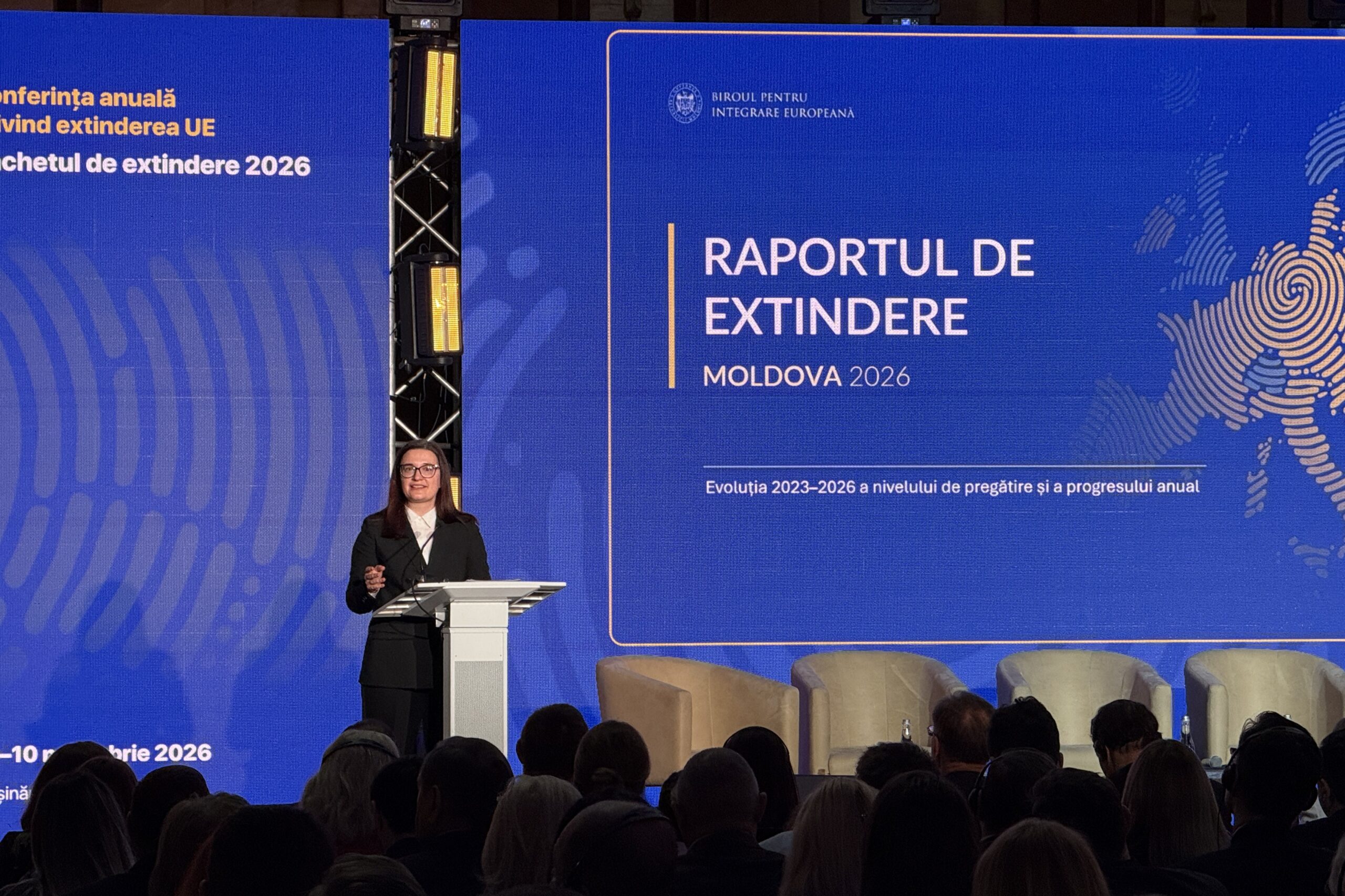
Moldova has made progress on 25 EU accession negotiation chapters, but 19 areas remain below a moderate level of preparedness, Deputy PM says

The Republic of Moldova has made progress in all 33 chapters of its accession negotiations with the European Union, with readiness for membership improving in 25 of them compared with the previous year. The country has also reached a moderate or good level of preparedness in 21 chapters. Deputy Prime Minister for European Integration Cristina Gherasimov presented the figures at the Annual Conference on EU Enlargement, held in Chisinau, IPN reports.

According to the official, three areas have reached a good level of preparedness: the customs union, energy, and foreign, security and defence policy. At the same time, 19 of the 40 areas assessed remain below a moderate level of preparedness and will require further efforts.

Cristina Gherasimov noted that the European Commission’s report confirms good or substantial progress in 33 of the 40 areas assessed over the past 12 months. This marks a significant improvement compared with previous years: in 2023, good progress was recorded in just six chapters, and in 2025, in 19.

The Deputy Prime Minister stressed that the next stage of the accession process involves more than adopting legislation. It requires consistent implementation of laws, stronger institutional capacity, and tangible results that demonstrate the impact of reforms.

To this end, the roadmap for 2027 envisages the potential closure of nine negotiating chapters in the first half of the year and a further 16 in the second half. Cristina Gherasimov clarified that this timetable gives institutions a clear framework for planning their work, but does not guarantee that negotiations will be concluded within those time frames.

At the same time, the authorities are working to update the National Accession Programme to incorporate the European Commission’s recommendations and the benchmarks for the four negotiation clusters that have been opened.


The Republic of Moldova will receive a government loan of approximately one billion lei from Japan to modernize its agricultural sector. The financing agreement was signed by Deputy Prime Minister and Minister of Foreign Affairs Mihai Popsoi and Japan’s Ambassador to Chisinau, Kazuyuki Takeuchi, IPN reports.

The Ministry of Foreign Affairs states that the loan is being provided under an agreement with the Japan International Cooperation Agency (JICA) to implement the second phase of the “Modernization of Agricultural Machinery and Equipment” project. Deputy Prime Minister and Minister of Foreign Affairs Mihai Popsoi said that Japan is a trusted partner and that its support over the years has translated into tangible projects with a direct impact on the country’s development.

“Through this agreement, we are taking another step towards modernising agriculture by giving farmers access to advanced technologies and high-performance equipment. We value Japan’s ongoing contribution and look forward to further strengthening this partnership for the benefit of our citizens”, said Deputy Prime Minister Mihai Popsoi.

Earlier, Prime Minister Vasile Tofan explained that the loan would allow farmers to purchase agricultural machinery in instalments at prices 10-15% below market rates. He said the state would act as an intermediary in securing the financing, while farmers would be responsible for repaying the loan. The interest rate would be 3.2%.

The financing will be provided for a term of 20 years, with a six-year grace period. Since 2021, eight agricultural projects have been developed and implemented with Japan’s support. These projects have supported the purchase of agricultural machinery, the modernization of livestock farms, the adoption of renewable energy and digital solutions and training for farmers.

0 FacebookTwitterPinterestEmail


Moldova has made progress on 25 EU accession negotiation chapters, but 19 areas remain below a moderate level of preparedness, Deputy PM says

The Republic of Moldova has made progress in all 33 chapters of its accession negotiations with the European Union, with readiness for membership improving in 25 of them compared with the previous year. The country has also reached a moderate or good level of preparedness in 21 chapters. Deputy Prime Minister for European Integration Cristina Gherasimov presented the figures at the Annual Conference on EU Enlargement, held in Chisinau, IPN reports.

According to the official, three areas have reached a good level of preparedness: the customs union, energy, and foreign, security and defence policy. At the same time, 19 of the 40 areas assessed remain below a moderate level of preparedness and will require further efforts.

Cristina Gherasimov noted that the European Commission’s report confirms good or substantial progress in 33 of the 40 areas assessed over the past 12 months. This marks a significant improvement compared with previous years: in 2023, good progress was recorded in just six chapters, and in 2025, in 19.

The Deputy Prime Minister stressed that the next stage of the accession process involves more than adopting legislation. It requires consistent implementation of laws, stronger institutional capacity, and tangible results that demonstrate the impact of reforms.

To this end, the roadmap for 2027 envisages the potential closure of nine negotiating chapters in the first half of the year and a further 16 in the second half. Cristina Gherasimov clarified that this timetable gives institutions a clear framework for planning their work, but does not guarantee that negotiations will be concluded within those time frames.

At the same time, the authorities are working to update the National Accession Programme to incorporate the European Commission’s recommendations and the benchmarks for the four negotiation clusters that have been opened.


A fire broke out this morning in a building used to produce briquettes in the village of Tomai, Ceadar-Lunga district. The blaze destroyed the building’s roof and damaged several pieces of agricultural machinery and production equipment. No casualties were reported, IPN reports.

According to the General Inspectorate for Emergency Situations, the 112 emergency service received a call at around 5:00 AM after flames were spotted on the building’s roof. Three teams of firefighters and rescuers responded to the scene and brought the blaze under control at around 6:00 AM Efforts to extinguish the remaining pockets of fire are ongoing.

The fire destroyed the building’s roof, which covered an area of approximately 1,200 square metres. The flames also damaged a tractor, a trailer, several pieces of agricultural machinery and equipment used to produce briquettes.

The cause of the fire and the circumstances surrounding its outbreak will be determined by experts.

0 FacebookTwitterPinterestEmail


1 IANUARIE, 2025
1 IANUARIE, 2025