

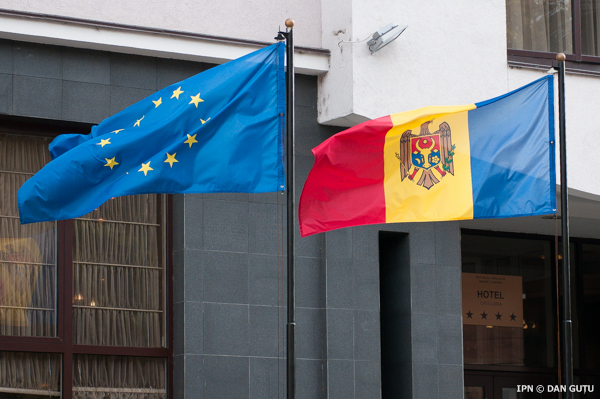
Insignificant progress was made in implementing Association Agreement with EU, study

Insignificant progress was made in implementing the Association Agreement with the European Union until September 1, 2018. Compared with the end of 2017, a qualitative slip back was witnessed, mainly owing to the slowdown of the EU –  Moldova political dialogue and the suspension of the EU financial assistance, says the Alternative Report No. 3 on the implementation of the EU –  Moldova Association Agreement for the first half of this year that was presented by the Institute for European Policy and Reforms, IPN reports, quoting a press release of the Institute.

The assessment results show the National Action Plan for implementing the EU –  Moldova Association Agreement in the second quarter of 2018 was 41.2% implemented and the general fulfillment rate in relation to all the measures planned until 2019 was of 20.7%.

According to the authors of the report, until June 30, 2018, the 679 analyzed measures were 41.2% implemented. Some 4.1% of the measures were carried out beforehand, 38.7% are being implemented, while 15.9% of the measures weren’t carried out.

Conducting a comparative statistical analysis of each of the five assessed titles of the Association Agreement, the experts noticed that most of the results until June 30, 2018 were achieved in implementing the measures from Title V (Trade and aspects related to trade – DCFTA). The implementation rate here was 57-8%. The measures stipulated in Title III (Justice, freedom and security) were only 29.6% carried out.

The main conclusion of the study is that in general the progress was insignificant (grade 2.6 out of 5).

The report was compiled by the Institute for European Policy and Reforms in cooperation with the Konrad Adenauer Foundation of Germany and the National Platform of the Eastern Partnership Civil Society Platform. There were assessed 679 of the 1,487 measures stipulated in the National Action Plan for implementing the EU – Moldova Association Agreement in the second quarter of 2018, including those initiated in 2017.


In just a few days after taking office, the Government received 55 notifications from entrepreneurs regarding administrative barriers. Prime Minister Vasile Tofan stated that the issues reported on the controale.gov.md platform will form the basis of a package of measures for simplifying business activities, which is to be presented by September 9, reports IPN.

During the government meeting, the prime minister mentioned that the examples received are important because they reflect the real difficulties that companies face, beyond reports and indicators.

Among the cases presented is the situation of an entrepreneur from Floresti, who runs a company with three employees who repair computing equipment. He complained that the legislation imposes on him the same obligations regarding safety and health at work as a company with hundreds of employees.

According to the prime minister, the entrepreneur does not request the elimination of labor protection rules, but the application of requirements proportional to the size of the business.

Another case concerns a company from Criuleni, which noticed an increase in the local advertising tax from 5% to 80% of sales revenue. The entrepreneur argues that such a tax affects economic activity, as it is calculated on revenue and not on profit.

Vasile Tofan emphasized that local taxes should represent reasonable contributions and not become an obstacle to business development. The Prime Minister asked the government team to develop by September 9 a package of measures to reduce administrative burdens and simplify entrepreneurs’ activities.

0 FacebookTwitterPinterestEmail


Insignificant progress was made in implementing Association Agreement with EU, study

Insignificant progress was made in implementing the Association Agreement with the European Union until September 1, 2018. Compared with the end of 2017, a qualitative slip back was witnessed, mainly owing to the slowdown of the EU –  Moldova political dialogue and the suspension of the EU financial assistance, says the Alternative Report No. 3 on the implementation of the EU –  Moldova Association Agreement for the first half of this year that was presented by the Institute for European Policy and Reforms, IPN reports, quoting a press release of the Institute.

The assessment results show the National Action Plan for implementing the EU –  Moldova Association Agreement in the second quarter of 2018 was 41.2% implemented and the general fulfillment rate in relation to all the measures planned until 2019 was of 20.7%.

According to the authors of the report, until June 30, 2018, the 679 analyzed measures were 41.2% implemented. Some 4.1% of the measures were carried out beforehand, 38.7% are being implemented, while 15.9% of the measures weren’t carried out.

Conducting a comparative statistical analysis of each of the five assessed titles of the Association Agreement, the experts noticed that most of the results until June 30, 2018 were achieved in implementing the measures from Title V (Trade and aspects related to trade – DCFTA). The implementation rate here was 57-8%. The measures stipulated in Title III (Justice, freedom and security) were only 29.6% carried out.

The main conclusion of the study is that in general the progress was insignificant (grade 2.6 out of 5).

The report was compiled by the Institute for European Policy and Reforms in cooperation with the Konrad Adenauer Foundation of Germany and the National Platform of the Eastern Partnership Civil Society Platform. There were assessed 679 of the 1,487 measures stipulated in the National Action Plan for implementing the EU – Moldova Association Agreement in the second quarter of 2018, including those initiated in 2017.


Russia has significantly increased the costs for obtaining Russian citizenship through consular institutions, shortly after President Vladimir Putin simplified, in May, the procedure for granting citizenship to the residents of the Transnistrian region of the Republic of Moldova, reports IPN.

The decree signed by Putin exempts residents of the Transnistrian region over the age of 18, who permanently reside on the left bank of the Dniester, from the obligation to have a domicile in Russia and from taking Russian language, history and legislation exams to obtain Russian Federation citizenship.

Two months after simplifying the procedure, the Moscow Government approved new consular fees for examining citizenship applications.

The fee for examining an application for acquiring Russian citizenship has increased from 65 to 600 dollars. In the case of renunciation of citizenship, the fee has been raised from 130 to 1,200 dollars. The payment will be charged for each person included in the application, not for a single request, as it was until now.

The new rates for these services were also published on the website of the Embassy of the Russian Federation in Chisinau.

Thus, although the procedure for obtaining Russian citizenship for the residents of the Transnistrian region has been simplified, the costs for processing the documents will be considerably higher.

In recent years, Russia has expanded simplified mechanisms for granting citizenship to residents of unrecognized or occupied territories. Similar procedures have been applied in Abkhazia, South Ossetia and in the occupied Ukrainian regions of Ukraine.

0 FacebookTwitterPinterestEmail


1 IANUARIE, 2025
1 IANUARIE, 2025