

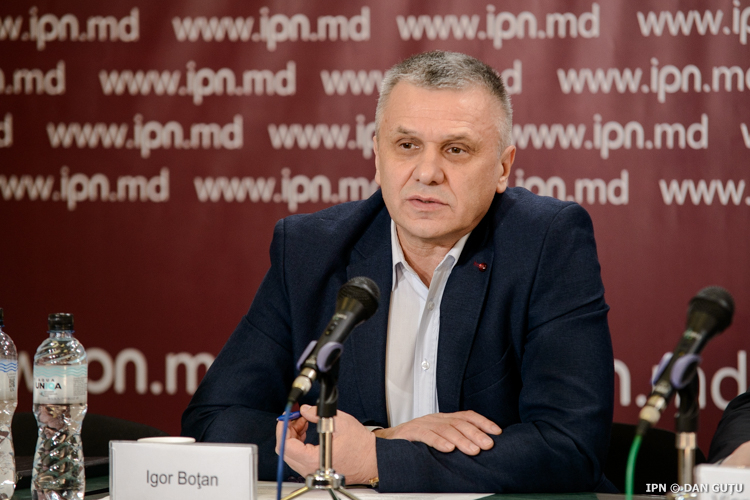
Igor Boțan: Prosecution service and government should move in one direction

Following the statements made by President Maia Sandu after the August 10 meeting of the Supreme Security Council, the Prosecutor General’s Office (PGO) reacted with a short text that leaves yet room for different interpretations.

In connection with this, IPN asked for the opinion of Igor Boțan, executive director of the Association for Participatory Democracy (ADEPT). He noted the position stated by PGO is the expression of a conflict between the political power and the judicial power. It goes to a bizarre conflict. The current government accuses the Prosecutor General’s Office of inefficiency, while the latter accuses the first of incompetence in terms of law. In general, neither the current government nor the PGO are right in this conflict.

The government has in hand massive popular support and all the tools needed to bring things in Moldovan justice in order. But it is impatient and resorts to chivalry attacks, including on PGO. On the other hand, PGO reacted surprisingly inappropriately. It decided to take the bull by the horns, giving the current government an “unsatisfactory grade’ for the comprehension of the rule of law principles. Moreover, the position of PGO contains threatening notes against the current government:  “The PGO’s response to any attack on its institutional and procedural independence will be proportional to the gravity of such attacks”.

Undoubtedly, the PGO should have the whole range of instruments that ensures its independence. But the independent state institutions should be efficient! This was specified by the Constitutional Court (CC), which noted that “the importance of the rule of law as a trans-dimensional matter resides in the ensuring of the respect for the human rights and democracy, security and stability, good governance, mutual economic and commercial relations, security of investigations and a favorable business climate and in its role in fighting corruption […], which this way serve as a basis for political, economic, social development…”. That’s why, before giving grades to the current government as regards understanding of the rule of law concept, PGO should have presented its successes in the areas mentioned by CC. 

The scandal involving the current government and the PGO should be resolved swiftly. The government should work out clear policies for correctly assessing the efficiency of the autonomous public institutions and, only after the appropriate application of these assessments, it should propose measures for remedying the situation. This way, the current government should remember that those who are patient can obtain what they intend to, while those who are impatient will get nothing.

IPN asked the press services of the Presidential Administration and Parliament to formulate the institutions’ attitude to the created situation, but hasn’t yet received a response.    


Seniors from the capital are invited to a new edition of musical shows, taking place within the socio-cultural weekend project “Dialogue between generations” (August 29-30) /Public Garden “Stefan cel Mare si Sfant” /at 04:00 PM/.

The City Hall of Chisinau is organizing fairs and markets with local products and goods in the districts of the capital /29-30 August/.

The national exhibition “Domestic Product”, 2nd edition, continues, organized by the Chamber of Commerce and Industry of the Republic of Moldova /Moldexpo /28-30 August/.

0 FacebookTwitterPinterestEmail


Igor Boțan: Prosecution service and government should move in one direction

Following the statements made by President Maia Sandu after the August 10 meeting of the Supreme Security Council, the Prosecutor General’s Office (PGO) reacted with a short text that leaves yet room for different interpretations.

In connection with this, IPN asked for the opinion of Igor Boțan, executive director of the Association for Participatory Democracy (ADEPT). He noted the position stated by PGO is the expression of a conflict between the political power and the judicial power. It goes to a bizarre conflict. The current government accuses the Prosecutor General’s Office of inefficiency, while the latter accuses the first of incompetence in terms of law. In general, neither the current government nor the PGO are right in this conflict.

The government has in hand massive popular support and all the tools needed to bring things in Moldovan justice in order. But it is impatient and resorts to chivalry attacks, including on PGO. On the other hand, PGO reacted surprisingly inappropriately. It decided to take the bull by the horns, giving the current government an “unsatisfactory grade’ for the comprehension of the rule of law principles. Moreover, the position of PGO contains threatening notes against the current government:  “The PGO’s response to any attack on its institutional and procedural independence will be proportional to the gravity of such attacks”.

Undoubtedly, the PGO should have the whole range of instruments that ensures its independence. But the independent state institutions should be efficient! This was specified by the Constitutional Court (CC), which noted that “the importance of the rule of law as a trans-dimensional matter resides in the ensuring of the respect for the human rights and democracy, security and stability, good governance, mutual economic and commercial relations, security of investigations and a favorable business climate and in its role in fighting corruption […], which this way serve as a basis for political, economic, social development…”. That’s why, before giving grades to the current government as regards understanding of the rule of law concept, PGO should have presented its successes in the areas mentioned by CC. 

The scandal involving the current government and the PGO should be resolved swiftly. The government should work out clear policies for correctly assessing the efficiency of the autonomous public institutions and, only after the appropriate application of these assessments, it should propose measures for remedying the situation. This way, the current government should remember that those who are patient can obtain what they intend to, while those who are impatient will get nothing.

IPN asked the press services of the Presidential Administration and Parliament to formulate the institutions’ attitude to the created situation, but hasn’t yet received a response.    


The state of alert in Romania’s energy sector has been extended until September 30. The decision was approved on Friday, during an extraordinary meeting of the Romanian Government, given that the flow of the Danube remains at low levels, affecting the operation of the Cernavoda nuclear power plant, reports IPN.

By extending the measure, the mechanisms through which Transelectrica can intervene to ensure the safe operation of the national energy system are kept in force.

According to Romanian authorities, the greatest vulnerability is between 06:00 PM-10:00 PM, when, in certain situations, the available production might not cover the energy demand. This is compounded by the estimated reduced production from wind and photovoltaic sources, as well as the possibility of limiting imports in the event of a regional energy crisis.

In the event that the system’s safety is threatened, Transelectrica can apply, in order, several measures. These include activating production capacities that are in reserve, as well as reducing or cancelling energy exports. Limiting consumption is only envisaged as a last resort measure. Transelectrica determines whether intervention is necessary and must notify market participants at least 24 hours in advance.

Romania has instituted, at the beginning of August, a national alert for 30 days, due to the reduction in electricity production caused by the prolonged drought and the decrease in the Danube’s flow.

0 FacebookTwitterPinterestEmail


1 IANUARIE, 2025
1 IANUARIE, 2025