

Green economy to ensure sustainability in Moldova

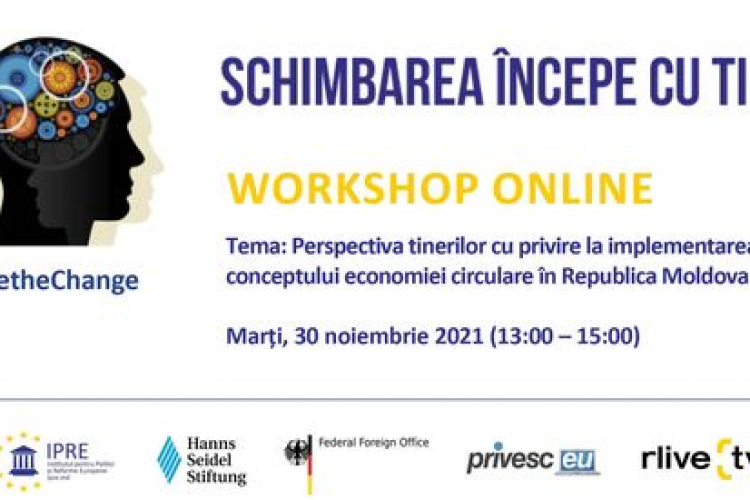
The circular or green economy is at an incipient stage in Moldova in terms of the accumulated experience. There are few countries that have systemic approaches to all the aspects. However, being aware that waste mutilates the face of the planet Earth, the people work out rules and laws, learn to transform waste into different useful things that help preserve nature. The Republic of Moldova is part of this process and is connected to sources that generate and promote changes beneficial to nature. The subject was discussed in a workshop titled “Young people’s perspective on the implementation of the concept of circular economy in the Republic of Moldova” that was staged by IPRE with support from the Hanns Seidel Foundation, IPN reports.

The event brought together speakers from the legislative and executive spheres and from the participatory sector. For the effort to produce result, one should be trained as things will stagnate without competence, said Aurelia Bahnaru, president of the Association for Waste Recovery. She noted that certification is to be obtained for training courses on the environment and recycling economy so that primarily the young people know the ecological ABC.

Vladislav Cain, a Moldovan who lives in the Swedish city Malmö, considers the awareness-raising stage was passed and emphasis now should be placed on concrete projects and this would be the best signal that the authorities really focus on waste recycling.

Moldova’s wooded areas represent 11% of its territory and tree planting seems to be a solution. But Moldsilva Agency has to pay salaries to almost 2,000 employees with proceeds coming from the sale of wood, said MP Ina Coșeru. She noted that only now the legislation was amended and allows to burn oil and tires and to make a substitute for asphalt and material for covering running tracks from these.

To have a complex view on recycling economy, Moldova signed an agreement with the EU for working out the national waste management strategy so as to bring things in order not only in recycling, but to also in the extraction sector, to stop the waste of food products that turn into waste and to regulate environmental areas that generate problems instead of contributing to the greening of the planet.


Economic operators and service providers will be required to ensure the accessibility of products and services for people with disabilities, the elderly, and individuals with temporary or permanent functional limitations. The accessibility requirements are contained in a bill voted on in the first reading by Parliament, reports IPN.

The new requirements will target six areas: technology and software programs, e-commerce, financial services, transportation, services provided by public institutions, and emergency communications. The regulations will also apply to electronic communication services, access to audiovisual media services, web pages, mobile applications, and self-service terminals.

Accessibility requirements will also be mandatory for certain products, such as hardware systems, payment terminals, ATMs, and e-book readers. Micro-enterprises that offer services will be exempt from complying with these obligations.

The project, developed by the Ministry of Labor and Social Protection, aims to increase the autonomy and inclusion of people who face access difficulties.

Non-compliance with accessibility requirements will be subject to administrative penalties. The project will be examined in the second reading, and the new rules will come into effect on January 1, 2028, with certain exceptions for products and services.

0 FacebookTwitterPinterestEmail


Green economy to ensure sustainability in Moldova

The circular or green economy is at an incipient stage in Moldova in terms of the accumulated experience. There are few countries that have systemic approaches to all the aspects. However, being aware that waste mutilates the face of the planet Earth, the people work out rules and laws, learn to transform waste into different useful things that help preserve nature. The Republic of Moldova is part of this process and is connected to sources that generate and promote changes beneficial to nature. The subject was discussed in a workshop titled “Young people’s perspective on the implementation of the concept of circular economy in the Republic of Moldova” that was staged by IPRE with support from the Hanns Seidel Foundation, IPN reports.

The event brought together speakers from the legislative and executive spheres and from the participatory sector. For the effort to produce result, one should be trained as things will stagnate without competence, said Aurelia Bahnaru, president of the Association for Waste Recovery. She noted that certification is to be obtained for training courses on the environment and recycling economy so that primarily the young people know the ecological ABC.

Vladislav Cain, a Moldovan who lives in the Swedish city Malmö, considers the awareness-raising stage was passed and emphasis now should be placed on concrete projects and this would be the best signal that the authorities really focus on waste recycling.

Moldova’s wooded areas represent 11% of its territory and tree planting seems to be a solution. But Moldsilva Agency has to pay salaries to almost 2,000 employees with proceeds coming from the sale of wood, said MP Ina Coșeru. She noted that only now the legislation was amended and allows to burn oil and tires and to make a substitute for asphalt and material for covering running tracks from these.

To have a complex view on recycling economy, Moldova signed an agreement with the EU for working out the national waste management strategy so as to bring things in order not only in recycling, but to also in the extraction sector, to stop the waste of food products that turn into waste and to regulate environmental areas that generate problems instead of contributing to the greening of the planet.


A new section of Muncesti Road has entered the rehabilitation process. The City Hall of Chisinau announces that the milling works on the roadway have begun on the sector between Arca Moldovei Street and Bacioii Noi Street, a stage that precedes the complete modernization of the asphalt surface, reports IPN.

On this section, with an area of approximately 23 thousand square meters, two layers of asphalt concrete are to be applied, the stormwater drainage channels are to be rehabilitated, and the shoulders are to be arranged with crushed stone.

In parallel, on the sector between Arca Moldovei Street and Iuri Gagarin Boulevard, the rehabilitation works using Slurry Seal technology are nearing completion. During this period, the second layer, the wear layer, is being applied, which serves to protect the road surface and extend its service life.

According to the municipality, after the completion of the works, Muncesti Road will have a modernized roadway, with better traffic conditions and an increased level of safety for traffic participants.

0 FacebookTwitterPinterestEmail


1 IANUARIE, 2025
1 IANUARIE, 2025