

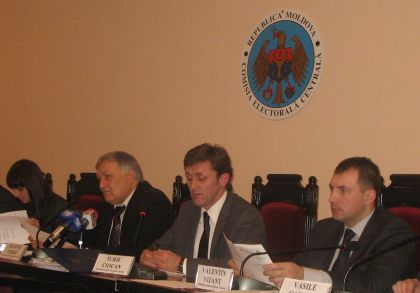
CEC warns PCRM

The Central Election Commission (CEC) Tuesday warned the Communists Party (PCRM), following an appeal submitted by the Democratic Party (PDM). The PCRM is accused of having used, in electoral ads, contrary to the law, images with foreign officials, as the premier and the president of Russia. The ads were aired by seven TV stations and on the official site of the PCRM. The CEC obliged the party to withdraw the ads, Info-Prim Neo reports.

The PDM’s representative at the CEC, Andrei Volentir has stated his delight with warning the PCRM. Volentir says he has video evidence to prove that on February 23 the PCRM posted new images from the quarters of the Parliament and of the Chisinau City Hall, what runs counter the by-law approved by the CEC.

In its turn, the PCRM’s representative at the CEC, Sergiu Sarbu, has said the ads with foreign officials were already withdrawn from TV stations and are to be withdrawn from the party’s site. He has added “other competitors were also warned and compelled to observe the electoral law.”

When ask to comment the results of the monitoring by the Electronic Press Association (APEL), according to which public broadcaster Moldova-1 makes political partisanship for the Communists Party, Sarbu accused the public broadcaster of favoring Moldova Noastra Alliance. He has said “the PCRM lodged an appeal with the CEC and the Broadcasting Council to take action against M1 and for ensuring the equality of chances among all the electoral competitors.” He has added “practically all the electoral competitors violate the law, as a series of appeals will be submitted to the CEC one of these days”.

In case party is found to have breeched the electoral law several times, the CEC members may ask the Supreme Court of Justice to outs that competitor from the election race. But the Election Code does not specify for what breeches the procedure may be applied. The CEC may decide how many warnings it should issue to a party, depending on the seriousness of the violations committed.


In recent months, one of the topics increasingly exploited by the Tiraspol administration and the controlled press from the Transnistrian region is the creation of the Convergence Fund. This is presented as a mechanism through which Chisinau is supposed to “take the money of the Transnistrians”, to “strangle the economy” of the region and, ultimately, to cause the closure of businesses, impoverishment of the population and even a “humanitarian catastrophe”.

In reality, the authorities of the Republic of Moldova intend to gradually eliminate the tax benefits enjoyed by economic agents in the Transnistrian region and to apply VAT and excise duties on imports. However, Tiraspol combines this information with unverified estimates, omits other sources of funding for the Fund, and almost completely ignores the money and services that the inhabitants of the region already benefit from through the public systems of the Republic of Moldova.

What is the Convergence Fund?

The convergence fund is a mechanism that the authorities in Chisinau intend to create within the state budget. Through this, some projects aimed at reducing economic and social differences between the two banks of the Dniester will be financed.

According to the explanations provided so far by the authorities, the money could be used for infrastructure, education, energy efficiency, business environment development, and support for the population in the Transnistrian region.

The Deputy Prime Minister for Reintegration, Valeriu Chiveri, previously stated that the Fund could also finance social programs. In the event of a strong increase in energy tariffs on the left bank, Chisinau could extend the compensation system already applied on the right bank to the inhabitants of the region. The value of the Fund was estimated preliminarily at about three billion lei. However, this does not represent a fixed sum nor the value of the taxes that would be collected from the companies in the region. The final volume will depend on the actual revenues accumulated and the funding provided by external partners.

Where will the money come from?

In the statements and documents previously presented by the Moldovan authorities, it was stipulated that a part of the Fund’s revenues could come from taxes and duties paid by individuals and legal entities from the Transnistrian region. Other sources were expected to be the state budget and funding provided by external partners, including the European Union. In parallel, the authorities intend to gradually standardize the tax regime applied to companies on both banks of the Dniester.

The Tale of Tiraspol: “The Looting Fund”

In recent months, the rhetoric of the Transnistrian administration has become increasingly harsh. The person responsible for foreign relations in Tiraspol, Vitali Ignatiev, has called the Convergence Fund a “looting fund of Transnistria” and claimed that the introduction of VAT and excise taxes could lead to the shutdown of enterprises, impoverishment of the population, and a “serious escalation” of tensions.

The post “First Transnistrian” describes the mechanism as an attempt by Chisinau to “take the money of Transnistrians” through “pseudo-VAT and excise taxes”. The deputy of the so-called parliament, Vadim Kravciuk, characterized the Fund as a “smokescreen” for alleged measures of rapprochement between the two banks.

Another deputy, Andrei Safonov, went even further, saying that Chisinau’s aim would be for the region to be left without money, for the economy to collapse, businesses to close, and the population to leave.

Thus, the dispute about taxation and the management of a future fund is transformed into a scenario according to which the Moldovan authorities are pursuing the deliberate destruction of the Transnistrian region’s economy.

“Three billion will be taken from Transnistrian companies”

The figure of approximately three billion lei is sometimes used in Tiraspol without context. This represents a preliminary estimate of the size of the Convergence Fund and not the sum that would be collected exclusively from companies in the Transnistrian region.

The fund is designed to combine multiple sources of financing: budget revenues, a portion of the taxes and duties related to the region, and money provided by external partners.

Therefore, the formula according to which Chisinau would supposedly “take three billion lei from Transnistria” and then decide on its own what to do with this money does not correspond to the mechanism presented so far by the authorities in Chisinau.

“Taxes are introduced to destroy the region’s economy”

The application of VAT and excise duties can indeed lead to increased costs for some businesses and the price increase of certain imported goods. The economic impact of the measure is a legitimate issue and needs to be evaluated. But the claims that the introduction of taxes will inevitably lead to factory shutdowns, job losses, or a “humanitarian catastrophe” are, at this point, political forecasts, which are not based on analyses.

At the same time, the speech from Tiraspol overlooks the fact that businesses in the region are already deeply integrated into the trade system of the Republic of Moldova. At the end of the first semester of 2026, the state register listed 2,492 economic agents from the left bank of the Dniester and the city of Bender. Moreover, 76.9% of the region’s exports in the first semester of 2026 were directed towards the European Union. The main destinations were Romania, Italy, and Slovakia.

Access to the European market implies the use of the customs framework, documents, and procedures of the Republic of Moldova, as well as the application of the standards necessary for trade with the EU. Thus, Tiraspol talks about the costs of tax uniformity, but much less frequently about the benefits of access to the European market obtained through the trade system of the Republic of Moldova.

“Chisinau will only take our money, and will not give”

Another image often promoted is that the financial relationship between the two banks operates in one direction: money would leave the region for Chisinau, without the inhabitants of the left bank of the Dniester benefiting from the state’s resources. However, official data shows a much more complex situation.

In the year 2025, citizens of the Republic of Moldova residing in the Transnistrian region received social benefits amounting to 138.53 million lei from the state social insurance budget. Over 10 thousand people benefited from such payments. In just the first six months of 2026, another 76.3 million lei were paid out to 8,016 beneficiaries. The largest increases were recorded in the case of child-raising allowances and one-time birth payments.

A similar dynamic also exists in the medical system. At the end of 2025, 74,500 citizens residing in the Transnistrian region were registered in the mandatory health insurance system. By the end of the first half of 2026, their number had reached over 82 thousand.

In the year 2025, 119.48 million lei were allocated for 6,456 cases treated in hospitals within the national system. Another 23.15 million lei were used for reimbursed medicines and medical devices provided to residents in the eastern districts.

These data do not mean that all the social needs of the region are covered by Chisinau. However, they do show that the claim that the Republic of Moldova only collects money from the region’s inhabitants ignores significant financial flows in the opposite direction.

Economic integration is already taking place

The convergence fund appears in a context where economic and legal convergence between the two banks is advancing even in the absence of a political solution for the Transnistrian conflict. At the end of 2025, the State Population Register recorded 364,885 inhabitants of the Transnistrian region and the city of Bender. Of these, 356,833 were citizens of the Republic of Moldova, and over 337 thousand held a Moldovan passport.

In the year 2025, 13,810 people residing in the region were officially employed on the right bank. More than 80% of these were working in the municipality of Chisinau. In the same year, 856 young people from the region benefited from state-funded places in universities and vocational-technical education institutions.

The process is visible in the transportation sector as well. Thousands of cars owned by the region’s inhabitants are registered with national plates, and the neutral number mechanism is described by the authorities as a transitory one. Analysts from the Carnegie Foundation have also noted that the Republic of Moldova has made significant progress in the economic and legal integration of the Transnistrian region without resuming negotiations on its final political status.

Chisinau leaves room for speculation

The rhetoric of Tiraspol cannot be analyzed without observing the communication issues of the Moldovan authorities as well. The exact mechanism of the Fund is not yet fully clear to the public. It is still unknown what amount will be accumulated annually, how much will come from the national budget, how much from the collected taxes, and how much will be offered by external partners.

Also, it is not clear enough how the projects will be selected or proposed, under what conditions investments can be financed in localities not controlled by constitutional authorities, and to what extent the administration from Tiraspol will be involved in the process.

Conclusion

The assertion that the Convergence Fund is merely a mechanism through which Chisinau wants to “plunder Transnistria” transforms the intention of the right bank into a threat scenario.

VAT and excise duties will indeed be applied gradually, and their effects on businesses and prices need to be monitored. There is no evidence at the moment that these measures will inevitably cause the collapse of the economy, depopulation of the region, or the “humanitarian disaster” that representatives of Tiraspol speak about.

At the same time, companies in the region predominantly export to the European Union through the system of the Republic of Moldova, and tens of thousands of residents already benefit from health insurance, social benefits, education, jobs, and documents issued by constitutional authorities.

Therefore, the essential question is not whether the Fund “will take the money of the Transnistrians”, but how it will actually work: how much money will be collected, how much will the Republic of Moldova and external partners contribute, who will decide on the projects, who will manage the Fund and what concrete benefits will reach the inhabitants of the left bank of the Dniester. Until these mechanisms become completely transparent, the subject will continue to provide the administration in Tiraspol with a favorable ground for manipulation and fueling fear.

0 FacebookTwitterPinterestEmail


CEC warns PCRM

The Central Election Commission (CEC) Tuesday warned the Communists Party (PCRM), following an appeal submitted by the Democratic Party (PDM). The PCRM is accused of having used, in electoral ads, contrary to the law, images with foreign officials, as the premier and the president of Russia. The ads were aired by seven TV stations and on the official site of the PCRM. The CEC obliged the party to withdraw the ads, Info-Prim Neo reports.

The PDM’s representative at the CEC, Andrei Volentir has stated his delight with warning the PCRM. Volentir says he has video evidence to prove that on February 23 the PCRM posted new images from the quarters of the Parliament and of the Chisinau City Hall, what runs counter the by-law approved by the CEC.

In its turn, the PCRM’s representative at the CEC, Sergiu Sarbu, has said the ads with foreign officials were already withdrawn from TV stations and are to be withdrawn from the party’s site. He has added “other competitors were also warned and compelled to observe the electoral law.”

When ask to comment the results of the monitoring by the Electronic Press Association (APEL), according to which public broadcaster Moldova-1 makes political partisanship for the Communists Party, Sarbu accused the public broadcaster of favoring Moldova Noastra Alliance. He has said “the PCRM lodged an appeal with the CEC and the Broadcasting Council to take action against M1 and for ensuring the equality of chances among all the electoral competitors.” He has added “practically all the electoral competitors violate the law, as a series of appeals will be submitted to the CEC one of these days”.

In case party is found to have breeched the electoral law several times, the CEC members may ask the Supreme Court of Justice to outs that competitor from the election race. But the Election Code does not specify for what breeches the procedure may be applied. The CEC may decide how many warnings it should issue to a party, depending on the seriousness of the violations committed.


An earthquake with a magnitude of 7.1 on the Richter scale caused the collapse of several buildings and damage to roads in Japan. Dozens of people were injured, and nearly 300 thousand residents were ordered to evacuate. Authorities warn that strong aftershocks may follow, reports the agency Reuters, quoted by IPN.

The earthquake occurred on Tuesday, with the epicenter in Kumamoto prefecture, at a shallow depth, which amplified the intensity of the movements felt in several localities. Rescue teams are searching for people trapped under rubble, and operations are hampered by damaged roads.

Prime Minister Sanae Takaichi stated that the toll of victims and the extent of the damage are still being assessed. Several areas have been left without electricity, and infrastructure, including roads, bridges, and buildings, has been affected. Authorities have opened centers for evacuees and have asked residents in vulnerable areas to avoid damaged buildings.

Kyushu Electric Power Company announced that approximately 48 thousand homes were left without power, and the JR Kyushu railway operator temporarily suspended services. Kumamoto Airport was closed for safety checks, and several flights were cancelled or redirected.

0 FacebookTwitterPinterestEmail


1 IANUARIE, 2025
1 IANUARIE, 2025