

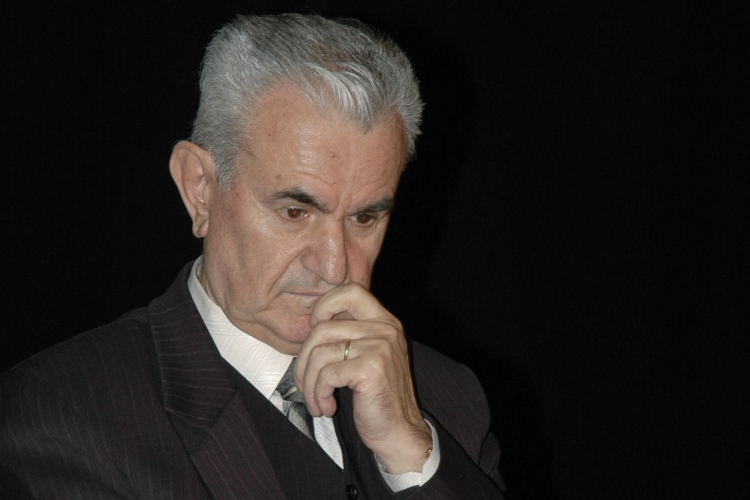
Andrei Strâmbeanu buried

Poet, prose writer, dramatist and essayist Andrei Strâmbeanu was buried. His family, friends and maters and those who knew Andrei Strâmbeanu took part in funeral rites at the Central Cemetery in Chisinau, IPN reports.

According to Minister of Culture Sergiu Prodan, Andrei Strâmbeanu was the man who always taught lessons. “He never spoke about money. He always referred to romanticism, love, friendship. It is known that when you leave, you do not take anything with you. The coffin does not have pockets. You actually take with you what you leave here. He left an artistic, dramaturgical inheritance. Andrei Strâmbeanu deserved state honors on his last way, but he chose to leave when the old ones left, while the new ones haven’t yet come. I think this is the last lesson taught by Andrei Strâmbeanu,” stated the minister.

The funeral was also attended by Moldova’s first President Mircea Snegur, who said that 2021 will remain in the memory as the year during which he experienced sadness owing to the death of a number of representatives of the national intellectual elite. He described Andrei Strâmbeanu as a famous personality, patriot, active militant of the national liberation movement. He noted he was impressed by the poet’s realistic works and he reached the conclusion that his works are profound and valuable as they reflect the real problems of society, including from historical viewpoint. Andrei Strâmbeanu was a good person from all viewpoints, but for him he was also a real friend.

Academician, literary critic and historian Mihai Cimpoi said a man of truth departed this life. Andrei Strâmbeanu was born to say the truth and he said it through literature that for him wasn’t fiction, but the expression of truth. From now on, those who will examine the postwar realities will have to examine his prose, plays, essays. Andrei Strâmbeanu was active in the public life and even wanted to take part in the last election campaign. The poet phoned him often in the recent past as he was writing an article about him. He left a huge gap behind him.

President of the Writers Union of Moldova Arcadie Suceveanu was a man who confronted the calendar and biological order of life. He was a robust spirit with character who had life projects. He was a man of writing, culture, theater. He was permanently involved and wasn’t a contemplative artist. He was a fortress man till then end. He had a civilian, nonconformist attitude. He was in opposition to the current and previous elites. He was inconvenient as he always told the truth.

The coffin with the body of Andrei Strâmbeanu was laid at “Saint Teodora de la Sihla” Church where tens of people bid farewell to the poet.

Andrei Strâmbeanu was born in Fântâna Albă village of Bălți County, currently Edineț district, on August 25, 1934. Among his most famous works are “White Well” (poetry, 1963), “Throw Me into the Sky” (children’s stories 1965), “The Bride” (stories, 1967), “Counterpoint” (anthology, 2004), “Poems with Wormwood Taste (2015), etc.

Andrei Strâmbeanu worked as a translator, editor, adviser at the Theater Division of the Ministry of Culture. He sat on Moldova’s Parliament in 1998-2001 and served as an adviser to the President. He was a member of the Writers Union of Moldova.

For prodigious activity in the field of culture and for civic involvement, Andrei Strâmbeanu was awarded the medal “Mihai Eminescu” in 1997, the Order of the Republic in 2011, the National Award of the Republic of Moldova and the Award “I. L. Caragiale” for dramaturgy of the Romanian Academy in 2008. He was a laureate of the National Dramaturgy Contest for five times.


The Art Theatre of Chisinau presents the play “A Man and Several Women” by Leonid Zorin, directed by Eugeniu Matcovschi /Odeon Cultural Center /at 06:00 PM/.

The exhibition “The Unknown Work of Bessarabian Masters” continues /Constantin Brancusi Exhibition Center/ July 30-August 16/.

The personal exhibition Untitled by the artist Konstantin Benkovich continues, organized by the National Art Museum of Moldova, in partnership with the ALT Foundation /MNAM /July 30-August 30/.

The immersive exhibition continues, inspired by the mythology and mystical folklore of the Republic of Moldova, “The Forest”, created by Milen Chelea /Plai Gallery / July 23-August 6/.

The exhibition “Scent of Warm Bread. Bread in the Iron Age” continues /National Museum of History of Moldova /July 22 – September 4/.

The exhibition “Urban Archaeology and the Hidden Memory of Chisinau” continues /National Museum of History of Moldova /July 17-November 30/.

The documentary exhibition “Echo from the past, for the present and the future” continues, dedicated to the memory of the victims of Stalinist deportations and one of the most tragic episodes in the history of Bessarabia /BNRM /July 3-August 3/.

The exhibition “The Thread of Identity! The traditional Romanian costume in book illustration made by plastic artists from the Republic of Moldova” /BNRM /June 25-August 15/ continues.

The graphic exhibition by Lica Sainciuc continues, unveiled within the Creative Industries Festival /Lutnita Gallery /June 5-July 31/.

0 FacebookTwitterPinterestEmail


Andrei Strâmbeanu buried

Poet, prose writer, dramatist and essayist Andrei Strâmbeanu was buried. His family, friends and maters and those who knew Andrei Strâmbeanu took part in funeral rites at the Central Cemetery in Chisinau, IPN reports.

According to Minister of Culture Sergiu Prodan, Andrei Strâmbeanu was the man who always taught lessons. “He never spoke about money. He always referred to romanticism, love, friendship. It is known that when you leave, you do not take anything with you. The coffin does not have pockets. You actually take with you what you leave here. He left an artistic, dramaturgical inheritance. Andrei Strâmbeanu deserved state honors on his last way, but he chose to leave when the old ones left, while the new ones haven’t yet come. I think this is the last lesson taught by Andrei Strâmbeanu,” stated the minister.

The funeral was also attended by Moldova’s first President Mircea Snegur, who said that 2021 will remain in the memory as the year during which he experienced sadness owing to the death of a number of representatives of the national intellectual elite. He described Andrei Strâmbeanu as a famous personality, patriot, active militant of the national liberation movement. He noted he was impressed by the poet’s realistic works and he reached the conclusion that his works are profound and valuable as they reflect the real problems of society, including from historical viewpoint. Andrei Strâmbeanu was a good person from all viewpoints, but for him he was also a real friend.

Academician, literary critic and historian Mihai Cimpoi said a man of truth departed this life. Andrei Strâmbeanu was born to say the truth and he said it through literature that for him wasn’t fiction, but the expression of truth. From now on, those who will examine the postwar realities will have to examine his prose, plays, essays. Andrei Strâmbeanu was active in the public life and even wanted to take part in the last election campaign. The poet phoned him often in the recent past as he was writing an article about him. He left a huge gap behind him.

President of the Writers Union of Moldova Arcadie Suceveanu was a man who confronted the calendar and biological order of life. He was a robust spirit with character who had life projects. He was a man of writing, culture, theater. He was permanently involved and wasn’t a contemplative artist. He was a fortress man till then end. He had a civilian, nonconformist attitude. He was in opposition to the current and previous elites. He was inconvenient as he always told the truth.

The coffin with the body of Andrei Strâmbeanu was laid at “Saint Teodora de la Sihla” Church where tens of people bid farewell to the poet.

Andrei Strâmbeanu was born in Fântâna Albă village of Bălți County, currently Edineț district, on August 25, 1934. Among his most famous works are “White Well” (poetry, 1963), “Throw Me into the Sky” (children’s stories 1965), “The Bride” (stories, 1967), “Counterpoint” (anthology, 2004), “Poems with Wormwood Taste (2015), etc.

Andrei Strâmbeanu worked as a translator, editor, adviser at the Theater Division of the Ministry of Culture. He sat on Moldova’s Parliament in 1998-2001 and served as an adviser to the President. He was a member of the Writers Union of Moldova.

For prodigious activity in the field of culture and for civic involvement, Andrei Strâmbeanu was awarded the medal “Mihai Eminescu” in 1997, the Order of the Republic in 2011, the National Award of the Republic of Moldova and the Award “I. L. Caragiale” for dramaturgy of the Romanian Academy in 2008. He was a laureate of the National Dramaturgy Contest for five times.


Romanian farmers protested in Bucharest on Thursday against the ban on sheep and goat exports, claiming losses of hundreds of millions of euros and calling for the intervention of the authorities. The demonstration degenerated into scuffles with the gendarmes, and the security forces used tear gas, reports Digi24, quoted by IPN.

The protest began in front of the headquarters of the National Veterinary and Food Safety Authority, where breeders from several counties requested to discuss with the institution’s leadership. Subsequently, the farmers moved to Victoriei Square, in front of the Government, where approximately five thousand people gathered. They demanded the resumption of exports, compensation for the losses suffered, and the resignation of the ANSVSA leadership.

The demonstration takes place against the backdrop of the crisis in the livestock sector, affected by the plague of small ruminants and by sanitary-veterinary restrictions. The European Commission has extended until December 31 the ban on sheep and goat exports from Romania to third countries, following the outbreak of a disease in Mures county.

Farmers claim that the restrictions have blocked the resumption of exports to Arab countries, and the losses for this year could exceed 300 million euros. They urgently request the lifting of trade restrictions and support measures for the affected farms.

The ANSVSA management has announced the convening of a crisis cell and stated that the institution is discussing with representatives of the European Commission to identify solutions.

0 FacebookTwitterPinterestEmail


1 IANUARIE, 2025
1 IANUARIE, 2025