

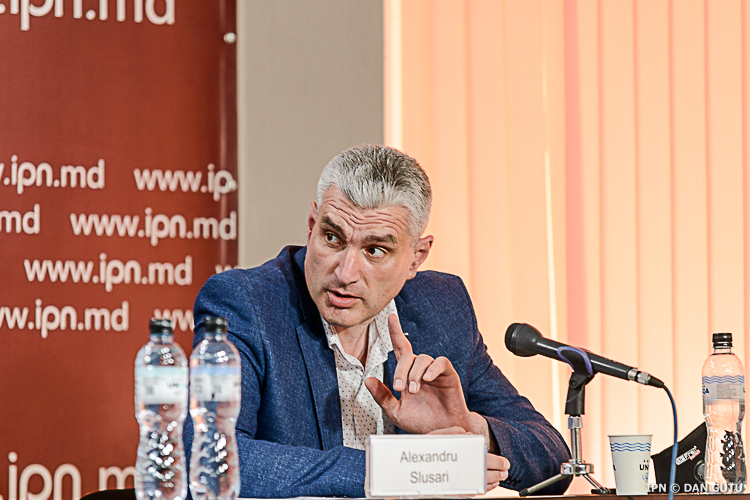
Alexandru Slusari: Farmers got neither compensation nor Romanian diesel fuel

The Moldovan authorities didn’t fulfill the promises they made during the protests mounted by farmers in June. The Cabinet didn’t approve the regulations on the payment of compensation and the mechanism for distributing the diesel fuel provided by the Government of Romania, said the executive director of the association “Force of Farmers”. Alexandru Slusari noted the authorities’ refusal to help makes the farmers resume the protests, IPN reports.

Alexandru Slusari said the situation in the agricultural sector is difficult due to the low grain prices, the large production costs and the pressure exerted by creditors on farmers.

“The protest is the last thing we want as the farmers are harvesting the crops. Since June until October, the farmers are extremely busy. But the situation worsened in terms of prices. Even those who have a good crop and gather by 5 tonnes of wheat per hectare sustain losses with such prices. The harvest is larger than last year. It is above the multiannual average, but this does not gladden the farmers as the selling prices are very low. The wheat can be now sold for at most 2.85 lei per kg,” Alexandru Slusari stated in the program “Refection Points” on Vocea Basarabiei station.

Alexandru Slusari accused the government of ignoring farmers’ demands and asked to urgently approve the regulations on the payment of compensation for wheat and barley and the mechanism for distributing Romanian diesel fuel.

“In the last protest mounted in the Great National Assembly Square, the minister of agriculture promised 200 million lei in compensation and 4,000 tonnes of diesel fuel. Then, the farmers weren’t very satisfied, but went to work. It happened on June 27. The farmers haven’t received either money or diesel fuel. Not even the distribution mechanism for the diesel fuel or for the money was approved. The Cabinet didn’t have a meeting this week and is to meet on August 14. The agenda of this meeting does not include these very important subjects,” said the executive director of the “Force of Farmers.

The farmers also demand to introduce a moratorium on the payment of the debts of micro-, small- and medium-sized producers of grain and oil crops to private creditors and to the national public budget until December 31, by the decision of the Commission for Exceptional Situations, and to set up special customs corridors for the export of grain and oil products in summer-autumn. If the demands are not satisfied, the farmers intend to resume the protests on August 14.


Pest control and disinsection works will be carried out in approximately 2,500 residential blocks in Chisinau by October. The interventions will take place at least twice in the basements of each building, as part of the actions initiated by the Chisinau City Hall to prevent infestation with rodents and insects, reports IPN.

The actions will be carried out through the General Directorate of Housing and Community Facilities. The GDHCF mentions that the works include the spraying of chemical products in basements. Also, the Directorate’s employees will place poisonous baits for rodents.

The municipality specifies that maintaining cleanliness, eliminating sources of humidity and properly managing waste significantly contribute to preventing the reappearance of pests.

0 FacebookTwitterPinterestEmail


Alexandru Slusari: Farmers got neither compensation nor Romanian diesel fuel

The Moldovan authorities didn’t fulfill the promises they made during the protests mounted by farmers in June. The Cabinet didn’t approve the regulations on the payment of compensation and the mechanism for distributing the diesel fuel provided by the Government of Romania, said the executive director of the association “Force of Farmers”. Alexandru Slusari noted the authorities’ refusal to help makes the farmers resume the protests, IPN reports.

Alexandru Slusari said the situation in the agricultural sector is difficult due to the low grain prices, the large production costs and the pressure exerted by creditors on farmers.

“The protest is the last thing we want as the farmers are harvesting the crops. Since June until October, the farmers are extremely busy. But the situation worsened in terms of prices. Even those who have a good crop and gather by 5 tonnes of wheat per hectare sustain losses with such prices. The harvest is larger than last year. It is above the multiannual average, but this does not gladden the farmers as the selling prices are very low. The wheat can be now sold for at most 2.85 lei per kg,” Alexandru Slusari stated in the program “Refection Points” on Vocea Basarabiei station.

Alexandru Slusari accused the government of ignoring farmers’ demands and asked to urgently approve the regulations on the payment of compensation for wheat and barley and the mechanism for distributing Romanian diesel fuel.

“In the last protest mounted in the Great National Assembly Square, the minister of agriculture promised 200 million lei in compensation and 4,000 tonnes of diesel fuel. Then, the farmers weren’t very satisfied, but went to work. It happened on June 27. The farmers haven’t received either money or diesel fuel. Not even the distribution mechanism for the diesel fuel or for the money was approved. The Cabinet didn’t have a meeting this week and is to meet on August 14. The agenda of this meeting does not include these very important subjects,” said the executive director of the “Force of Farmers.

The farmers also demand to introduce a moratorium on the payment of the debts of micro-, small- and medium-sized producers of grain and oil crops to private creditors and to the national public budget until December 31, by the decision of the Commission for Exceptional Situations, and to set up special customs corridors for the export of grain and oil products in summer-autumn. If the demands are not satisfied, the farmers intend to resume the protests on August 14.


The A7 crypto network, led by fugitive oligarch Ilan Șor, and the Russian company Inter RAO, which owns the Moldovan power plant in Cuciurgan (MGRES), are targeted in the 21st package of sanctions from the European Union against Russia, reports IPN.

The new package includes four new designations related to the A7 network, among which are recently identified connections with Africa. The network is associated by European institutions with support given to Moscow in evading international sanctions through crypto platforms.

The measure comes in parallel with the expansion of the trading ban for 14 cryptocurrency platforms registered in Georgia, Panama, United Arab Emirates, Marshall Islands, Kyrgyzstan and Belarus. At the same time, a tool was introduced for the first time that allows the EU to impose a total ban at the level of a third country for the crypto asset services used by Russia to evade sanctions.

At the same time, the EU Council has included the Russian company Inter RAO in the new sanctions list, which has owned the power plant in the Transnistrian region since 2005. Chisinau has not been purchasing energy from MGRES since 2024 and intends to put into operation, in August, the Isaccea-Vulcanesti-Chisinau power line, which bypasses the Cuciurgan power plant.

The 21st package of sanctions against Moscow as a result of the outbreak of the war of aggression in Ukraine was adopted on Thursday by the EU Council and targets the sectors with the greatest impact on the Russian economy: energy, financial services and cryptocurrencies. It contains the most extensive expansion of the list of sanctioned entities, 218 in total, of which 48 are individuals and 170 are companies, including refineries in Russia and Belarus, as well as companies related to the production of drones and drone components. The final list of sanctions now includes 250 individuals and over 660 companies.

0 FacebookTwitterPinterestEmail


1 IANUARIE, 2025
1 IANUARIE, 2025