

A sober protest

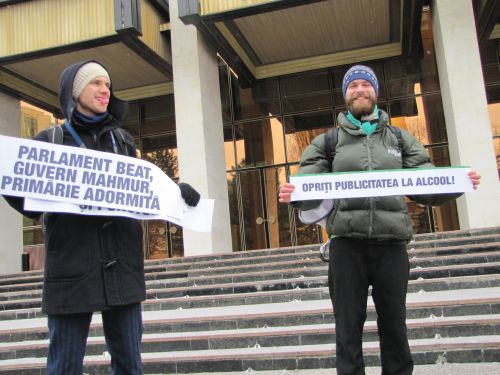
Several net activists on Monday staged a series of protests outside the main governmental buildings requesting the introduction of a ban on alcohol ads and imports, Info-Prim Neo reports.

“We are protesting against the practice of alcohol abuse in Moldova. The Governments seems to not have any plan to combat this. Our nation has become a subject for mockery in the international media”, said one of the protesters. They also demand the elimination of the “drinking holidays”, like the annual observance the Wine Day, for their presumed role in encouraging alcohol consumption.

The number of protesters at the beginning of the event stood modestly at three, but they said their ranks would hopefully swell over time.

According to a recent World Health Organization report, Moldova is the world’s hardest drinking nation, with 18.22 liters per capita annually, which is thrice the global average.


The hydrological warning regarding the reduced water flow in rivers has been extended until July 31. The yellow and orange codes remain in effect on several sectors of the Nistru and Prut rivers, while five small rivers remain under red code, with flows of only 10% of the multiannual monthly average values, reports IPN.

According to the Authority for Meteorology and Environmental Monitoring, the yellow code is maintained on the Nistru sector from Naslavcea to Dubasari, where the water flow is 35-40% of the multiannual average for this period. Between Dubasari and Tudora, the orange code is valid, with values of 25-30% of the usual average.

On the Prut, the yellow code targets the Criva-Ungheni sector, where the water flow is 30-40% of the multiannual monthly average values, and on the Ungheni-Branza segment, an orange code is established, with flows of 25-30% from the average.

Reduced flows are also recorded on small rivers. Rautul and Bacul are under yellow code, with a discharge of about 35% of the multiannual average, while Ciulucul Mic and Ichel are under orange code, with values of at most 30%. The rivers Vilia, Draghiste, Cubolta, Cainar, and Botna remain under red code, where the water discharge constitutes only 10% of the multiannual monthly averages.

The government has instituted a state of alert in the hydrological sector for a period of 30 days, due to the significant reduction of the Nistru river flow. During this period, the authorities may intervene to manage water consumption, including by temporarily modifying the conditions of special water use permits, to ensure the population’s needs are prioritized.

0 FacebookTwitterPinterestEmail


A sober protest

Several net activists on Monday staged a series of protests outside the main governmental buildings requesting the introduction of a ban on alcohol ads and imports, Info-Prim Neo reports.

“We are protesting against the practice of alcohol abuse in Moldova. The Governments seems to not have any plan to combat this. Our nation has become a subject for mockery in the international media”, said one of the protesters. They also demand the elimination of the “drinking holidays”, like the annual observance the Wine Day, for their presumed role in encouraging alcohol consumption.

The number of protesters at the beginning of the event stood modestly at three, but they said their ranks would hopefully swell over time.

According to a recent World Health Organization report, Moldova is the world’s hardest drinking nation, with 18.22 liters per capita annually, which is thrice the global average.


The reform of local public administration must lead to the creation of functional local authorities, capable of financing their activity and providing quality services to citizens. The statement belongs to Iurie Tap, doctor in administrative sciences, and was made during the public debate “How is the effectiveness of local public administration reform assessed: by costs, quality of services or the level of development of territories?”, organized by the IPN Press Agency.

According to the expert, the current administrative system does not allow many local authorities to effectively exercise their duties. He argues that over 70% of the 898 first-level administrative-territorial units fail to finance their own administrative apparatus, which limits their ability to provide public services and implement projects for communities.

“People’s question is: why do I need an authority that cannot provide me with the necessary services?”, said Iurie Tap. He mentioned that numerous localities fail to provide basic services, such as water supply and sewage. In his opinion, a functional local administration should be able to cover at least half of its budget from its own revenues.

Regarding the second level of local public administration, Iurie Tap believes that sufficiently strong structures need to be created to manage services that cannot be efficiently organized by each community individually, such as education, health and institutional social protection. According to him, decentralization represents both an efficient method of administration and a political reform intended to contribute to the democratization of the state and society.

In this context, the expert advocates for the organization of the country into three administrative regions – North, Center and South -, which should have their own competencies in the field of regional development. These are expected to be governed by councils elected by citizens and accountable to them. In his opinion, such an organization could contribute to reducing development disparities between regions.

At the same time, Iurie Tap criticized the transfer of some competences from the local level to the territorial structures of the central public administration, mentioning that the establishment of new agencies does not automatically guarantee more efficient public services.

In the expert’s view, the future administrative-territorial units should be balanced in terms of population, area, and financial capacity, taking into account demographic, economic, territorial and cultural criteria. He believes that the reform can be prepared in the remaining period, but its success depends on the existence of a clear vision and the will to implement it.

Disclaimer: This material was developed by the IPN Press Agency, within the project “Local Government Reform in Dialogue”, financed by the Ministry of Culture from the Media Subsidy Fund.


0 FacebookTwitterPinterestEmail


1 IANUARIE, 2025
1 IANUARIE, 2025