

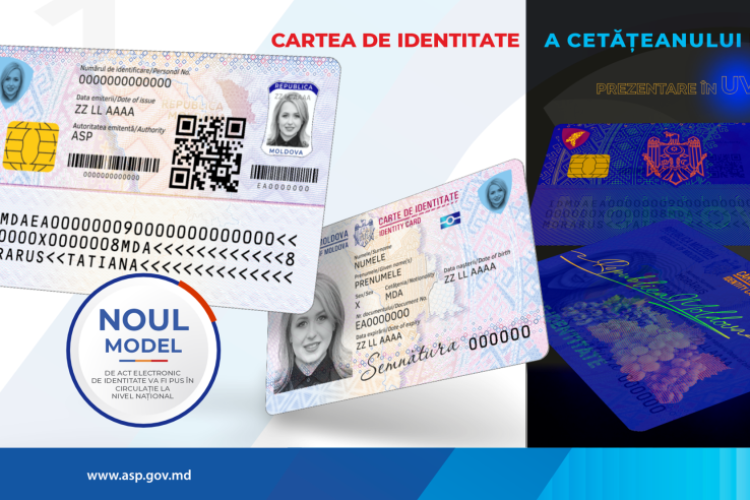
The information about your domicile or temporary residence will not be on your identity card

No information on the holder’s domicile or temporary residence will be included in the identity card, including the provisional one. The exclusion of these data will relieve holders from the obligation to exchange their documents each time they change their place of residence. Information on the holder’s patronymic will also not be included. The Parliament approved today in its final reading legislative measures for putting the new ID cards into circulation, IPN reports.

Data on domicile, residence or patronymic will be accessible in the State Population Register through the interoperability platform (MConnect).

The draft also provides for an exemption from the payment of the state fee for the registration of newborn children at their domicile and/or temporary residence upon their initial registration in the State Population Register. Children under the age of 14, who do not have an identity document, will also benefit from the same facility when they are registered in the State Population Register after updating the data on their birth certificate.

The document also contains provisions aimed at exempting foreign or stateless children who have entered the territory of the Republic of Moldova without being accompanied by an adult or have been left on the territory of the Republic of Moldova without a legal document from paying the state tax.

The changes also cover the way in which the names of national minorities are included in official documents. Persons belonging to national minorities will have the right to use their names in the form accepted in their mother tongue. The document also stipulates that when foreigners’ names and surnames are entered on residence cards, they are not translated or transliterated, but are spelled according to the Latin spelling of the national passport or travel document issued by the competent foreign authorities.

In addition to the personal data of the beneficiary, the ID card also contains an electronic signature, valid for five years, which will allow access to the data in electronic format.

According to data provided by the Public Services Agency, over 50 thousand people have applied for identity cards so far. Identity cards will be issued free of charge to one million people, with the costs being covered by the ASP budget. Subsequently, the fee for issuing ID cards will be 290 lei.


The designated Prime Minister, Vasile Tofan, will request the Parliament’s vote of confidence for the cabinet of ministers and the government program today. The plenary session in which the deputies will examine the request is scheduled for 11:00 AM, reports IPN.

In accordance with the legislation, the Parliament gives the vote of confidence to the Government with the vote of the majority of elected deputies. Based on the vote of confidence granted by the Parliament, the President of the Republic of Moldova appoints the Government.

In the Government proposed by the designated Prime Minister Vasile Tofan, ten ministers from the current executive will be found, and four portfolios will go to new members of the cabinet. At the same time, the deputy prime ministers for reintegration and for European integration, Valeriu Chiveri and Cristina Gherasimov, will retain their positions.

Alexandru Gasnaș, presidential advisor, is designated for the position of Minister of Health. Radu Musteața, the director of the National Agency for Food Safety, is proposed for the leadership of the Ministry of Agriculture and Food Industry, while Victoria Belous, PAS deputy, who previously held the same portfolio, is put forward for the position of Minister of Finance. Dan Suruceanu, the current vice-administrator of the multimedia and sports complex Chisinau Arena, is proposed for the leadership of the Ministry of Culture.

Vasile Tofan has been appointed as the prime ministerial candidate by President Maia Sandu, at the proposal of the Action and Solidarity Party, following the resignation of Alexandru Munteanu.

0 FacebookTwitterPinterestEmail


The information about your domicile or temporary residence will not be on your identity card

No information on the holder’s domicile or temporary residence will be included in the identity card, including the provisional one. The exclusion of these data will relieve holders from the obligation to exchange their documents each time they change their place of residence. Information on the holder’s patronymic will also not be included. The Parliament approved today in its final reading legislative measures for putting the new ID cards into circulation, IPN reports.

Data on domicile, residence or patronymic will be accessible in the State Population Register through the interoperability platform (MConnect).

The draft also provides for an exemption from the payment of the state fee for the registration of newborn children at their domicile and/or temporary residence upon their initial registration in the State Population Register. Children under the age of 14, who do not have an identity document, will also benefit from the same facility when they are registered in the State Population Register after updating the data on their birth certificate.

The document also contains provisions aimed at exempting foreign or stateless children who have entered the territory of the Republic of Moldova without being accompanied by an adult or have been left on the territory of the Republic of Moldova without a legal document from paying the state tax.

The changes also cover the way in which the names of national minorities are included in official documents. Persons belonging to national minorities will have the right to use their names in the form accepted in their mother tongue. The document also stipulates that when foreigners’ names and surnames are entered on residence cards, they are not translated or transliterated, but are spelled according to the Latin spelling of the national passport or travel document issued by the competent foreign authorities.

In addition to the personal data of the beneficiary, the ID card also contains an electronic signature, valid for five years, which will allow access to the data in electronic format.

According to data provided by the Public Services Agency, over 50 thousand people have applied for identity cards so far. Identity cards will be issued free of charge to one million people, with the costs being covered by the ASP budget. Subsequently, the fee for issuing ID cards will be 290 lei.


The European Union has fined the online marketplace AliExpress 550 million euros for a serious violation of the Digital Services Act. The decision was made because the platform did not take sufficient measures to prevent the sale of unsafe and counterfeit products, according to IPN.

The fine is the latest development in the formal proceedings launched in 2024 regarding a possible violation of the EU Digital Services Act. The European Commission stated that AliExpress had failed to implement an effective system for identifying and removing illegal products and had underestimated the resources needed for content moderation.

According to the European Commission, the mechanisms for verifying product compliance could be easily circumvented, with unscrupulous sellers misclassifying products to avoid stricter requirements. European authorities also argue that the platform does not have enough staff to verify suspicious products.

At the same time, the European Commission found that a large number of illegal products, including unsafe toys and hazardous cosmetics, continued to be sold through AliExpress. In some cases, these products remained available on the platform for weeks after being reported. Furthermore, the Commission found that AliExpress had not properly enforced its own penalty policy and had allegedly allowed sellers of illegal products to remain active even after they had been penalized.

AliExpress now has until October 20 to submit an action plan outlining how it will address the issues raised by the European Commission. The Commission will then decide, within two months of receiving the plan, whether additional measures are necessary.

The sanction comes after the EU introduced a three-euro fee in early July for packages valued at up to 150 euros originating from outside the EU. The measure could significantly impact the business models of the Chinese e-commerce platforms AliExpress, Temu, and Shein.

0 FacebookTwitterPinterestEmail


1 IANUARIE, 2025
1 IANUARIE, 2025