

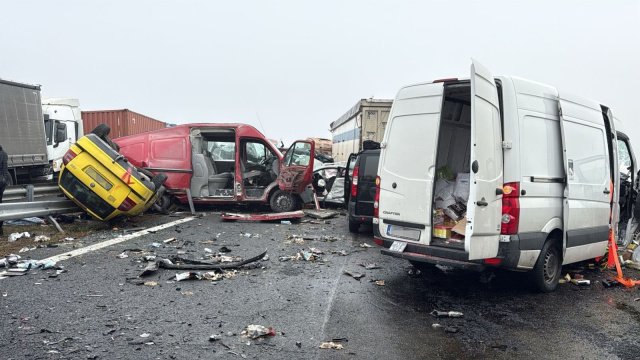
Two multi-vehicle crashes on a Bulgarian motorway leave 12 dead

Photo credit: BTA

At least 12 people were killed and 48 others injured in two pile-ups on Bulgaria’s Trakia motorway. According to Bulgarian authorities, more than 70 vehicles were involved in the collisions, with initial findings pointing to poor visibility caused by dense fog, IPN reports.

According to RFI, the accidents occurred on both carriageways near the Zimnitsa interchange, bringing traffic to a complete standstill. One crash took place on the carriageway heading towards Burgas, and the other on the carriageway leading to the capital, Sofia.

Bulgaria’s Health Minister, Katia Ivkova, announced that ten people died at the scene and two others died in hospital. A further 46 people were taken to hospital for medical treatment. The death toll could be revised as the situation continues to develop.

Romanian Foreign Minister Dan Neculaescu announced that a Romanian citizen was among the injured and is receiving medical treatment.

Representatives of the Ministry of Foreign Affairs in Chisinau said that, according to the information currently available, no Moldovan citizens were among the victims of the accidents.


Low salaries are driving community mediators to leave the profession, and those still working are too few to meet the needs of Roma communities. The shortage of specialists limits Roma people’s access to public services and hampers their integration. These issues were discussed at public hearings held in Parliament, IPN reports.

Valeriu Caldararu, executive director of the National Association of Community Mediators, said that a shortage of specialists is limiting Roma people’s access to public services. While an estimated 82 mediators were needed in 2021, only 59 positions had been established by June 2026, of which 52 were filled. The association is calling for updated figures and the allocation of the resources needed to address the shortfall.

The organization also proposes a national training and professional certification program, as well as retaining mediator positions during the voluntary amalgamation of municipalities. According to Valeriu Caldararu, administrative restructuring should not lead to the elimination of these positions or distance mediators from the communities they serve.

The Chair of the Equality Council, Ian Feldman, highlighted Roma children’s limited access to education, which later restricts their employment prospects and perpetuates socioeconomic vulnerability. He proposed expanding evening schools and vocational and technical education programmes for adults.

He also highlighted the difficulties Roma people face in obtaining identity documents, particularly those who have arrived from Ukraine and been granted temporary protection. Obtaining documents, including birth certificates, remains a challenge that requires cooperation between the authorities and the Roma community.

For his part, Robert Cerari, the Roma baron of the Republic of Moldova, proposed establishing a platform for cooperation between the Roma community and government ministries. To this end, each institution would appoint designated contacts to liaise with Roma representatives, allowing the community’s concerns to be discussed directly with the relevant authorities.

Roma activist and law student Romanița Radita called for greater participation by Roma women in decision-making, including on local councils and advisory bodies. She also proposed offering incentives to employers who hire Roma people and increasing scholarships for Roma students.

0 FacebookTwitterPinterestEmail


1 IANUARIE, 2025
1 IANUARIE, 2025