

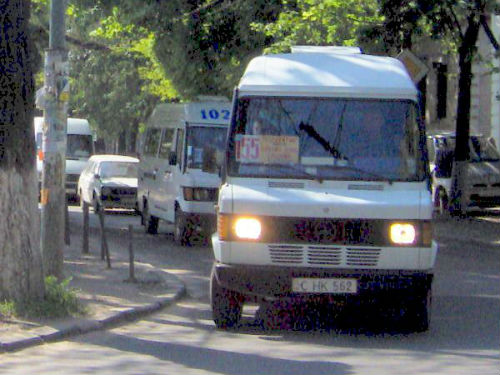
Minibus drivers’ ‘ticket tricks’

In some minibuses in Chisinau, drivers posted warnings that passengers are responsible if they travel without a ticket. Route administrators told Info-Prim Neo that it was an attempt to get the passengers used to asking for a ticket and keeping it until the end of the trip. However, there is no regulation stipulating anything like this as is the case of trolleybuses.

“The goal is to make sure the passenger has a ticket”, said Serghei Olaru, administrator of routes 186, 113 and 188.

Mihai Reus, administrator of route 110, said that there were no such warnings in his minibuses because there weren’t any instructions to do so from the transport division or other institutions. However, he knew that some of his colleagues still did it.

Head of the Private Transporters Association Ion Mamaliga said this was a trick used by some drivers to make passengers keep the ticket until the end of the trip. Otherwise, if tax inspectors get on the minibus and find passengers without a ticket, the driver will be fined. Mamaliga admitted that there was no body that could fine the passengers. The Tax Inspectorate could apply fines only to route administrators.

Warnings about the passengers’ responsibility for trips without tickets have appeared since talks about raising the fares started and fiscal inspectors began checking if drivers offered tickets to passengers.


The Independent Analytical Center “Expert-Grup”, in collaboration with Maib and with the support of the Embassy of the Kingdom of the Netherlands in the Republic of Moldova, organizes the launch event of the public offer regarding the municipal bonds issued by the Ceadâr-Lunga City Hall /maib park /at 10:00 AM/.

The PRESS AGENCY IPN invites media representatives to the public debate on the topic: “Neutrality and the defense capacity of the citizen and the state”, the 354th edition of the series “Developing political culture in public debates”. Participants: Dionis Cenusa, political scientist, associate expert at the Center for Eastern European Studies, Lithuania; Andrei Curararu, expert in international and national security, WatchDog Community; Igor Botan, permanent expert of the project /Conference room of the IPN Agency, Teatrului street, 2/2, 3rd floor, online on the YouTube channel of the Agency, on the Facebook page IPN Press Agency and accessed later in the archive; Realitatea TV, live or replayed, as well as on www.Rlive.md /at 11:00 AM/.

The Ministry of Education and Research, in partnership with the Interethnic Relations Agency, the Ethnographic Association of Roma and the “Voice of the Roma” Coalition, is organizing a roundtable discussion entitled: “The Memory of the Roma Holocaust – lessons for the present and future”, in the context of the European Day of Remembrance for Victims of the Holocaust against the Roma /Government House, entrance from Banulescu-Bodoni Street /at 11:00 AM/.

The exhibition “Bessarabian Authors in the World” is inaugurated as part of the Diaspora Days 2026, which takes place under the theme “Wherever we are, Moldova unites us!” /National Library of the Republic of Moldova /at 11:00 AM/.

The People’s Assembly of Gagauzia convenes for a meeting /APG, Comrat /at 02:00 PM/.

Flower laying and the unveiling ceremony of the commemorative plaque dedicated to the memory of the Holocaust victims against the Roma during the Second World War will take place /at the Visterniceni Station area in the city of Chisinau, Petricani street no. 3 /at 03:00 PM/.

The Minister of Foreign Affairs of the Republic of Latvia, Baiba Braže, is making a working visit to the Republic of Moldova /August 3-4/.

0 FacebookTwitterPinterestEmail


Minibus drivers’ ‘ticket tricks’

In some minibuses in Chisinau, drivers posted warnings that passengers are responsible if they travel without a ticket. Route administrators told Info-Prim Neo that it was an attempt to get the passengers used to asking for a ticket and keeping it until the end of the trip. However, there is no regulation stipulating anything like this as is the case of trolleybuses.

“The goal is to make sure the passenger has a ticket”, said Serghei Olaru, administrator of routes 186, 113 and 188.

Mihai Reus, administrator of route 110, said that there were no such warnings in his minibuses because there weren’t any instructions to do so from the transport division or other institutions. However, he knew that some of his colleagues still did it.

Head of the Private Transporters Association Ion Mamaliga said this was a trick used by some drivers to make passengers keep the ticket until the end of the trip. Otherwise, if tax inspectors get on the minibus and find passengers without a ticket, the driver will be fined. Mamaliga admitted that there was no body that could fine the passengers. The Tax Inspectorate could apply fines only to route administrators.

Warnings about the passengers’ responsibility for trips without tickets have appeared since talks about raising the fares started and fiscal inspectors began checking if drivers offered tickets to passengers.


One in ten students in Moldova comes from abroad. Their number has reached a record level in the academic year 2025-2026 – 6,423 people, 667 more than the previous year. Economic expert Veaceslav Ionita believes that this segment has significant potential, but it remains insufficiently exploited, reports IPN.

The proportion of foreign students in the total university population has significantly increased in recent years, from 1.3% in 2010 to 10.2% in 2026. According to the IDIS “Viitorul” expert, attracting young people from other countries can contribute both to the financial consolidation of universities and to the improvement of education quality and the development of educational services export.

The majority of foreign students come from Romania – 56.4% of the total. This is followed by India, with 19%, Ukraine – 8.6%, Turkey – 6.9% and Israel – 6.7%.

Veaceslav Ionita asserts that the Republic of Moldova has several advantages in attracting international students, among which are the cultural and linguistic proximity to Romania, but also the possibility of developing training programs in Romanian for young people from other countries.

In the last two decades, the total number of students in the Republic of Moldova has decreased from about 128 thousand in 2006-2007 to 62,900 in 2025-2026. However, in the last two years, their number has increased by about 6,400, and approximately 20% of this increase was generated by the rise in the number of foreign students.

0 FacebookTwitterPinterestEmail


1 IANUARIE, 2025
1 IANUARIE, 2025