

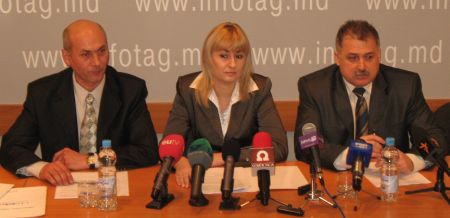
League for Defense of Human Rights is concerned because Parliament does not rush to establish election date

The League for the Defense of Human Rights (LADOM), a member of the civic Coalition for free and correct elections (Coalition 2009), launched the first monitoring report on the 2009 parliamentary elections on Tuesday, December 23. The organization is worried that the Parliament doesn’t rush to set the election date, Info-Prim Neo reports.

LADOM’s chief Paul Strutzescu stated that positive and negative trends have been recorded in organizing the elections. The positive aspects refer to the existence of an institutional stability, a national consensus on a European tendency of Moldova, obtaining some trade facilities with the EU, promises of deepening the relations with the EU, conditioned by unfolding free and correct elections. The negative aspects are about the small parties being limited to get into the Parliament, the tense relations between central and local public authorities, the European Court of Human Rights (ECHR) condemning the Moldovan Government, and aspects concerning the electoral legislation. Besides, there is the Transnistrian problem, and no lasting solution has been found until now.

According to analyst Ion Creanga, LADOM is especially worried about the lack of transparency of the Parliament as to naming the date of the parliamentary elections. “No decision draft regarding the election date has been registered as a legislative initiative and included in the order of the day of the parliament, and this fact keeps the whole society in suspense. This fact may delay the plans of the Central Electoral Commission (CEC) in organizing the electoral activities,” Ion Creanga said. The Parliament has hot evinced an adequate reaction to the ECHR’s decision and to the recommendations of the Venice Commission regarding the legislation which jeopardizes the electoral rights.

LADOM is also worried about the fact that some parties invoked restrictions to registering the statutory modifications; many persons have been summoned, arrested, investigated and sanctioned for participating in political meetings. As a result, the Law on checking candidates to public functions by the Security and Information Service was adopted.

LADOM ascertains that the central authorities involved in electoral actions, which diminish the local autonomy and democracy. The financial resources from the state budget have been distributed on political criteria, and the CEC has reacted to electoral events organized by different parties partially.

LADOM’s report presents findings made after noticing the behavior of the electoral bodies, the public authorities, mass-media and political parties in the pre-electoral period. The information has been collected by 37 long-term supervisors and 6 regional coordinators. The monitoring has been performed from October to December, 2008.

The Electoral Code stipulates that the MPs are elected 3 months the latest, after the expiration of the Parliament’s mandate (the mandate expires on March 7, 2009). The date of the parliamentary elections is established through a decision of the parliament at least 60 days before the election day.

ion creanga despre data alegerilor.mp3


The refusal of the Minister of Defense, Anatolie Nosatii, to answer in Russian to a journalist has sparked strong reactions in the public and political space of the Republic of Moldova. The gesture was immediately transformed by some political forces and voices close to Moscow into an alleged case of “linguistic discrimination”. Former dignitaries, representatives of the parliamentary opposition, people associated with the separatist regime from Tiraspol, and influencers known for promoting narratives favorable to the Russian Federation tried to shift the discussion from the essence of the problem to a conveniently propagandistic identity controversy.

Beyond the immediate political reactions, the Nosatîi case deserves to be analyzed from a much broader perspective. It’s not just about the language in which a minister answers a question. It’s about the relationship between inherited reflexes from the past and the behavior of an independent state, about the ability of institutions to assert their identity and, above all, about the connection between the decolonization of the collective mindset and national security.

In a sovereign state, the official language is not just a simple administrative tool. It represents one of the elements through which the state expresses its historical continuity, constitutional identity, and institutional authority. In the Republic of Moldova, the Romanian language is the state language, and its use by representatives of public institutions cannot be presented as an act of hostility towards citizens speaking other languages. On the contrary, it is the normal expression of the functioning of a state that assumes its own identity.

From political reflex to state responsibility

The fundamental problem is that the Republic of Moldova continues to bear, more than three decades after the proclamation of independence, the traces of an imperial order that did not disappear with the disintegration of the Soviet Union. Empires do not survive solely through military bases, geopolitical pressures, or economic mechanisms. They can also survive in mentalities, in social reflexes, in symbolic hierarchies, and in the belief that the language of the former metropolis must implicitly occupy a privileged position.

This is one of the most challenging dimensions of the decolonization process: change does not occur solely through the modification of legislation, the renaming of institutions, or the rewriting of school textbooks. It must also take place in public consciousness.

The Republic of Moldova became independent in 1991, but legal independence did not automatically mean a mental detachment from the old imperial center. For decades, the population between the Prut and Nistru rivers was subjected to a systematic process of identity reshaping, in which the Romanian language was marginalized, the Latin script was replaced, and the existence of a Moldovan identity distinct from the Romanian one was transformed into a political instrument.

Therefore, the language issue must be viewed today also as a security problem. Not because speaking Russian would in itself be a threat. Millions of citizens of the Republic of Moldova have the right to speak Russian, to study it, and to use it in private and public life within the confines of the law. The problem arises when the Russian language is transformed from a linguistic heritage into a tool for preserving an imperial hierarchy, in which the state language is treated as secondary even within its own institutional space.

This difference is essential. Defending the Romanian language does not mean attacking the Russian language. It means refusing to allow the Russian language to be used as a tool to challenge the Romanian character of the state language and the symbolic sovereignty of the Republic of Moldova.

Decolonization of the collective mind – a dimension of national security

In recent decades, the concept of national security has been primarily understood through the lens of the military, borders, critical infrastructure, or defense capabilities. Under current conditions, this definition is insufficient. A state may have functional military institutions and yet remain vulnerable if a significant part of its society continues to regard the former imperial center as a superior political, cultural or civilizational authority.

Security, in this sense, begins also within the collective consciousness. A state is vulnerable when its own citizens can be easily convinced that the state language can be ignored, that their identity is “invented”, that their history is “wrong” or that their independence is just a temporary anomaly. It is vulnerable when the state language is treated as a secondary option, and its observance as a norm of the public space is relativized. In such a context, external propaganda finds within society groups willing to reproduce the same narratives and present them as ordinary political opinions.

From this perspective, the decolonization of the collective mindset is not an operation directed against an ethnic or linguistic community. It is the process through which society regains its ability to define itself what it is, who it is, and what its fundamental interests are. An independent state should not have to ask the former metropolis for permission to assert its identity. And a defense minister, by the very function he exercises, is not just a politician who seeks the immediate reaction of the electorate. He is the representative of a fundamental institution of the state. In such a context, the choice to use the official language can have a significance that goes beyond communication itself.

When identity becomes part of the defense

The statements of expert Alexandru Tanase, according to which the minister’s gesture must be understood also as a political message in the context of the tense relations between the Republic of Moldova and the Russian Federation, provide an important element of interpretation. In circumstances where the security of the Republic of Moldova is affected by the war in Ukraine, by incidents related to the violation of airspace, and by hybrid pressures exerted on society, the symbolic dimension of such gestures cannot be ignored.

In this logic, the refusal to automatically change the official language of the state depending on the interlocutor can be seen not as a challenge, but as an affirmation of institutional normality.

However, it is important that this position should not be transformed into a policy of exclusion. The Republic of Moldova does not need a new border between its citizens, this time a linguistic one. It needs a consolidation of the Romanian language as the common language of the state, without this implying the marginalization of minorities.

This is precisely where the difference lies between institutional patriotism and exclusive nationalism. A secure state is a state where the citizen can speak multiple languages, but is very clear about the official language of the state. It is a state where linguistic diversity is protected, but is not used to relativize constitutional identity.

The anachronism of the “language of interethnic relations”

The idea that the Russian language should have a privileged status as an “interethnic communication language” represents one of the most persistent vestiges of the Soviet order. In a multiethnic space, knowing a widely spoken language can obviously be an advantage. But one thing is the usefulness of a language and another is the institutionalization of a linguistic hierarchy inherited from an imperial system.

In the conditions of the independent Republic of Moldova, the common language of the citizens must be the state language. This is the minimum condition for social and institutional integration.

Every citizen must be able to access administration, education, justice, public services and central institutions in the official language. Not to demonstrate loyalty to an ideology, but because this is the natural function of the state language.

The paradox is that the very radicalization of the discourse against the Romanian language risks producing the opposite effect to that claimed by its promoters. When the Romanian language is presented as a tool of discrimination, and its knowledge is treated as a “foreign” obligation, the artificial idea that two communities should live in parallel linguistic spaces is fueled. This does not strengthen society. It fragments it.

Colonialism can survive in mentalities

At 35 years of independence, the Republic of Moldova must have the courage to acknowledge that decolonization is not a completed process. The change of generations does not automatically produce a change in mentalities. Some of the reflexes formed during the Soviet period have been socially and culturally transmitted, sometimes even to generations that did not directly know the USSR.

In the public space and especially on social networks, discourses based on an imperial superiority logic can still be encountered: the Moldovan-Romanians are portrayed as being “inferior”, the Romanian language is ridiculed, and the return to the Latin alphabet or to the Romanian terminology is described as an aggression against Russian speakers.

This type of discourse should not be confused with the mere expression of a political opinion. In a democratic society, everyone has the right to criticize government policies. But when criticism is built on the denial of the state’s right to define its own identity and on the perpetuation of imperial ethno-linguistic hierarchies, the issue goes beyond the sphere of an electoral dispute. It becomes a matter of social resilience.

Therefore, the decolonization of the collective mindset also implies the ability to identify these mechanisms without turning Russian-speaking citizens into an “internal enemy”. The Russian language should not be seen as a threat, but its political instrumentalization against the sovereignty of the state. This distinction must be strictly maintained.

The Romanian language as an element of national resilience

In 2023, the Parliament legislatively consecrated the replacement of the phrase “Moldovan language” with “Romanian language”. Subsequently, measures were adopted regarding the use of the Romanian language in the Parliament’s activity. These decisions are not mere terminological changes. They have a significant historical and institutional significance.

For a state that has gone through an experience of sovietization and artificial redefinition of identity, the recovery of the correct terminology represents a form of restoring normality.

Asserting this does not mean rewriting the identity of the citizens of the Republic of Moldova. It means precisely eliminating an ideological construction imposed by Soviet policies and allowing society to freely relate to its own language and history. In this sense, the Romanian language can become not a factor of division, but one of civic integration.

The statesman and the temptation of electoral calculation

The Nosatii case raises a deeper issue: the difference between a politician and a statesman. The politician primarily thinks about the immediate reaction, polls, social networks and the next election round. The statesman is obliged to look beyond the electoral cycle. He must consider the institutions he leaves behind, the resilience of society, and the state’s ability to withstand external pressures.

In this regard, the Minister of Defense has conveyed a message that can be interpreted as an assumption of the role of the institution he leads.

Defending the Republic of Moldova does not only mean protecting its borders. It also means protecting the constitutional space, the institutions, the historical memory, the civic identity, and the citizens’ ability to freely decide their own future. A state that defends its territory but abandons its identity remains vulnerable.

A state that strengthens its institutions, but allows its own symbols to be constantly relativized from the outside, risks gradually losing control over its own national narrative.

From legal independence to mental independence

The true independence of the Republic of Moldova will not be consolidated merely through laws, international agreements or defense investments. It will be consolidated when the citizen of the Republic of Moldova will naturally expect the state to speak in its official language, for its institutions to defend their identity, and for no external actor to be able to dictate how this country should define itself. This is the real stake of decolonization.

We should not turn against the past through revenge, but detach from it through maturation. We should not deny the linguistic diversity of society, but place it in a framework where there is a common language of the state and clear rights for all citizens. And in this process, the state institutions must set the example.

The refusal of the defense minister to abandon the Romanian language in favor of another should not be turned into an interethnic conflict. It can be rather understood as a signal that the Republic of Moldova is beginning to overcome the reflex of constantly adapting to the sensitivities of the former imperial center.

This is, in essence, the difference between a politician and a statesman. The politician fears losing votes. The statesman fears his country losing its future.

In a moment when the Republic of Moldova finds itself in a deeply changed geopolitical environment, the decolonization of the collective mentality must become part of the national security policy. Not through intolerance, not through discrimination, and not through the marginalization of Russian speakers, but through the strengthening of an assumed state identity, of the Romanian language as a common language, and of the society’s ability to resist manipulation and external pressures.

Because the security of a state begins where its psychological dependence on the former empire ends. And the Republic of Moldova needs, more than ever, not just politicians who calculate tomorrow’s reaction, but statesmen capable of building independence over a generation.

0 FacebookTwitterPinterestEmail


League for Defense of Human Rights is concerned because Parliament does not rush to establish election date

The League for the Defense of Human Rights (LADOM), a member of the civic Coalition for free and correct elections (Coalition 2009), launched the first monitoring report on the 2009 parliamentary elections on Tuesday, December 23. The organization is worried that the Parliament doesn’t rush to set the election date, Info-Prim Neo reports.

LADOM’s chief Paul Strutzescu stated that positive and negative trends have been recorded in organizing the elections. The positive aspects refer to the existence of an institutional stability, a national consensus on a European tendency of Moldova, obtaining some trade facilities with the EU, promises of deepening the relations with the EU, conditioned by unfolding free and correct elections. The negative aspects are about the small parties being limited to get into the Parliament, the tense relations between central and local public authorities, the European Court of Human Rights (ECHR) condemning the Moldovan Government, and aspects concerning the electoral legislation. Besides, there is the Transnistrian problem, and no lasting solution has been found until now.

According to analyst Ion Creanga, LADOM is especially worried about the lack of transparency of the Parliament as to naming the date of the parliamentary elections. “No decision draft regarding the election date has been registered as a legislative initiative and included in the order of the day of the parliament, and this fact keeps the whole society in suspense. This fact may delay the plans of the Central Electoral Commission (CEC) in organizing the electoral activities,” Ion Creanga said. The Parliament has hot evinced an adequate reaction to the ECHR’s decision and to the recommendations of the Venice Commission regarding the legislation which jeopardizes the electoral rights.

LADOM is also worried about the fact that some parties invoked restrictions to registering the statutory modifications; many persons have been summoned, arrested, investigated and sanctioned for participating in political meetings. As a result, the Law on checking candidates to public functions by the Security and Information Service was adopted.

LADOM ascertains that the central authorities involved in electoral actions, which diminish the local autonomy and democracy. The financial resources from the state budget have been distributed on political criteria, and the CEC has reacted to electoral events organized by different parties partially.

LADOM’s report presents findings made after noticing the behavior of the electoral bodies, the public authorities, mass-media and political parties in the pre-electoral period. The information has been collected by 37 long-term supervisors and 6 regional coordinators. The monitoring has been performed from October to December, 2008.

The Electoral Code stipulates that the MPs are elected 3 months the latest, after the expiration of the Parliament’s mandate (the mandate expires on March 7, 2009). The date of the parliamentary elections is established through a decision of the parliament at least 60 days before the election day.

ion creanga despre data alegerilor.mp3

At least 12 people have died, and dozens more were injured after a bus with Polish license plates overturned last night on the M3 motorway in Hungary. According to initial information provided by the police, the driver may have fallen asleep at the wheel, reports IPN, citing Telex.

The accident occurred around 01:00 AM, after leaving Mezőkeresztes, heading towards Nyíregyháza. There were 57 passengers and two drivers on the bus. The vehicle left the roadway and overturned.

The National Ambulance Service of Hungary mobilized 14 crews to the accident site. Several people were injured, some of them seriously, and were transported to hospitals in Miskolc, Debrecen, Nyíregyháza and Eger. Firefighters evacuated 35 passengers from the bus, while others remained trapped under the vehicle. Cranes were also used to lift the vehicle.

According to preliminary information, the driver is believed to have fallen asleep at the wheel. He is expected to be detained by the authorities, and the police continue their investigations to determine the exact circumstances of the accident.

The Prime Minister of Hungary, Péter Magyar, expressed condolences to the families of the deceased and thanked the rescue teams for their operations.

0 FacebookTwitterPinterestEmail


1 IANUARIE, 2025
1 IANUARIE, 2025