

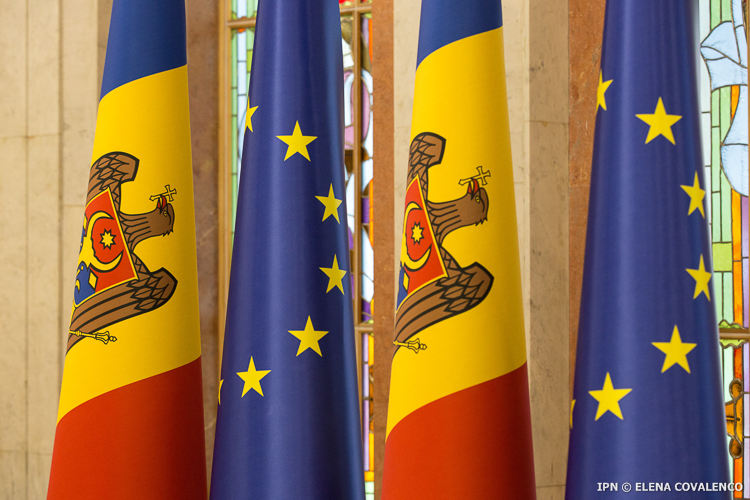
EU presents Support Package for Moldova

The European Commission and the European External Action Service have put together a package of support for the Republic of Moldova to address the impact of Russia’s war of aggression against Ukraine on Moldova and to bring the country closer to the European Union. The support package for Moldova has five priorities, aimed at addressing the impact of Russia’s war of aggression against Ukraine and bringing Moldova closer to the European Union, IPN reports.

 “Moldova has stood firmly in solidarity and in defense of European values. And despite the enormous consequences Russia’s war of aggression is having on the country, Moldova is taking great strides to advance on its European future. With today’s package, the EU shows we stand by Moldova and we will work to accelerate your European integration and reforms. Moldova’s future lies in the EU,” said the President of the European Commission Ursula von der Leyen.

Among the priorities is facilitating economic development and connectivity through the Priority Action Plan for trade under the DCFTA and the dedicated flagships of the Economic and Investment Plan (EIP). These focus on support to SMEs, trade, energy efficiency, human capital development as well as connectivity. Under the EU-Ukraine Solidarity Lanes initiative, the Connecting Europe Facility (CEF) for Transport will provide funding to projects addressing bottlenecks at key border crossing points.

Another priority is supporting Moldova’s reforms through strengthening administrative capacity, advisory services focusing on challenges arising on the enlargement path, dedicated training and support programs as well as increasing the participation of Moldova in EU programs like Horizon Europe, Fiscalis, Customs, LIFE and EU4Health.

Ensuring Moldova’s energy security through increasing domestic electricity production, participating in the EU common gas purchasing mechanism, boosting renewables and focusing on energy efficiency is another priority of the support package.

The other priorities are enhancing Moldova’s security through targeted actions guided by the High Level Political and Security Dialogue; expanding cooperation through the newly-launched EU Partnership Mission to Moldova, the EU-Moldova Support Hub for Internal Security and Border Management, the EU Border Assistance Mission, as well as with European agencies notably Frontex, Europol, Eurojust and CEPOL; strengthening Moldova’s defense sector through the European Peace Facility, and its internal security and border management through targeted investments and provision of equipment, and countering foreign information manipulation and interference, including disinformation, and enhancing strategic communication through providing technical support to the Moldovan government and capacity building for independent media civil society and youth to address disinformation and to communicate actively on the benefits of EU integration.

Since the start of Russia’s war of aggression against Ukraine, Moldova has been tackling significant challenges, including large numbers of refugees, inflation, threats to its energy supplies, violations of its airspace, as well as a multitude of hybrid actions such as disinformation and cyber-attacks. The EU has already mobilized €1.2 billion to help Moldova in facing multiple crises since the autumn of 2021.


A bomb alert was reported on Wednesday in the Port of Constanta in Romania. Authorities have restricted access to the targeted area, temporarily suspended ship maneuvers, and preemptively evacuated several buildings, without closing the entire port, reports IPN.

The interim Minister of Defense, Radu Miruta, told Digi24 that the threat was conveyed through a message in Romanian, about which there are suspicions that it was generated with the help of artificial intelligence. This was sent from two phone numbers outside of Romania, one with a Ukrainian prefix and the other with a Polish prefix.

According to the minister, the evacuations targeted only the buildings within the perimeter indicated in the message, following assessments made by security structures. Among these are the Maritime Station, the headquarters of the Romanian Naval Authority, and other buildings in the area, all of which have been checked by specialized teams.

The Romanian authorities have opened an investigation to determine the circumstances of the incident.

0 FacebookTwitterPinterestEmail


EU presents Support Package for Moldova

The European Commission and the European External Action Service have put together a package of support for the Republic of Moldova to address the impact of Russia’s war of aggression against Ukraine on Moldova and to bring the country closer to the European Union. The support package for Moldova has five priorities, aimed at addressing the impact of Russia’s war of aggression against Ukraine and bringing Moldova closer to the European Union, IPN reports.

 “Moldova has stood firmly in solidarity and in defense of European values. And despite the enormous consequences Russia’s war of aggression is having on the country, Moldova is taking great strides to advance on its European future. With today’s package, the EU shows we stand by Moldova and we will work to accelerate your European integration and reforms. Moldova’s future lies in the EU,” said the President of the European Commission Ursula von der Leyen.

Among the priorities is facilitating economic development and connectivity through the Priority Action Plan for trade under the DCFTA and the dedicated flagships of the Economic and Investment Plan (EIP). These focus on support to SMEs, trade, energy efficiency, human capital development as well as connectivity. Under the EU-Ukraine Solidarity Lanes initiative, the Connecting Europe Facility (CEF) for Transport will provide funding to projects addressing bottlenecks at key border crossing points.

Another priority is supporting Moldova’s reforms through strengthening administrative capacity, advisory services focusing on challenges arising on the enlargement path, dedicated training and support programs as well as increasing the participation of Moldova in EU programs like Horizon Europe, Fiscalis, Customs, LIFE and EU4Health.

Ensuring Moldova’s energy security through increasing domestic electricity production, participating in the EU common gas purchasing mechanism, boosting renewables and focusing on energy efficiency is another priority of the support package.

The other priorities are enhancing Moldova’s security through targeted actions guided by the High Level Political and Security Dialogue; expanding cooperation through the newly-launched EU Partnership Mission to Moldova, the EU-Moldova Support Hub for Internal Security and Border Management, the EU Border Assistance Mission, as well as with European agencies notably Frontex, Europol, Eurojust and CEPOL; strengthening Moldova’s defense sector through the European Peace Facility, and its internal security and border management through targeted investments and provision of equipment, and countering foreign information manipulation and interference, including disinformation, and enhancing strategic communication through providing technical support to the Moldovan government and capacity building for independent media civil society and youth to address disinformation and to communicate actively on the benefits of EU integration.

Since the start of Russia’s war of aggression against Ukraine, Moldova has been tackling significant challenges, including large numbers of refugees, inflation, threats to its energy supplies, violations of its airspace, as well as a multitude of hybrid actions such as disinformation and cyber-attacks. The EU has already mobilized €1.2 billion to help Moldova in facing multiple crises since the autumn of 2021.


The parliamentary inquiry commission for investigating the activity of some state enterprises will organize the first public hearings on Friday. The announcement was made by the commission’s president, PAS deputy Dinu Plingau, who specified that the works were unblocked after a period in which the commission could not meet due to lack of quorum, reports IPN.

During the first session with public hearings, subjects related to the management of public heritage, the activity of state enterprises, as well as their reorganization and privatization plans will be addressed.

The committee members will analyze the situation of active state enterprises and the status of their transfer to the management of the Public Property Agency. At the same time, explanations will be requested regarding any delays in this process and the risks associated with the administration of state assets.

Another topic on the agenda concerns the procedures for appointing and remunerating members of the board of directors, as well as the screening plan developed by APP in 2023, which provides for the reorganization, privatization, or liquidation of some state-owned enterprises.

The public hearings are scheduled for Friday, July 31, at 2:00 PM.

0 FacebookTwitterPinterestEmail


1 IANUARIE, 2025
1 IANUARIE, 2025